Clear Sky Science · en
Effects of replacing chemical fertilizer with organic fertilizer on organic carbon mineralization and carbon cycle functional genes in yellow soil
Why this soil story matters
Soils quietly help regulate the planet’s climate by storing or releasing carbon. Farmers often rely on chemical fertilizers to grow crops, but these inputs can change how soil microbes behave and how much carbon escapes into the air as carbon dioxide. This study asks a practical question with global stakes: if we swap some or all chemical fertilizer for organic materials like compost or manure in a common “yellow soil,” can we still feed crops while helping the ground lock away more carbon?
Testing different ways to feed the land
Researchers in southwest China ran a three year field experiment on acidic yellow soil, a widespread but fragile soil type important for regional food production. They compared four fertilization strategies: no added fertilizer, chemical fertilizer alone, and chemical fertilizer partly or fully replaced with organic fertilizer. After harvest, they collected soil and ran controlled lab tests to see how quickly soil carbon was turned into carbon dioxide. At the same time, they used DNA based methods to read which microbial genes linked to the carbon cycle were present, revealing how the unseen soil community responded.
How the soil’s “breathing” changed
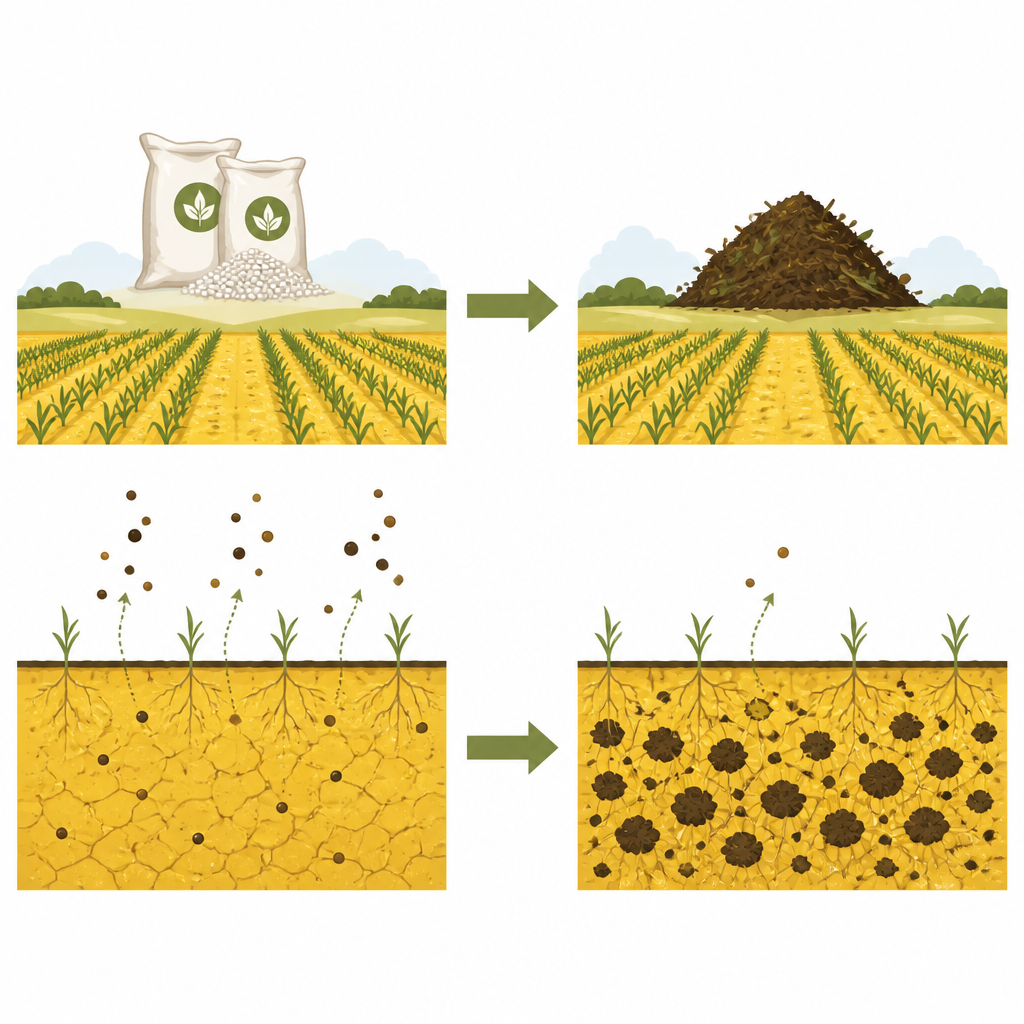
All fertilized plots released more carbon dioxide from the soil than unfertilized plots, showing that added nutrients woke up microbial activity. However, when the team looked at the share of total soil carbon that was lost, a clearer pattern appeared. Soils getting only chemical fertilizer had the highest fraction of carbon converted to gas, while those receiving organic fertilizer, especially full replacement, lost a smaller fraction. In simple terms, chemical fertilizer made the soil breathe out more of its stored carbon, whereas organic fertilizer helped the soil hold on to more of it, even though overall activity was still higher than in unfertilized soil.
Soil life and helpful genes
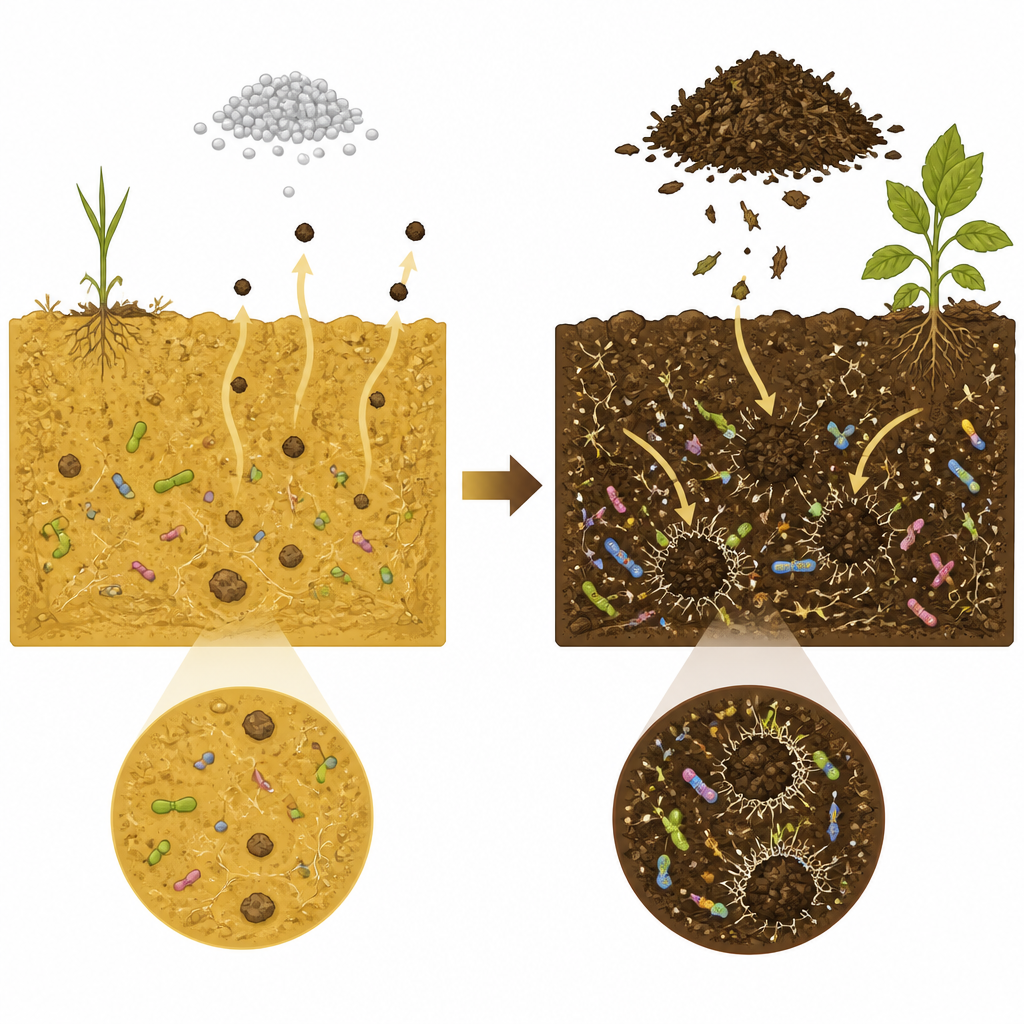
The DNA analyses showed that chemical fertilizer did not strongly change the overall set of carbon cycling genes, but it did lower the soil’s carbon to nitrogen balance and increased microbial diversity. Under these conditions, microbes appeared to mine extra carbon from soil organic matter, a “carbon compensation” behavior where they decompose both easy and harder to break down material to meet their needs. In contrast, adding organic fertilizer changed several key soil conditions at once: it raised pH slightly, increased available phosphorus and nitrate, and reshaped which microbes were most common.
Tilting the balance toward carbon storage
In soils receiving organic fertilizer, genes tied to building or fixing carbon became more abundant, while genes tied to breaking down complex plant materials declined. For example, genes involved in capturing carbon and using carbon monoxide increased, whereas genes linked to degrading pectin and chitin decreased. Statistical models suggested a cascade: improved soil chemistry altered microbial communities, which in turn shifted their genetic toolkit away from rapid breakdown and toward processes that favor carbon retention. This pattern was strongest where all chemical fertilizer was replaced with organic inputs.
What it means for farms and climate
For non specialists, the takeaway is straightforward: how we fertilize crops affects whether soils act more like carbon sources or carbon savings accounts. In this yellow soil, using only chemical fertilizer encouraged microbes to burn through organic matter faster, releasing a larger share of stored carbon. Replacing chemical fertilizer with organic materials still supported active soil life and nutrient supply but nudged the underground biology toward keeping more carbon in the ground. While real fields are more complex than any lab test, the work supports the idea that thoughtful use of organic fertilizers can help farmers maintain yields while giving soils a better chance to store carbon over the long term.
Citation: Yang, S., Wang, X., Duan, J. et al. Effects of replacing chemical fertilizer with organic fertilizer on organic carbon mineralization and carbon cycle functional genes in yellow soil. Sci Rep 16, 15734 (2026). https://doi.org/10.1038/s41598-026-47725-x
Keywords: soil carbon, organic fertilizer, chemical fertilizer, soil microbes, carbon sequestration