Clear Sky Science · en
Stability analysis of hydrodynamic journal bearings with variable axial geometrical configuration using titanium dioxide nanoparticles as lubricant additives
Keeping Fast Machines Running Smoothly
From jet engines to power-plant turbines, many of the world’s fastest spinning machines rely on a thin film of oil to keep metal parts from grinding themselves to pieces. This study explores how reshaping the surfaces that support a spinning shaft, and adding tiny titanium dioxide (TiO₂) particles to the oil, can make these machines more resistant to damaging vibrations. The work shows how careful tuning of both hardware shape and lubricant makeup can significantly widen the safe operating range of high-speed rotors.
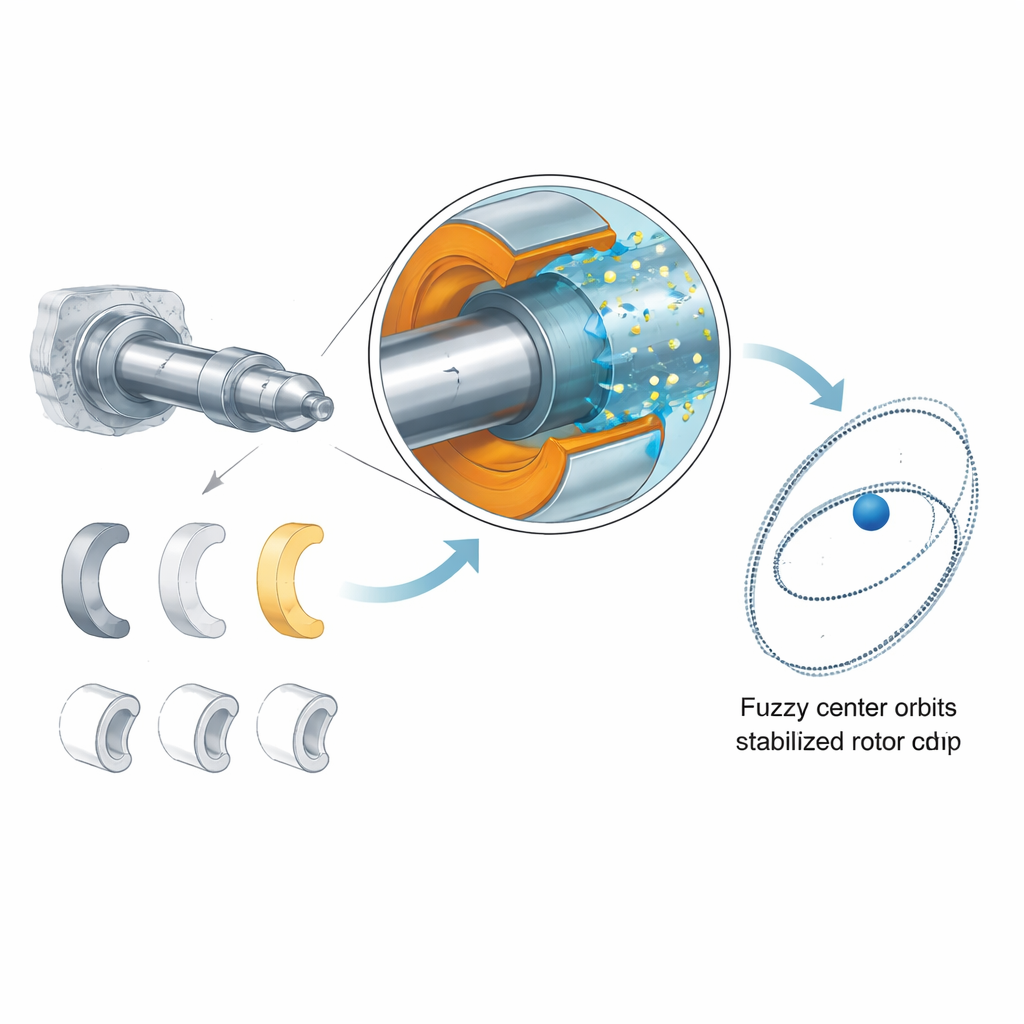
How a Small Part Does a Big Job
At the heart of the study is the journal bearing, a common component that cradles a rotating shaft on a very thin layer of oil. As the shaft spins, it drags oil around, building up pressure that lifts the shaft off the metal surface. If this fluid film behaves just right, the shaft stays centered and runs smoothly; if not, it can whirl and vibrate until the system fails. The authors focus on how the bearing’s shape along its length and the behavior of the lubricant together control the transition between calm rotation and unstable motion.
Shaping the Support Surface
Instead of using a simple straight cylinder, the researchers consider four axial shapes for the bearing surface: wedge-like, concave, convex, and wavy. These shapes subtly change how the oil film thickness varies along the length of the bearing, which in turn alters the pressure distribution that supports the shaft. Using a mathematical description of the oil film and a numerical solution to a standard lubrication equation, they compute how much load each shape can carry and how much friction it generates. Earlier work by the same group had already shown that shaped bearings can carry more load with less friction than conventional cylindrical ones, with the concave profile standing out as the best performer.
Supercharging the Oil with Nanoparticles
The study then adds another layer: nanolubricants, where tiny TiO₂ particles are mixed into ordinary engine oil. In real oils, these particles tend to clump into larger aggregates, trapping some of the oil and effectively increasing how “thick” or viscous the fluid behaves under shear. To capture this, the authors use a modified version of a classic viscosity model that explicitly accounts for particle clustering and how densely these clusters can pack. By varying both the particle concentration and the degree of aggregation in their calculations, they show that larger, more tightly packed clusters raise the effective viscosity and strengthen the oil film, especially when combined with the concave surface shape.
Mapping When Things Stay Stable
To connect these material and geometric choices to real-world behavior, the authors simulate how the rotor responds to small disturbances. They track the motion of the shaft center over time, distinguishing three regimes: stable motion where the orbit shrinks back to a steady position, a critical state where it traces a closed loop, and unstable motion where oscillations grow and suggest impending failure. From these simulations they construct “stability maps” that relate a dimensionless stability number and the shaft’s off-center position to whether the system runs safely or not. Concave and wedge shapes outperform convex and wavy ones, but the concave profile consistently delivers the highest stability threshold across operating conditions. Adding TiO₂ nanolubricant, particularly with higher particle volume and greater aggregation, pushes this threshold even higher, effectively expanding the safe operating window.

Designing Quieter, Safer High-Speed Machines
In everyday terms, the study shows that reshaping the bearing to have a gentle concave contour and using an oil fortified with suitably clustered nanoparticles can make fast-rotating machinery more resistant to vibration and failure. The concave geometry shapes the oil film so it carries more load and damps motion more effectively, while the nanoparticle aggregates thicken and strengthen that film without significantly increasing friction. Together, these effects raise the speed and load at which dangerous vibrations appear, offering engineers a practical recipe for building more reliable, longer-lasting turbines, compressors, and other high-speed industrial machines.
Citation: Awad, H., Saber, E., Abdou, K.M. et al. Stability analysis of hydrodynamic journal bearings with variable axial geometrical configuration using titanium dioxide nanoparticles as lubricant additives. Sci Rep 16, 13389 (2026). https://doi.org/10.1038/s41598-026-47711-3
Keywords: journal bearings, nanolubricants, rotor stability, titanium dioxide nanoparticles, hydrodynamic lubrication