Clear Sky Science · en
Quantum-inspired adaptive simulated annealing for antenna selection and joint optimization in RIS-assisted MIMO-NOMA systems
Why smarter airwaves matter
As our phones, sensors, and smart devices crowd the airwaves, future 6G networks must deliver far more data without wasting power. This paper explores a new way to "sculpt" radio waves in the air using programmable surfaces on walls and advanced antenna tricks at the base station. The authors also design a clever search algorithm, inspired by ideas from quantum computing and metallurgy, to coordinate all these knobs at once so networks can serve many users faster and more efficiently.
Bending signals with smart walls
Modern wireless systems already use many antennas at the base station to send several data streams at once, a technique known as MIMO. But performance still suffers when buildings block direct paths or when hardware becomes too complex and power-hungry. Two emerging tools promise relief. First, non-orthogonal multiple access (NOMA) lets several users share the same time and frequency by separating them in the power domain, boosting how much information can be squeezed through the channel. Second, reconfigurable intelligent surfaces (RIS) are thin panels made of many tiny reflecting elements whose properties can be electronically tuned. By carefully setting their phase shifts, an RIS can redirect and strengthen wireless signals, effectively reshaping the radio environment instead of just reacting to it.

Choosing the right antennas to save power
Turning on every antenna at a large base station is expensive in hardware and electricity. The paper uses antenna selection: only a subset of transmit antennas are active at any time, chosen to preserve most of the performance while cutting cost and power draw. The challenge is deciding which antennas to use, how to set the RIS elements, and how to share power among NOMA users—all at once. These decisions are tightly coupled: changing the active antennas affects which RIS configuration works best, which in turn influences how power should be divided among users, and vice versa. The resulting design problem spans many dimensions and has many local optima, so standard optimization methods often get stuck or take too long on realistic, large-scale deployments.
A quantum-inspired search through many possibilities
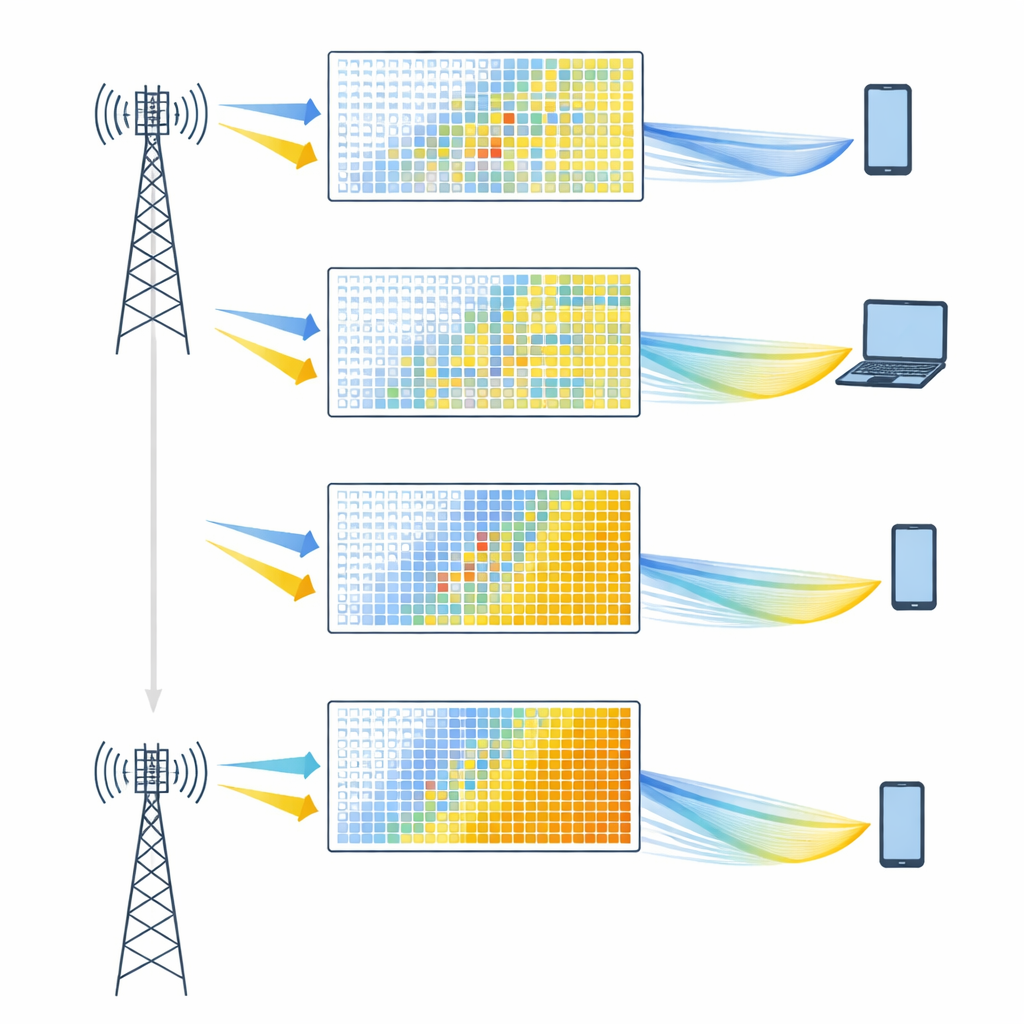
To tackle this, the authors propose an Adaptive Quantum-inspired Simulated Annealing (AQSA) framework. Classic simulated annealing mimics the cooling of hot metal: early on it allows worse choices to be accepted to explore broadly, then becomes more selective as the "temperature" falls, homing in on a good solution. AQSA enriches this idea in two ways. First, it borrows from quantum computing by representing choices—such as whether an antenna is on or off, or which phase a surface tile should take—through probability amplitudes, akin to a superposition of states. Measuring these states yields concrete configurations, while quantum-style rotation steps gradually tilt the probabilities toward better-performing options. Second, AQSA adapts its temperature schedule on the fly based on how often new solutions are accepted, keeping exploration high when progress stalls and speeding convergence when the search consistently improves.
Putting the new method to the test
The researchers embed AQSA inside a joint design loop that repeatedly refines three components: power allocation among NOMA users, selection of active base-station antennas, and phase patterns on the RIS. They test the approach in detailed computer simulations of a millimeter-wave downlink system around 28 GHz, with dozens of transmit antennas, many RIS elements, and multiple users. Across a wide range of conditions—different transmit powers, signal-to-noise ratios, numbers of antennas and RIS tiles, and numbers of users—the AQSA-based design consistently achieves higher spectral efficiency (more bits per second per hertz) than competing heuristics such as standard simulated annealing, particle swarm optimization, and gray wolf optimization. It also converts power into useful data more effectively, yielding better energy efficiency while keeping computational time realistic for large systems.
Balancing coverage, fairness, and complexity
Beyond headline data rates, the study shows that RIS-assisted systems tuned by AQSA can improve signal strength at the users and better balance performance among them, especially when the number of antennas or RIS elements grows. The algorithm exploits extra "degrees of freedom" from larger arrays more completely than rival methods, yet still limits how many antennas are actually switched on, avoiding runaway hardware cost. The authors also examine how different decoding orders in NOMA influence performance and confirm that carefully chosen orders, combined with AQSA, further raise spectral efficiency.
What this means for future networks
In simple terms, the paper demonstrates that making the radio environment programmable and then using a smart, adaptive search strategy to coordinate base-station antennas, smart surfaces, and power sharing can significantly boost both speed and energy savings in future wireless networks. Rather than relying on brute-force hardware or rigid designs, AQSA guides the system toward near-optimal settings with manageable effort, even as the number of antennas, users, and surface elements scales up. This suggests that quantum-inspired optimization paired with reconfigurable surfaces could be a practical path toward dense, power-efficient 6G and Internet of Things deployments.
Citation: Farghaly, S.I., Dawood, H.S. & Fouda, H.S. Quantum-inspired adaptive simulated annealing for antenna selection and joint optimization in RIS-assisted MIMO-NOMA systems. Sci Rep 16, 13623 (2026). https://doi.org/10.1038/s41598-026-47710-4
Keywords: reconfigurable intelligent surface, MIMO NOMA, antenna selection, quantum-inspired optimization, energy-efficient 6G