Clear Sky Science · en
Processing of abstract regularities in the human brain during dichotic listening
How the brain keeps track of sound patterns
Everyday life is full of repeating sounds, from traffic noise to music. Your brain quietly learns the patterns in these sounds so it can notice when something unexpected happens, like a wrong note in a melody. This study explores how the brain does this pattern tracking when different sounds are sent to each ear at the same time and what happens when your attention is focused or distracted.
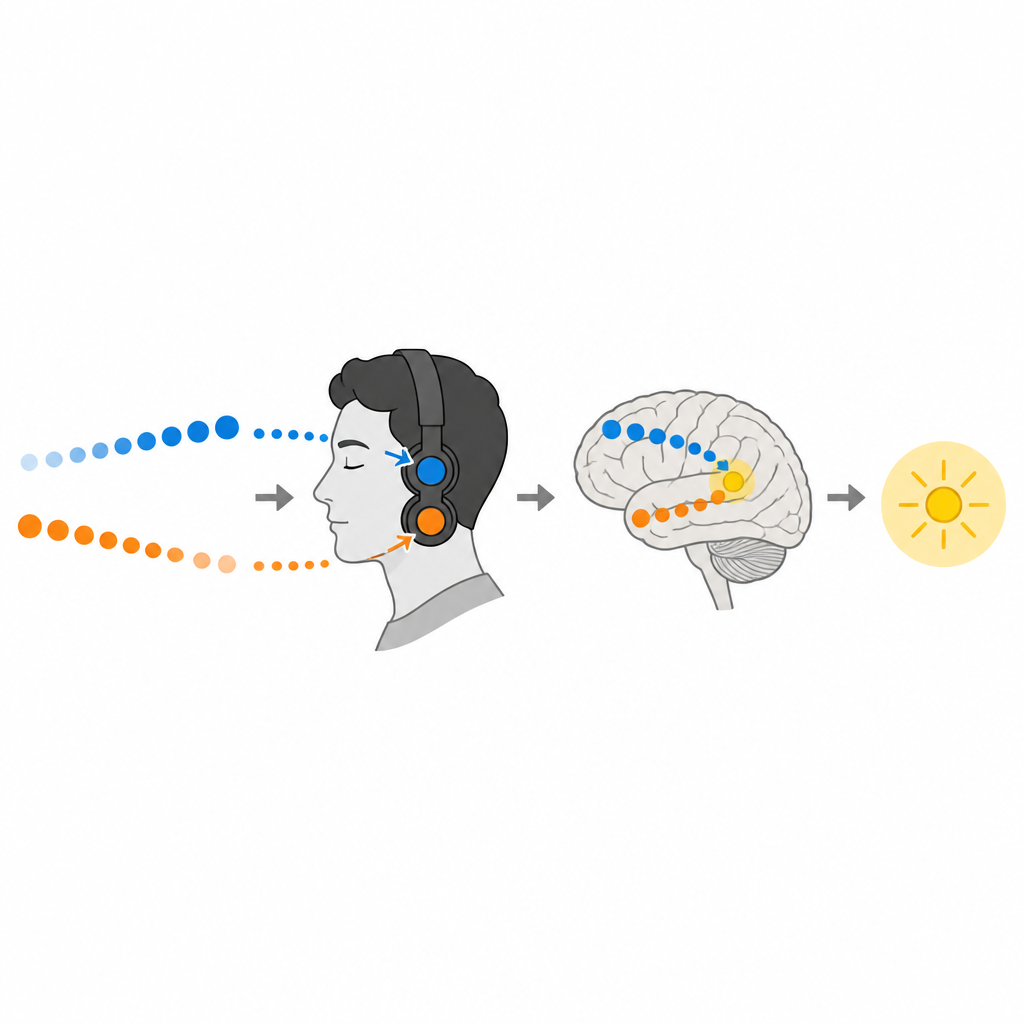
Listening to rules in rising and falling tones
The researchers used simple series of tones that either went steadily up or steadily down in pitch, like a scale on a piano. Most of the time the tones followed this rule, but occasionally one tone broke it by going in the opposite direction. These rare rule breaking tones were slipped into two kinds of listening situations. In one, the same downward pattern played in both ears. In the other, one ear heard a rising pattern while the other heard a falling pattern, so the brain had to keep track of two opposite rules at once.
Measuring the brain’s surprise signal
While volunteers listened, the team recorded electrical activity from the scalp using electrodes. A well known brain response called mismatch negativity acts as a kind of surprise signal, appearing when a sound breaks an expected pattern even if the person is not paying attention. Participants were sometimes asked to ignore the sounds while watching a silent movie and sometimes asked to listen carefully and press a button whenever they heard a rule breaking tone in a chosen ear.
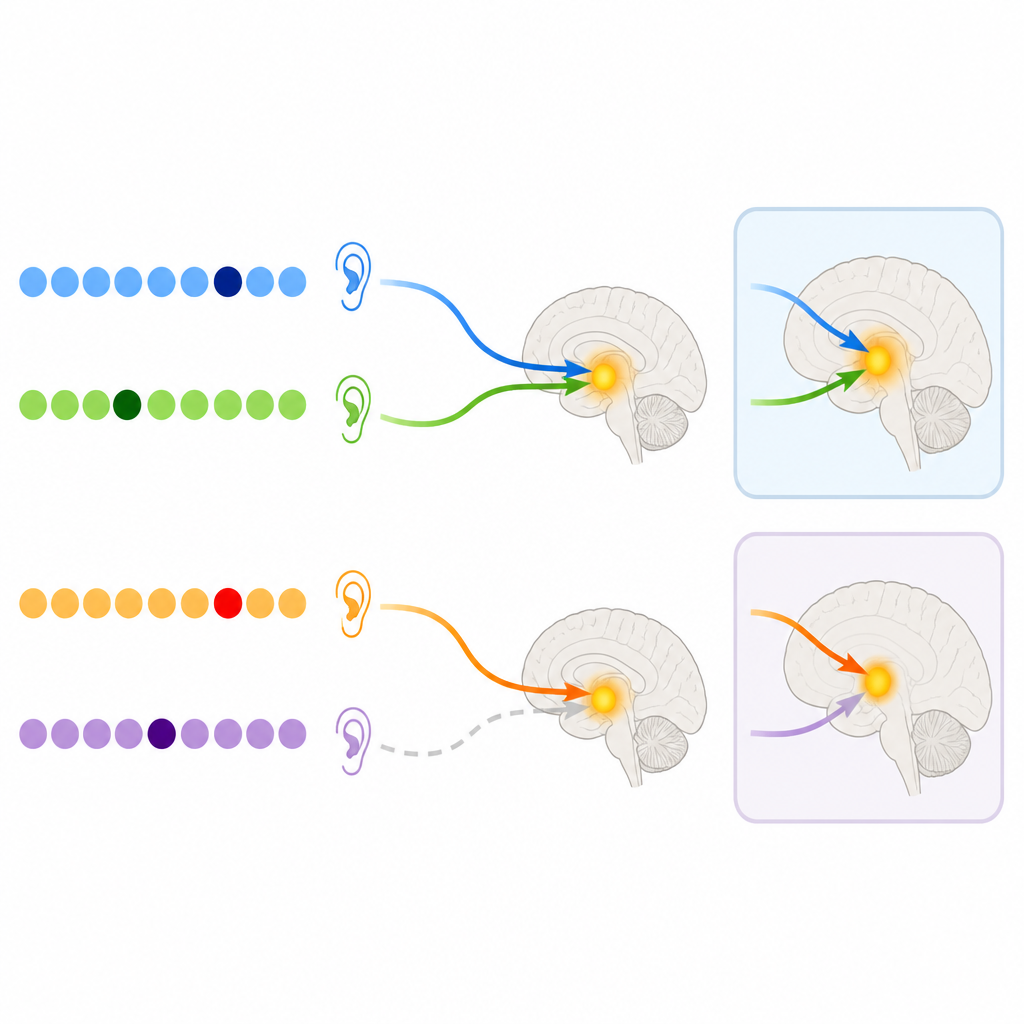
Two patterns at once without active attention
When participants watched the movie and ignored the sounds, the brain still produced a clear surprise signal for the rule breaking tones. This happened not only when a single tone stream was played to both ears, but also when two different streams were played at once, one rising and one falling. In other words, the brain could automatically separate the streams, learn two opposite rules, and register when either rule was broken, all without the listener deliberately paying attention.
Attention changes what the brain notices
The picture changed when people were told to focus on one ear and press a button for its rare rule breaking tones. Now, the surprise signal was seen only for the tones in the attended ear. Rule breaking tones in the ignored ear no longer triggered this automatic response. The data also showed other brain waves linked to conscious detection and decision making, confirming that listeners were truly concentrating on the instructed ear and that this strong focus dampened processing of sounds in the other ear.
What this means for everyday hearing
Taken together, the findings show that the brain is remarkably good at building separate sound patterns from both ears at once and at spotting when those patterns are violated, even without effort. At the same time, the study reveals that this ability is not completely independent of attention. When we focus very strongly on one stream of sound, the brain’s automatic change detector can fall silent for sounds coming from elsewhere. This balance between effortless monitoring and focused listening helps explain how we navigate noisy environments while still catching important changes when we need to.
Citation: Paavilainen, P., Karjalainen, L., Nousiainen, A. et al. Processing of abstract regularities in the human brain during dichotic listening. Sci Rep 16, 16098 (2026). https://doi.org/10.1038/s41598-026-47637-w
Keywords: auditory attention, brain responses, sound patterns, dichotic listening, mismatch negativity