Clear Sky Science · en
Modeling of fractional order DPG model insight global warming and pollution effect on desertification for control mechanism
Why dust, plants, and heat matter to our future
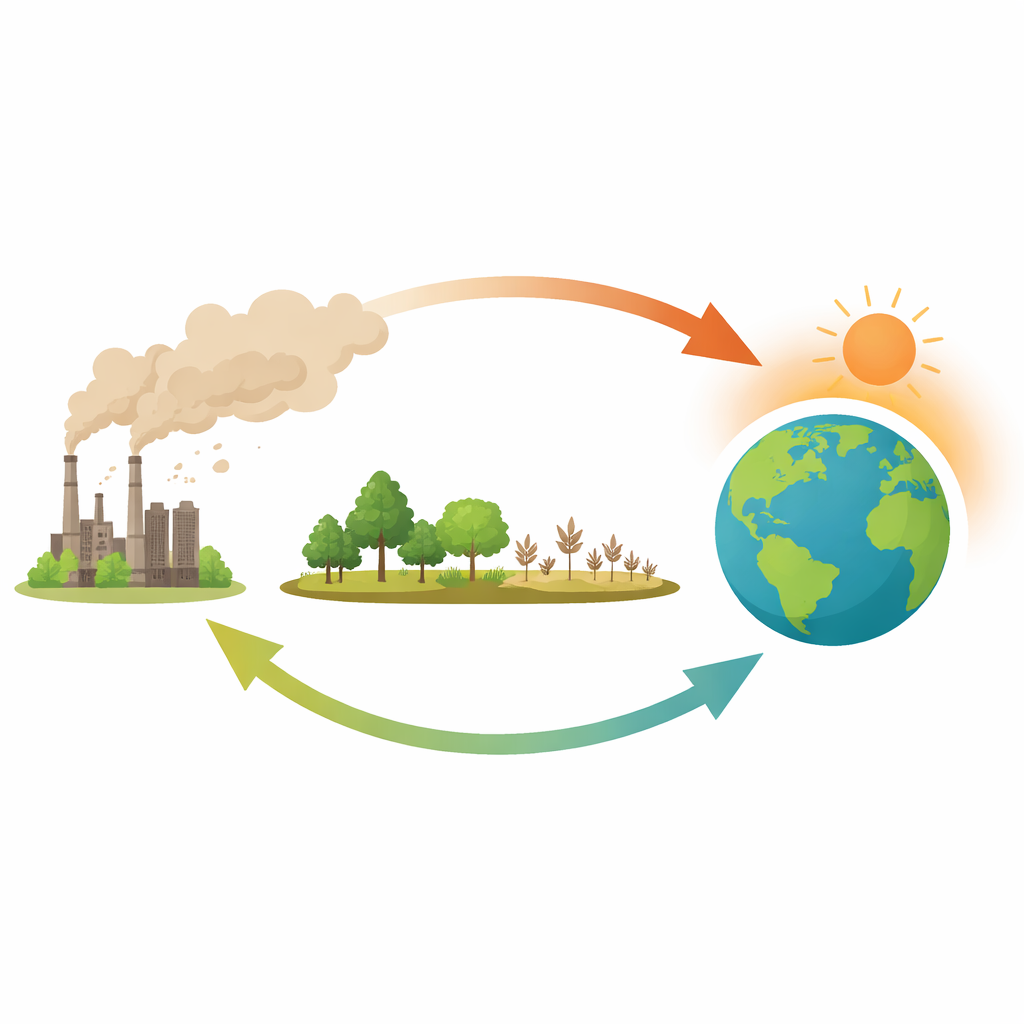
Across many parts of the world, once-productive land is turning into desert. This shift is not driven by a single culprit but by a web of links between air pollution, shrinking plant cover, and a warming climate. The paper summarized here builds a detailed mathematical "laboratory" where these links can be explored safely on a computer, helping scientists test how dust in the air, plant growth, and global warming push landscapes toward or away from desert conditions.
Three players in a fragile balance
The study focuses on three main ingredients of dryland health: dust pollution in the air, the amount of living plant material on the ground (plant biomass), and a simple index of global warming. Dust can be kicked up by bare soil, industry, and traffic. Plants act as natural cleaners, trapping dust and anchoring soil. Warming, driven largely by human activity, stresses plants and can reduce how much vegetation the land can support. The authors gather what is known from earlier ecological and climate work and encode these connections into a compact system they call the DPG model, where dust (D), plants (P), and global warming (G) constantly influence one another.
Adding memory to nature’s equations
Traditional models assume that nature reacts instantly: today’s dust and heat depend only on today’s conditions. But real ecosystems "remember" the past. Soils store pollution, plants take time to respond to stress, and the climate system builds up changes over years. To capture this, the authors use a mathematical tool called a fractional derivative, which lets the present depend partly on past states. In practice, this means the model’s equations smooth out abrupt jumps and retain a trace of what happened before. The team shows that, with this added memory, their system still behaves in a well-defined way: solutions exist, are unique, and remain stable under small disturbances, making the model trustworthy for long-term exploration.
When land tips toward desert
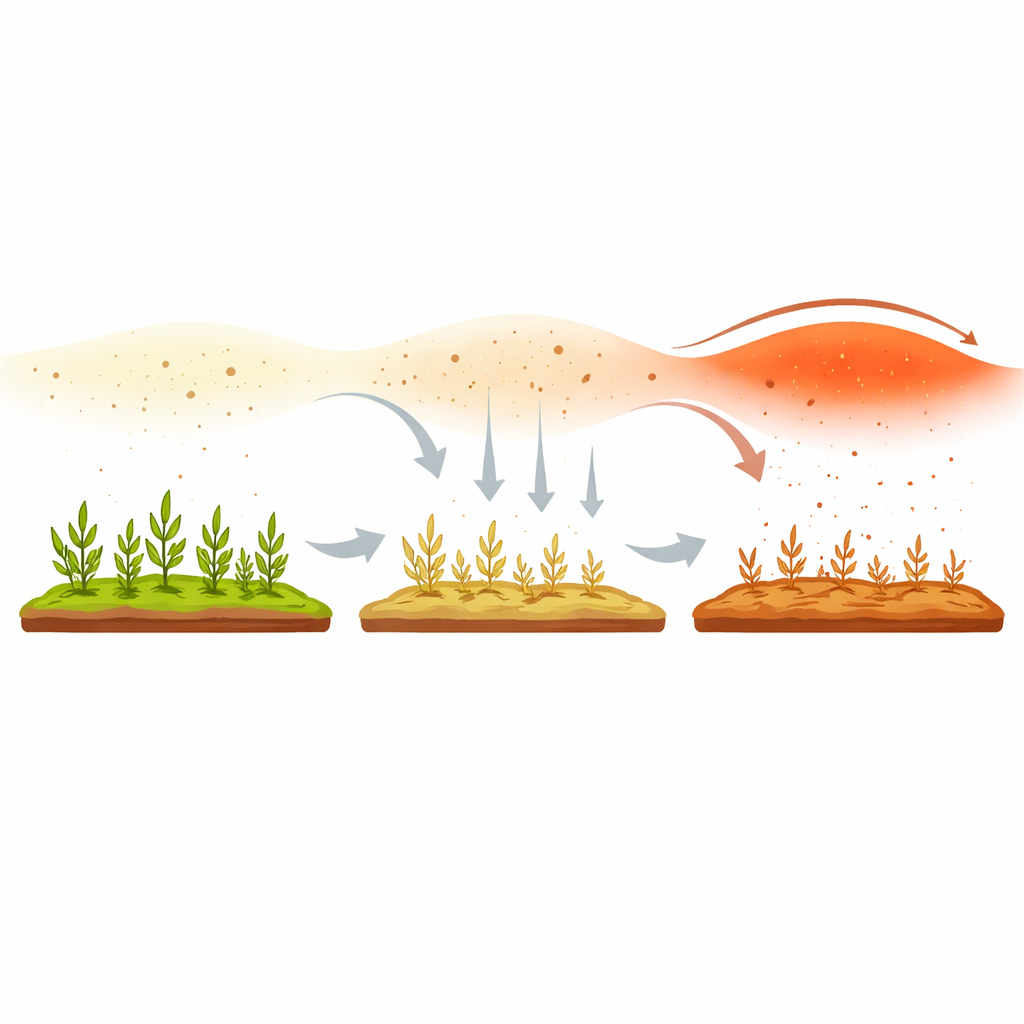
Within this framework, the researchers identify two broad outcomes: one in which plants collapse and the land slides toward desert, and another in which vegetation persists. A key threshold quantity emerges from the equations: if plant growth outweighs losses caused by dust, vegetation can survive; if not, it dies back. By varying model parameters, they assess which factors most strongly affect this threshold. Higher plant growth and natural dust removal work in favor of green landscapes, while stronger dust emissions and harsher dust damage to plants push the system toward desertification. A sensitivity analysis highlights that small changes in emission rates or plant vulnerability can have large impacts on whether vegetation holds on or disappears.
Taming chaos with control actions
Because all three components feed back on one another, the system can behave chaotically, with irregular swings in dust levels, plant cover, and warming. The authors interpret this as an echo of real-world surprises, like sudden dust storms or abrupt vegetation dieback. They test simple control terms that represent actions such as cutting emissions, restoring vegetation, or enhancing climate mitigation. In their simulations, these added efforts calm the erratic behavior and steer the system toward a steadier state, with more stable dust concentrations, healthier plant biomass, and a moderated warming signal. This suggests that coordinated interventions can reduce the chance of sudden, hard-to-reverse shifts.
What the findings mean for people and policy
By comparing versions of the model with and without memory, the study finds that including past influences leads to slower, more realistic changes in dust build-up, plant loss, and warming. Lower "memory orders" in the equations dampen dust growth, slow vegetation decline, and delay warming trends, mimicking the inertia seen in actual landscapes and climate. For a non-specialist, the main message is that desertification is not just about today’s pollution or this year’s heat wave; it reflects years of accumulated stress. The fractional DPG model offers a refined tool for testing how cutting emissions, boosting plant cover, and pursuing climate policies together can keep vulnerable regions from crossing the line into lasting desert.
Citation: Farman, M., Jamil, K., Jamil, S. et al. Modeling of fractional order DPG model insight global warming and pollution effect on desertification for control mechanism. Sci Rep 16, 11704 (2026). https://doi.org/10.1038/s41598-026-47606-3
Keywords: desertification, dust pollution, plant biomass, global warming, fractional modeling