Clear Sky Science · en
A simulation model to predict agricultural tractor-semi-trailer combination traction performance under different operating conditions
Why hauling crops across a field is a bigger problem than it looks
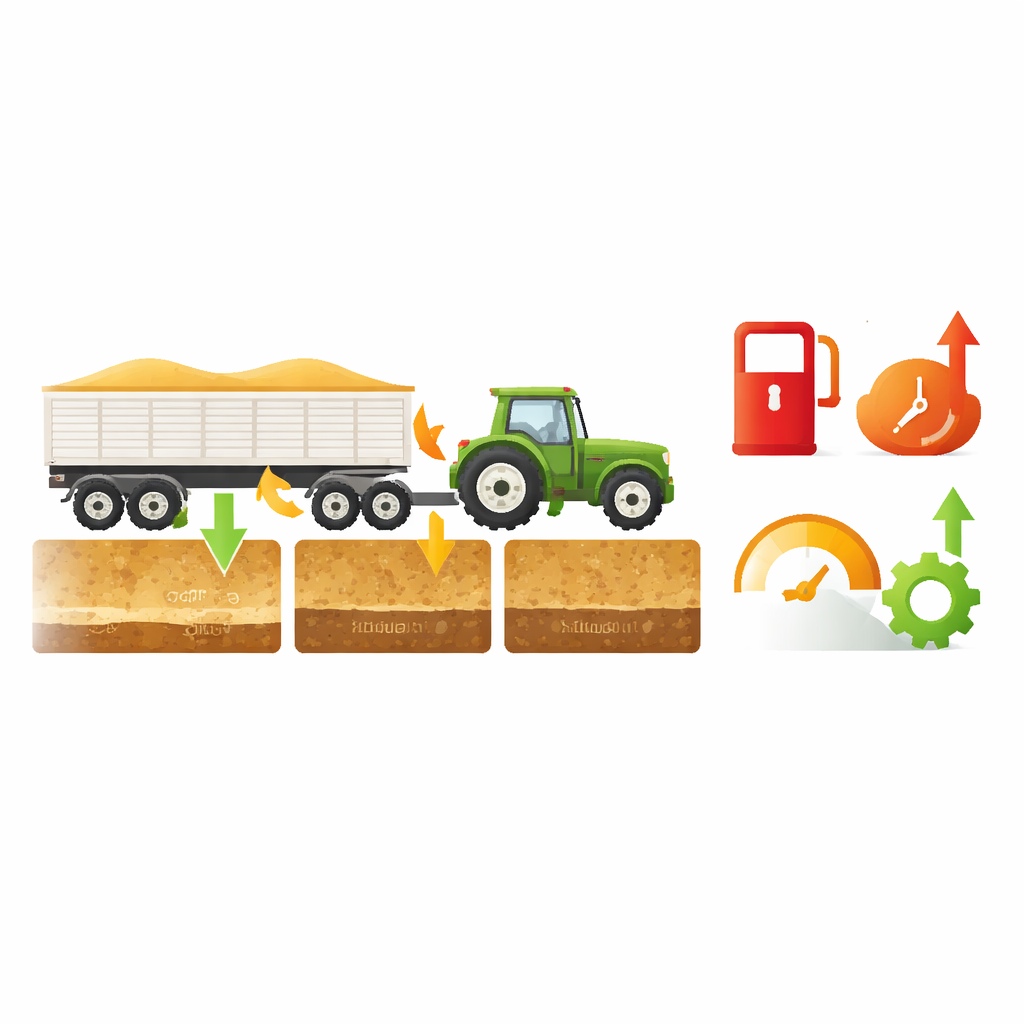
Moving harvests from field to storage or factory may sound routine, but it quietly eats up a large share of a farm’s fuel, time, and machinery wear. As farms grow larger and fields extend into rough, sandy or reclaimed land, tractors must pull heavier trailers over longer distances and tougher ground. This study looks under the hood of that everyday job, using a computer model to predict how a tractor pulling a semi-trailer will behave on different soils, with different loads, and with different tractor and tire choices. The aim is to help farmers and designers move more crop using less fuel, while keeping machines stable and safe.
A digital test track for tractors and trailers
The researchers built a simulation that treats the tractor–semi-trailer pair as a single system moving over soil. Instead of running many time‑consuming field trials, users enter key details into a computer tool: soil firmness, tractor size and drive type, tire style, trailer load, and travel speed. Behind the scenes, equations from vehicle mechanics and soil science estimate how much pulling force is needed at the hitch, how much power the tractor must deliver, how efficiently that power is turned into useful work, and how much fuel will be burned. The same model also suggests practical trailer design details—such as box dimensions, axle layout, and how much weight is transferred onto the tractor—so that one set of inputs yields both performance and design guidance.
How soil, slip, and load change the job
The study shows that the ground beneath the wheels is just as important as the engine under the hood. On firm, cohesive soils the tires can grip well, so the tractor can pull harder but must also deliver more power and fuel to move a heavy load. On loose sandy soils, grip is poor: the trailer is easier to pull in terms of force, yet the wheels spin more and overall efficiency drops. Wheel slip—the difference between how fast the wheels rotate and how fast the tractor actually moves—emerges as a key setting. The model finds a “sweet spot” around 10–20 percent slip where the tractor converts fuel into forward motion most efficiently; too little slip wastes potential grip, and too much simply churns the soil without moving the load efficiently.
Choosing the right tractor, tires, and trailer size
Different hardware choices also reshape performance. Four‑wheel‑drive tractors generally handled the same semi-trailer with less pulling force and lower power demand than two‑wheel‑drive machines, especially at higher speeds, even though the two‑wheel‑drive tractors sometimes showed slightly higher numerical efficiency. Radial tires, which flex more and spread the contact patch, delivered better grip and lower rolling drag than traditional bias‑ply tires, boosting traction efficiency but at the cost of somewhat higher fuel use in the scenarios studied. Increasing trailer payload predictably raised pulling force, power demand, fuel consumption, and the amount of weight shifted onto the tractor, while gradually eroding traction efficiency. The model helps identify loading ranges and weight transfer ratios that keep the combination stable and within recommended limits.
Testing the model against real tractors
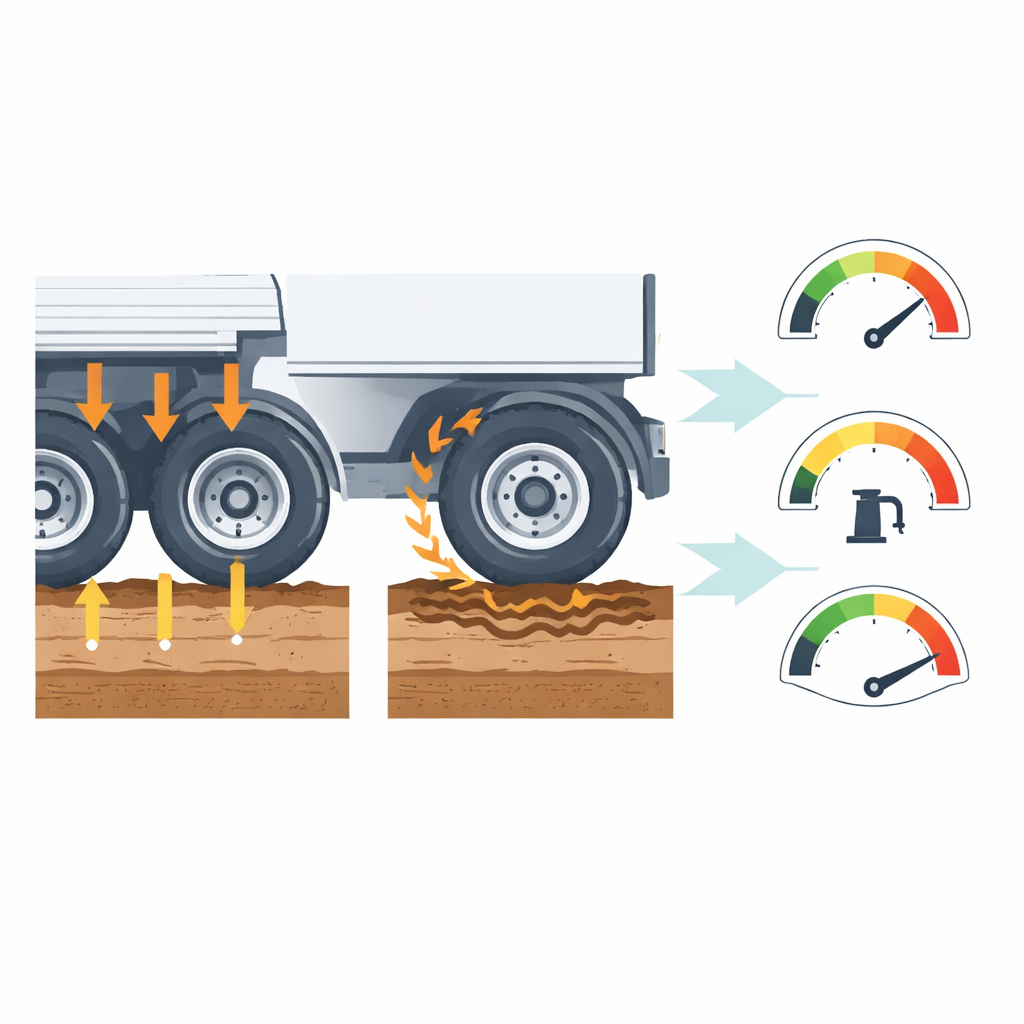
To check whether the virtual results match real‑world behavior, the team compared the model’s predictions with official test data for four production tractors from two major manufacturers working with a semi‑trailer. For a range of soil strengths, the simulated drawbar power—the power actually available at the hitch—fell between about 31 and 105 horsepower and typically used 62–74 percent of each tractor’s rated drawbar capability on firm soil. Statistical checks showed a strong correlation between predicted and measured power, with a modest spread in the errors. While the model assumes steady conditions and uniform soil, and would benefit from more field trials, it already reproduces the main trends engineers expect when soil strength, speed, slip, and load are varied.
From equations to everyday decisions
In plain terms, this work turns a complex mix of soil, machine, and load into a practical planning tool. Farmers, contractors, and designers can use the model’s spreadsheet and graphical interface to “test drive” different tractor–trailer setups on the computer before investing in hardware or fuel. By showing how changes in soil type, tire choice, drive configuration, speed, and payload affect pulling force, power demand, and fuel cost, the model points toward combinations that move the same crop more efficiently and safely. Although it cannot yet capture every bump, rut, or puddle in a real field, it provides a realistic, easy‑to‑use guide for designing and operating tractor–semi‑trailer systems under a wide range of agricultural conditions.
Citation: Fouda, T., Hegazy, R. & Alhamshary, K. A simulation model to predict agricultural tractor-semi-trailer combination traction performance under different operating conditions. Sci Rep 16, 13000 (2026). https://doi.org/10.1038/s41598-026-47522-6
Keywords: agricultural transport, tractor trailer, soil traction, fuel consumption, farm machinery design