Clear Sky Science · en
Design-based life cycle assessment of flexible pavements to evaluate embodied carbon footprint
Why the road under your wheels matters
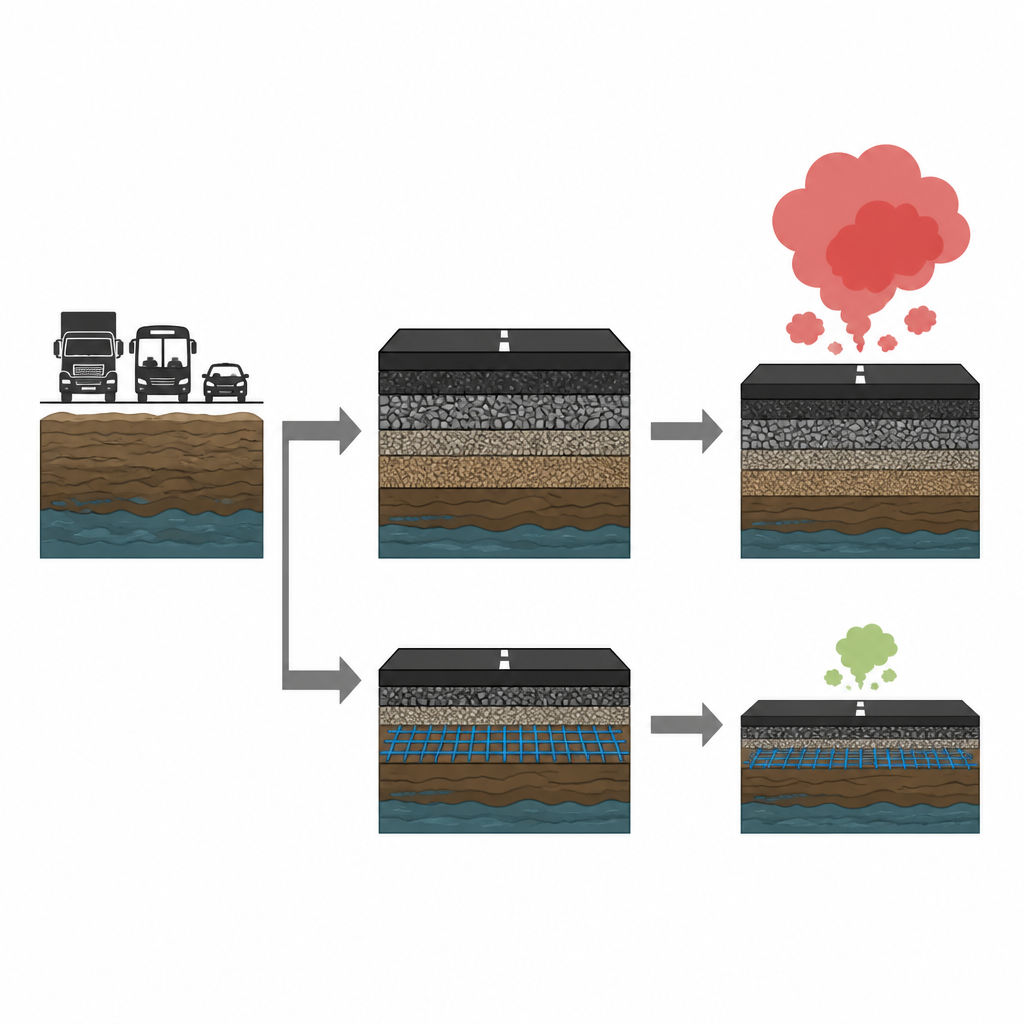
Every time we drive, we travel on layers of stone and asphalt that quietly consume vast amounts of raw materials and energy. As countries like India expand their road networks by tens of thousands of kilometres, the climate impact of building and maintaining these “flexible pavements” grows harder to ignore. This study looks at how small changes in road design, using a plastic grid hidden inside the pavement, can cut the carbon footprint and other environmental impacts of our roads without sacrificing performance.
Hidden helpers inside the road structure
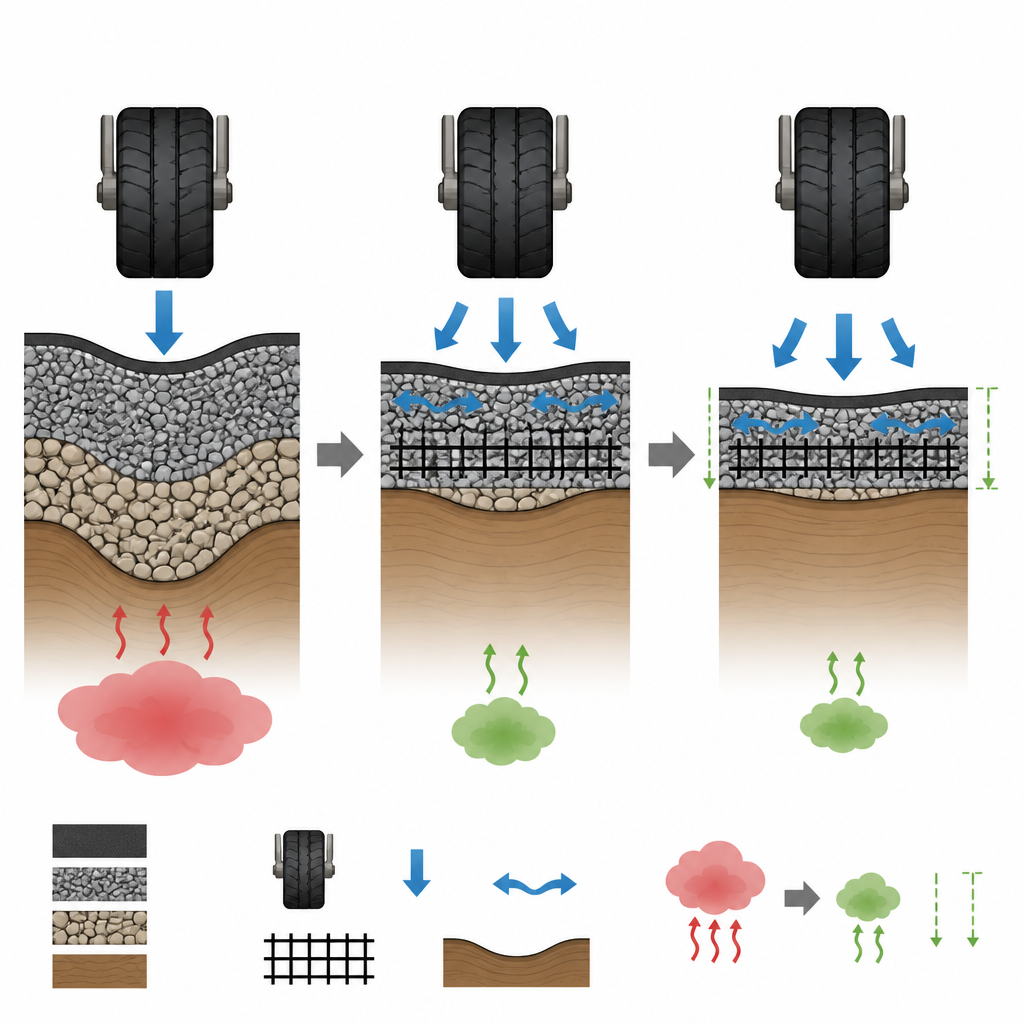
The research focuses on flexible pavements, the most common road type worldwide, especially in India. These pavements are built in layers over soil that can range from weak and soft to relatively strong. Traditional designs often need thick layers of crushed stone and asphalt to prevent rutting and cracking, which means high use of energy intensive materials. The authors examine geogrids, stiff plastic mesh panels placed within the stone layer. These grids lock the stones together, stiffen the road base, and spread traffic loads more evenly, allowing designers to achieve the same strength with less material.
Following the road from cradle to grave
To understand the true environmental cost of a road, the team uses life cycle assessment, a method that tracks impacts from raw material extraction through manufacturing, transport, construction, upkeep, and end of life. They compare conventional and geogrid reinforced pavements along a one kilometre lane over 20 years, for four different soil strengths. The analysis covers not only climate warming emissions but also acidification, which can harm air and water quality, and the use of fossil energy. The system boundary is “cradle to grave,” including material production, hauling, paving, maintenance overlays, and recycling of old asphalt, while daily traffic use is held the same for both designs.
Where most of the impact really comes from
The results show that the bulk of a road’s climate impact does not come from construction machinery on site, but from making and moving materials. More than half of total greenhouse gas emissions are tied to producing asphalt and aggregates, and just over one third comes from trucking these heavy materials to the site. Construction fuel contributes only a small share. At the end of life, milling and reusing reclaimed asphalt actually provide a modest emission “credit,” because recovered material replaces some virgin asphalt and stone. These patterns hold for both conventional and reinforced roads.
How a thin grid saves carbon, energy, and pollution
Because geogrids stiffen the road base, they allow thinner stone and asphalt layers while still meeting performance limits for cracking and rutting. This reduction in material mass directly lowers embodied carbon. For the weakest soil considered, the reinforced design cuts life cycle greenhouse gas emissions by about 14 percent per kilometre, with smaller but still clear benefits on stronger soils. The same trend appears for acidification and fossil energy use: the asphalt layer dominates these impacts, and any design that needs less asphalt performs better. A field plate load test on an actual road section confirms that the geogrid improves stiffness at least as much as assumed in the design, supporting the credibility of the calculated savings.
A simple yardstick for greener road choices
To make these findings easier to apply in practice, the authors introduce a carbon emission reduction factor, or CERF. This is the ratio of emissions from a reinforced pavement to those from a similar unreinforced one over the same service life. Values closer to zero indicate larger savings. In this study, CERF is lowest on weak soils, where reinforcement allows the biggest cut in layer thickness, and approaches one on strong soils, where the benefit is smaller. Along with a sensitivity study showing that material supply and transport distances matter far more than short term construction fuel use, the work offers a clear message: smart design and a thin plastic grid, used in the right ground conditions, can meaningfully shrink the environmental footprint of the roads we rely on every day.
Citation: Bodhanam S, P., Baadiga, R. Design-based life cycle assessment of flexible pavements to evaluate embodied carbon footprint. Sci Rep 16, 16125 (2026). https://doi.org/10.1038/s41598-026-47498-3
Keywords: flexible pavements, geogrid reinforcement, life cycle assessment, carbon footprint, road sustainability