Clear Sky Science · en
Comparative performance analysis of low-enthalpy geothermal energy in arid and semi-arid climates
Cooling buildings with the quiet power of the ground
In hot regions, air conditioners work overtime, straining power grids and wallets while adding to climate-warming emissions. This study explores a quieter helper that sits right under our feet: the steady temperature of the ground a few meters below the surface. By using buried pipes to tap this stable underground climate, buildings can pre-cool or pre-heat incoming fresh air and cut the work that air conditioners and heaters need to do.
A simple idea beneath our feet
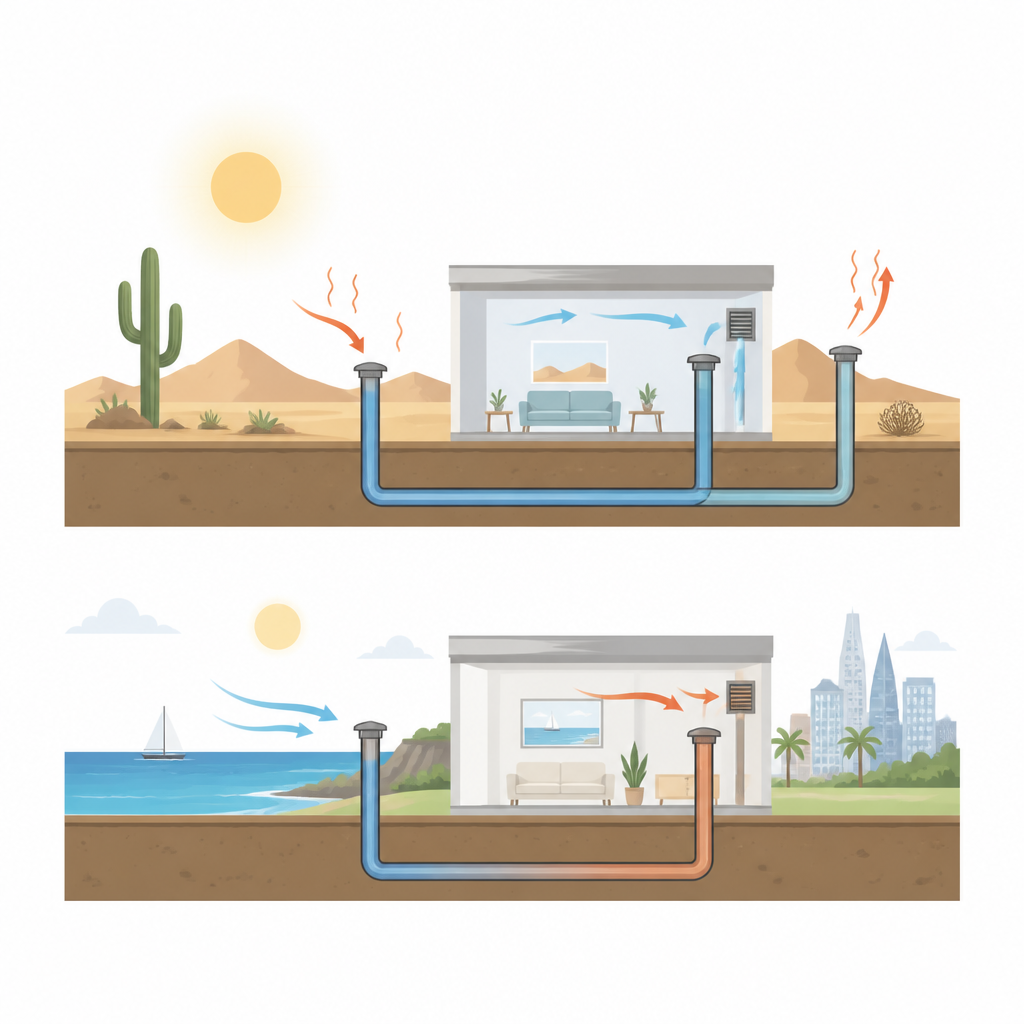
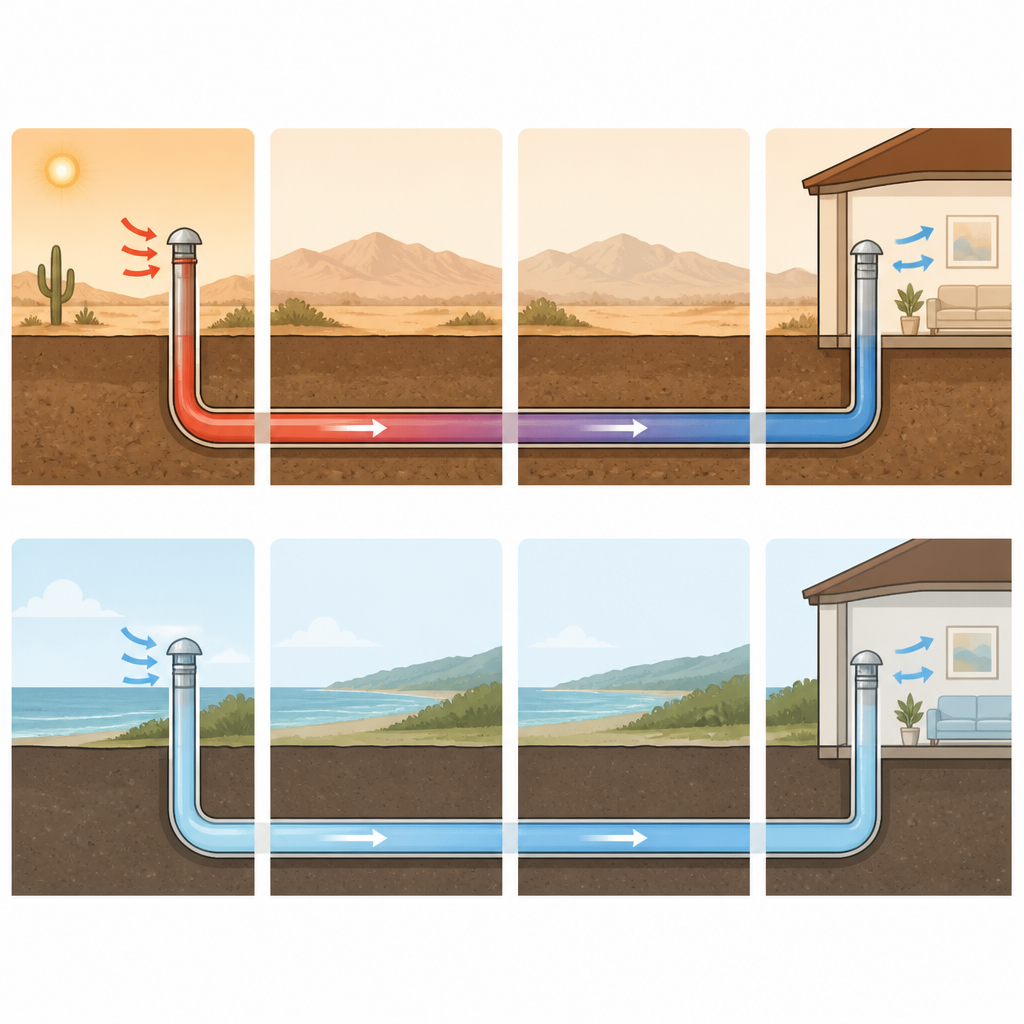
Far below the daily swings of sun and wind, the ground stays at a nearly constant temperature year-round. The system examined in this work, called an earth–air heat exchanger, takes advantage of that steady underground environment. Outside air is pulled by a fan through long plastic pipes buried several meters deep. As the air travels through the pipe, it trades heat with the surrounding soil. Hot air from summer streets is cooled before reaching the building, while cold winter air can be gently warmed. This “pre-conditioning” reduces the temperature gap that mechanical systems must overcome, saving energy without changing how people use their spaces.
Putting the ground to the test in two Egyptian cities
The researcher used a detailed computer model, previously checked against experiments, to see how well this underground pipe system would work in two very different Egyptian climates. Aswan, in Upper Egypt, represents an extremely hot and dry desert city, while coastal Alexandria has a milder, semi-arid climate shaped by the Mediterranean Sea. For each city, long-term weather records were used to estimate how soil temperature changes with depth and through the year. These soil profiles were then fed into a model of air flow and heat transfer inside the buried pipe, allowing the study to explore how design choices and local climate affect performance.
Finding the sweet spot for pipe design
The study tested how pipe length, burial depth, air speed, and pipe diameter influence the temperature of air leaving the system. Most of the cooling happens in the first 20 meters of pipe, with the benefit tapering off beyond about 40 to 50 meters. Going deeper into the ground improves performance up to around 4 to 5 meters, where the soil temperature becomes very stable; digging deeper adds cost but little extra gain. Slower air speeds, especially around 2 meters per second, give the air more time to adjust toward the soil temperature without demanding high fan power. Narrower pipes in the range of 0.1 to 0.2 meters in diameter provide a stronger temperature drop, and if more air is needed it is better to install several pipes in parallel rather than a single large one.
Why deserts can actually help with comfort
When the best pipe settings were applied, the model compared performance on the hottest hours in both cities. In Aswan, the system cooled incoming air by about 11 degrees Celsius, while in Alexandria the drop was about 7.6 degrees, giving the desert city a 45 percent larger reduction. The key factor is not the season itself but the size of the temperature difference between outdoor air and the undisturbed soil. In winter, when the ground is warmer than the air, the same setup can pre-heat air; in Alexandria, this winter heating potential was even stronger than the summer cooling effect. Across the year, locations with more extreme temperatures and a larger gap between air and soil, like Aswan, offer the greatest savings.
What this means for future buildings
This work shows that simple buried pipe systems can be tuned to local conditions and offer steady benefits in both heating and cooling seasons. By identifying practical design ranges for depth, length, air speed, and pipe size, the study provides a roadmap for using the ground as a natural partner to conventional air conditioning and heating. While future research will need to consider full building systems, complex pipe networks, and long-term soil behavior, the message for lay readers is clear: in hot, dry regions, the quiet, constant temperature underground can play a major role in making indoor life more comfortable while reducing energy use.
Citation: Hegazy, A. Comparative performance analysis of low-enthalpy geothermal energy in arid and semi-arid climates. Sci Rep 16, 14279 (2026). https://doi.org/10.1038/s41598-026-47489-4
Keywords: earth air heat exchanger, geothermal cooling, arid climate, building energy, passive cooling