Clear Sky Science · en
The analysis and control of scale accumulation for mixed layer injection of water for the Shuanghe oil area in Yanchang Oilfield
Why this matters for oil and water
In many oilfields, old wells are kept flowing by pumping water underground. But when different kinds of water are mixed, they can leave behind rock-hard deposits inside pipes and tiny underground channels. This study looks at such a problem in a Chinese oilfield and shows how understanding the chemistry of the waters involved can turn a clogging, wasteful system into a smoother and more efficient one.
The challenge of mixing different waters
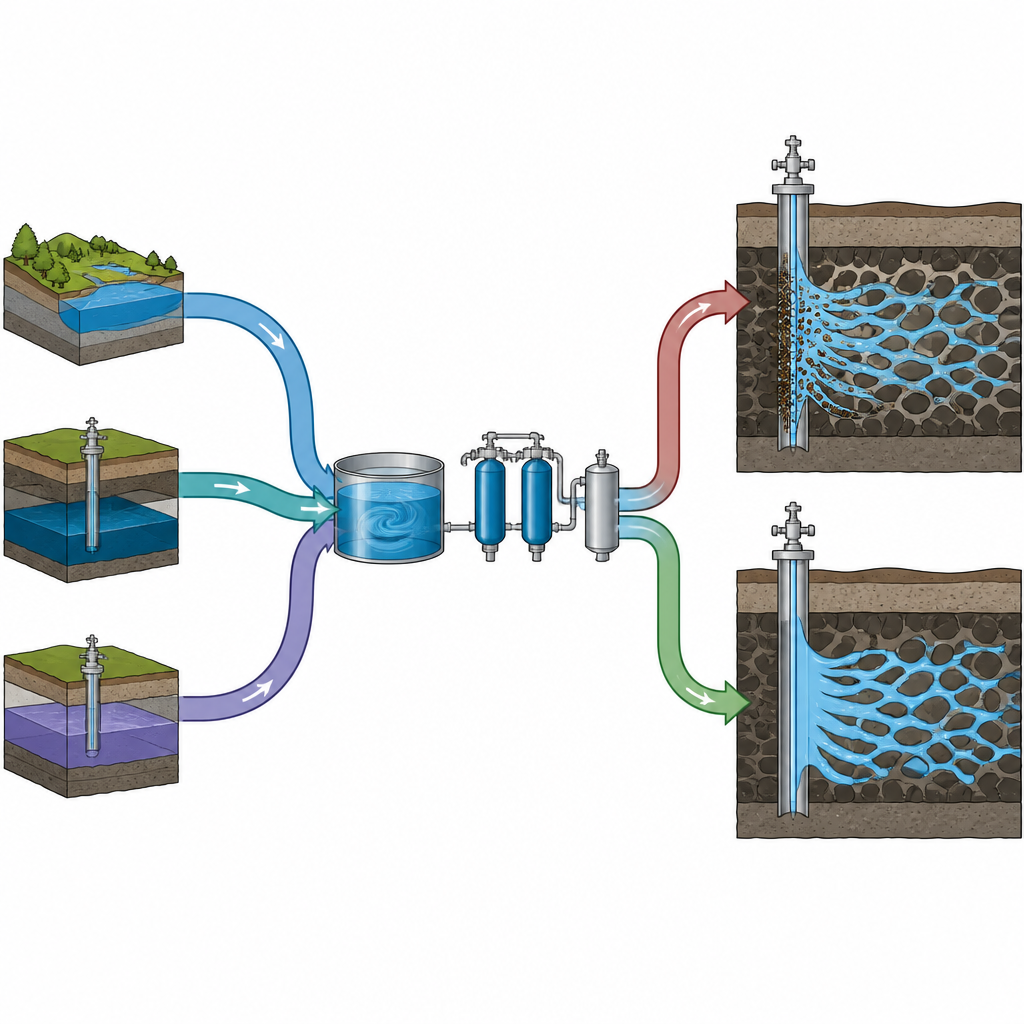
The Shuanghe oil area in the Yanchang Oilfield uses three water sources for injection: water that comes up with oil from one set of rocks, water from another rock layer, and local surface water. To save water and money, all three are collected, treated together, and sent back underground. The catch is that these waters have very different salt ingredients. One is rich in calcium, barium, and strontium, while another is rich in sulfate and carbonate. When such waters meet, they react like two cleaning products that should never be mixed, forming solid minerals that can clog metal pipes and the microscopic pores in the reservoir rock.
What builds up inside pipes and rocks
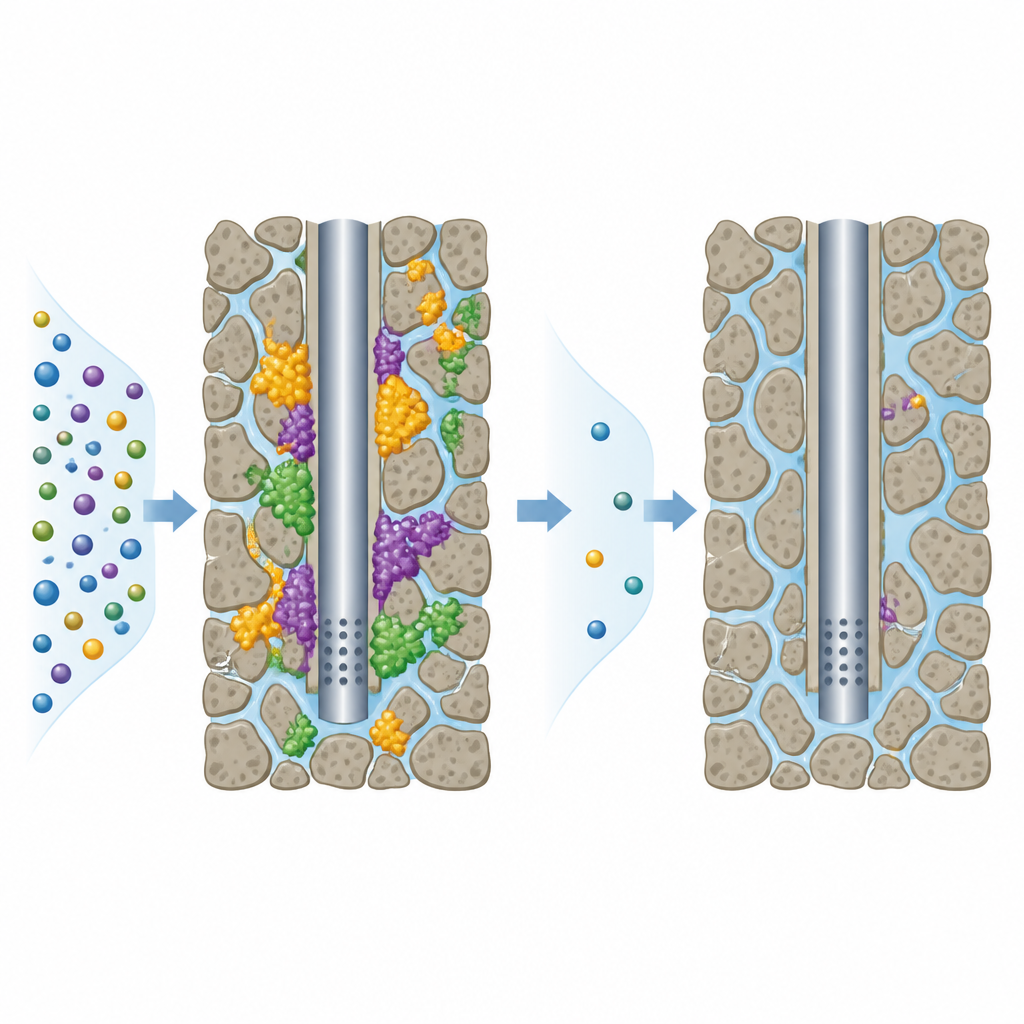
To find out exactly what was going on, the researchers first analyzed the salts dissolved in each water source. They then used specialized software to predict what minerals would form when the waters were blended under reservoir conditions of pressure, temperature, and acidity. The predictions showed that three main types of scale appear: calcium carbonate, barium sulfate, and strontium sulfate. Mixing the two produced waters was especially troublesome, creating much larger amounts of these solids than when either one was mixed with surface water. Samples scraped from clogged pipes confirmed the forecast: one sample was mostly calcium carbonate, while another was a mix of barium and strontium sulfates.
How temperature and acidity tip the balance
The team also tested how changes in temperature and pH (a measure of how acidic or alkaline the water is) affected scale formation. They found that warmer and more alkaline conditions strongly encouraged calcium carbonate to drop out of the water and coat surfaces. Barium and strontium sulfates were much less sensitive to these changes, staying almost equally insoluble over the tested range. In other words, small shifts in operating conditions could greatly influence one type of scale while barely touching the others. This understanding allowed the researchers to focus on the most effective points of control.
Designing a smarter treatment process
Rather than rely on constant doses of chemical additives, the researchers redesigned the surface treatment process. They added a pre-mixing tank where the two produced waters are combined in a controlled way, encouraging barium and strontium to react with sulfate and form solid grains that can be removed at the surface instead of underground. At the same time, they adjusted the pH of the final injected water to closely match the natural water in the main reservoir, keeping it slightly acidic to discourage calcium carbonate from forming. Field monitoring showed that sulfate levels in the injected water dropped sharply, and the pH stayed in the desired narrow band.
Proving the benefit in rock samples
To see whether this new process actually protected the reservoir, the team flowed different waters through small cores of reservoir rock in the laboratory. When untreated mixed water was used, almost half of the rock’s ability to pass fluid was lost, indicating severe blockage. With water that had gone through the new pre-mixing and pH control steps, the damage fell to around one fifth. This meant that many more of the rock’s microscopic pathways stayed open, so less pressure would be needed to inject the same volume of water in the field.
What this means for oilfields
For readers, the key message is that the chemistry of injection water can make or break the efficiency of an oilfield. This study shows that carefully measuring water ingredients, predicting how they will react, and then shaping the treatment process around those reactions can sharply reduce unwanted mineral buildup. By moving most of the scaling from the hidden depths of the reservoir to a controlled tank at the surface, operators can keep wells flowing more smoothly while relying less on long term chemical dosing. The approach demonstrated in Shuanghe offers a blueprint that other fields with similar water mixing problems can adapt to their own conditions.
Citation: Qi, C., Xia, Y. & Tang, S. The analysis and control of scale accumulation for mixed layer injection of water for the Shuanghe oil area in Yanchang Oilfield. Sci Rep 16, 15733 (2026). https://doi.org/10.1038/s41598-026-47479-6
Keywords: waterflooding, scale formation, injection water, reservoir damage, oilfield chemistry