Clear Sky Science · en
Unmasking non-malarial mosquito-borne infections among febrile children in malaria-endemic regions of western Kenya
Why fevers in children are not always malaria
In many parts of sub-Saharan Africa, a child with a fever is almost automatically assumed to have malaria. Yet other mosquito-borne infections can cause very similar symptoms, and they often go unnoticed. This study, carried out in two counties of western Kenya, shows that dengue fever—a viral disease spread by a different mosquito than malaria—is quietly responsible for a substantial share of fevers in young children, sometimes alongside malaria in the same child.
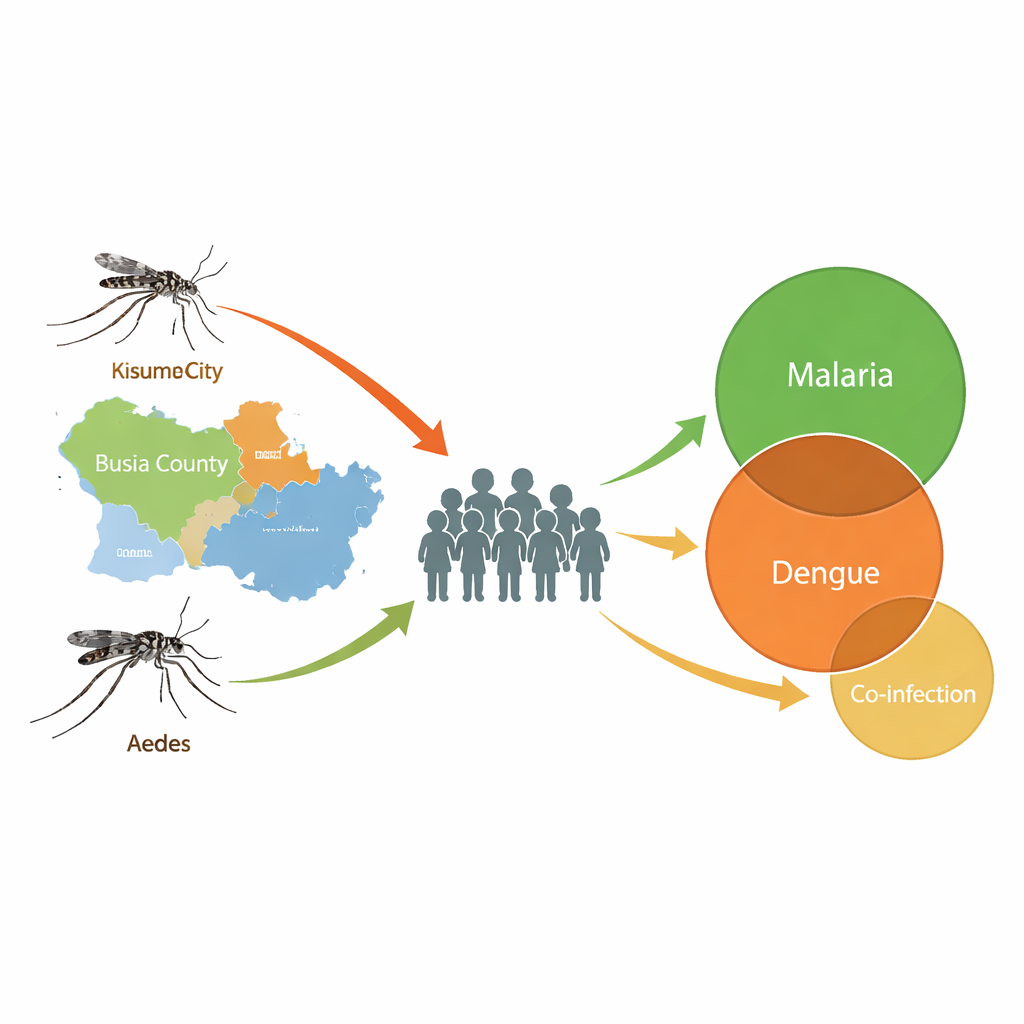
Where the study took place
The researchers focused on Busia County, a mainly rural lakeside area, and Kisumu City, a larger urban center on the shores of Lake Victoria. Both regions are long known hotspots for malaria, thanks to warm temperatures, standing water, and abundant mosquitoes. In recent years, however, climate-related changes and expanding mosquito habitats have increased concern that other mosquito species, especially those that spread dengue, are moving into new areas. Until now, routine testing in these counties has rarely looked beyond malaria, leaving health workers with little information when a febrile child tests negative for the parasite.
How the children were tested
At public health facilities in Busia and Kisumu, the team enrolled children under five years old who arrived with a fever. First, 1,004 children were screened using simple finger-prick blood tests for both malaria (specifically the species Plasmodium falciparum) and dengue virus. These rapid diagnostic tests can be used at the bedside and give results in about 20 minutes, making them suitable for busy, resource-limited clinics. Children who tested positive for at least one of the infections were then included in the analysis, resulting in 380 participants whose test results and basic family information were carefully recorded.
What the tests revealed
The findings showed that malaria is still a major cause of fever, but it is far from the only one. Of all the febrile children screened, about one in five had malaria alone, nearly one in eleven had dengue alone, and roughly one in thirteen carried both infections at the same time. Busia had more malaria-only infections, while Kisumu had more dengue-only cases, reflecting differences in local environment and mosquito species. Co-infections—children carrying both malaria parasites and dengue virus—were more common in Busia. Statistical analysis confirmed that the pattern of infection differed between the two counties and that malaria and dengue did not simply appear at random; where one was common, the other was somewhat less likely, yet overlap still occurred.
Why these hidden infections matter
The study highlights a serious blind spot in everyday medical practice. In malaria-endemic regions, health systems are built around finding and treating malaria, and many febrile children receive antimalarial drugs based on assumption rather than confirmed diagnosis. When dengue or other viral infections are the true cause, this habit leads to unnecessary drug use, rising treatment costs, and the risk of drug resistance, while leaving the real illness untreated. Because dengue often looks like a typical childhood fever and there is no widely available vaccine or specific cure, missing the diagnosis also undermines disease surveillance and outbreak preparedness, especially as climate change helps dengue-carrying mosquitoes spread.

What this means for families and health services
For parents, the study’s message is that a child’s fever in western Kenya may be caused by more than malaria, even in areas long known for the parasite. For health workers and policymakers, the results argue for updating screening routines so that rapid dengue tests are used alongside malaria tests in frontline clinics. Doing so would make it easier to distinguish among malaria, dengue, and co-infections, allowing more accurate treatment and better tracking of emerging outbreaks. In simple terms, the researchers show that dengue is no longer a rare intruder but a regular, under-recognized contributor to childhood fevers, and that looking for it systematically is essential to protect children’s health in a warming, changing climate.
Citation: Ogony, J., Karanja, S., Ayodo, G. et al. Unmasking non-malarial mosquito-borne infections among febrile children in malaria-endemic regions of western Kenya. Sci Rep 16, 11656 (2026). https://doi.org/10.1038/s41598-026-47471-0
Keywords: dengue fever, malaria, mosquito-borne disease, childhood fever, western Kenya