Clear Sky Science · en
Sustainable nanocellulose-supported ZIF-8/ZnO/activated carbon heterostructures enhance charge separation for efficient photocatalytic dye remediation
Cleaning Up Stubborn Dyes in Water
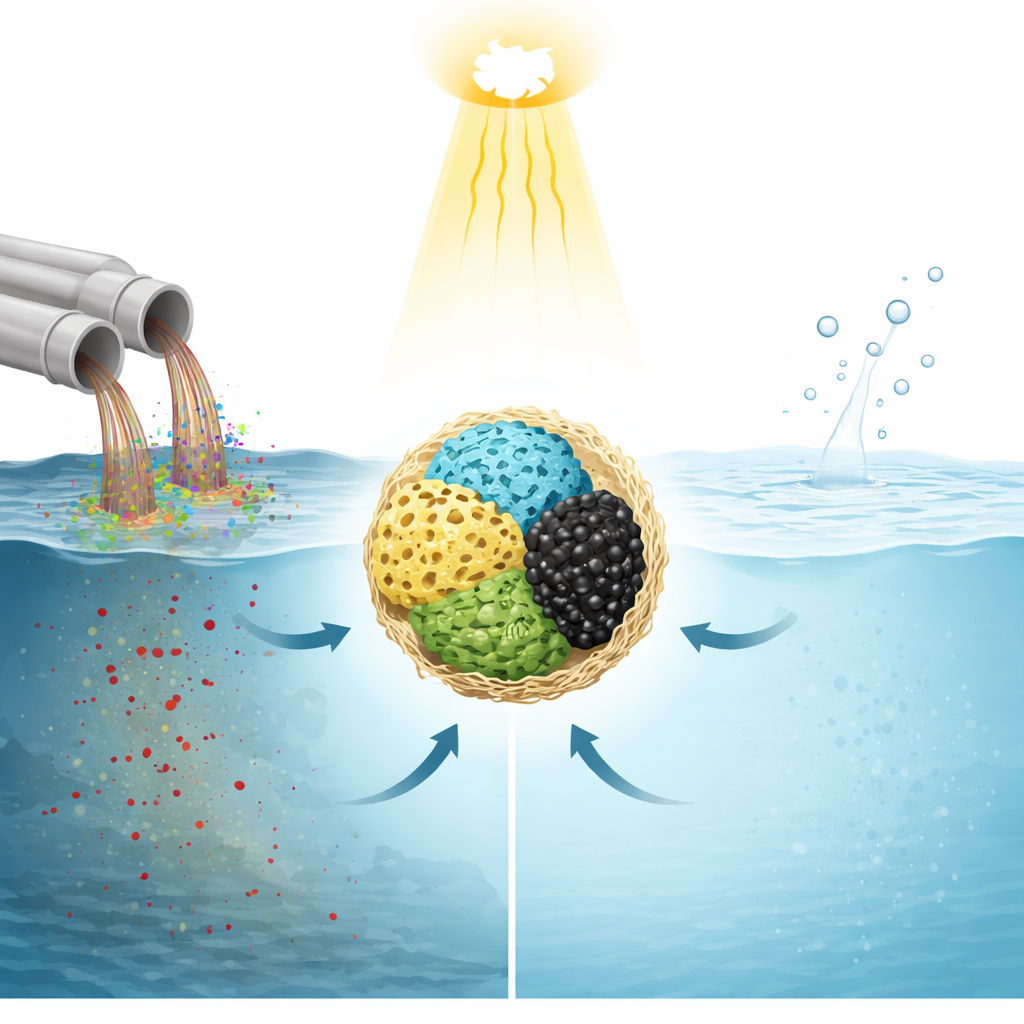
Colorful synthetic dyes make our clothes bright and our products attractive, but once they enter rivers and lakes they can linger for years, harming fish, plants, and even human health. This study explores a new, eco‑minded material that uses light to break down two common and persistent dyes in water, offering a promising route toward cleaner wastewater from textile and related industries.
Why Some Dyes Refuse to Disappear
Methylene Blue and Methyl Orange are widely used dyes that are chemically stable and difficult to remove once they reach waterways. Even at low levels, they can block sunlight in rivers, disrupt food chains, and pose risks such as irritation, toxicity, or even cancer. Conventional treatment methods—like simple filtration, settling, or biological breakdown—often struggle with these molecules or generate secondary waste. Scientists have therefore turned to photocatalysis, a process where special materials use light energy to trigger reactions that break complex pollutants into safer substances.
Building a Multifunctional Cleanup Sponge
The research team designed a single composite material that combines four different ingredients, each chosen for a specific job. Zinc oxide is a light‑sensitive semiconductor that generates reactive species under ultraviolet light. ZIF‑8, a metal–organic framework with a sponge‑like, highly porous structure, helps trap dye molecules near active sites. Activated carbon, made from coconut shells, adds extra surface area and serves as a conductive pathway for moving electrical charges. Nanocellulose, derived from rice straw, provides a strong and biodegradable scaffold that keeps the tiny particles well dispersed and prevents clumping. Blended together in a 2:1:1:1 ratio, these components form a hierarchically porous “heterostructure” that couples adsorption, light harvesting, and charge transport in one body.
How Light Turns the Composite into a Tiny Reactor
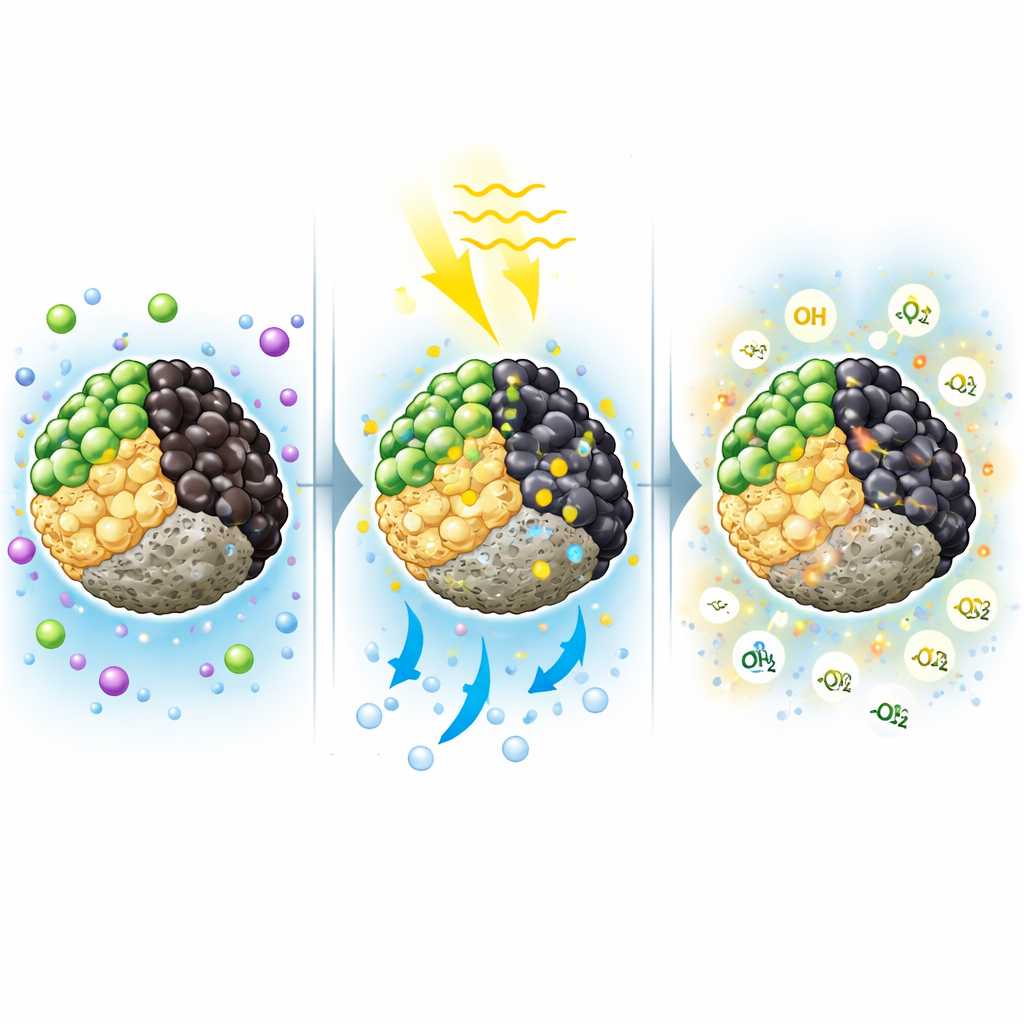
When this composite is mixed with dye‑contaminated water and exposed to ultraviolet light, several processes occur at once. First, the porous framework and carbon surfaces quickly adsorb dye molecules, concentrating them on and within the material. At the same time, zinc oxide absorbs the light and creates separated negative and positive charges. Activated carbon and nanocellulose help shuttle these charges and keep them from recombining too quickly, which would waste the captured light energy. Instead, the charges react with water and dissolved oxygen to form highly reactive species that attack the dye molecules, fragmenting them into smaller, less harmful products. The material’s surface charge, which shifts with pH, also influences how strongly it attracts positively or negatively charged dyes, making conditions around neutral pH particularly effective.
Putting the New Material to the Test
The scientists carefully characterized the structure and chemistry of their composite, confirming its large surface area, interconnected pores, and stable combination of all four components. In reactor tests under controlled ultraviolet light, the material removed about 92% of Methylene Blue and 87% of Methyl Orange within an hour at neutral pH, modest temperature, and a relatively low catalyst dose. These results clearly surpassed the performance of any single ingredient on its own. Analysis of how quickly the dyes disappeared suggested that the reaction depends strongly on interactions at the material’s surface, while adsorption studies showed that the dyes form a well‑ordered, single layer on the composite before being degraded. The process was spontaneous and released heat, and the material retained most of its activity over five reuse cycles, even in more realistic water samples containing salts, natural organic matter, and simulated industrial effluent.
A Step Toward Greener Wastewater Treatment
To a non‑specialist, the message of this work is that a smartly engineered, plant‑based support carrying light‑activated particles can act like a reusable sponge and micro‑reactor that both captures and destroys stubborn dyes in water. By pairing efficient photocatalysts with sustainable ingredients from agricultural waste, the composite offers a practical and environmentally friendly option for cleaning industrial wastewater. With further development under sunlight and real factory conditions, materials of this kind could help turn bright but problematic dye pollution into a more manageable challenge for future water treatment systems.
Citation: Nassar, A.A., El-Sawaf, A.K., Ali, A.O. et al. Sustainable nanocellulose-supported ZIF-8/ZnO/activated carbon heterostructures enhance charge separation for efficient photocatalytic dye remediation. Sci Rep 16, 14045 (2026). https://doi.org/10.1038/s41598-026-47425-6
Keywords: wastewater treatment, photocatalysis, dye pollution, nanocellulose composites, activated carbon