Clear Sky Science · en
Study on pressure-relief effect and protection scope of long-distance lower protective seam mining based on similar physical simulation and PFC3D
Why safer coal mining matters
Coal still powers much of China’s electricity, but digging it out of the ground can trigger sudden bursts of gas and rock that endanger miners. This study looks at how mining one coal seam deep underground can gently relieve pressure in another seam above it, making gas easier to drain and the next round of mining safer. By combining physical models in the laboratory with advanced computer simulations, the researchers map out how the rock between the seams cracks, bends, and settles as mining progresses.
Two coal layers working together
The work focuses on the No. 6 Coal Mine in Henan Province, where a deeper seam known as Wu 8 lies about 72 meters below an upper seam called Ding 5.6. The idea is to first mine the lower seam as a “protective seam.” When this seam is removed, the weight of the overlying rock shifts, changing pressure in the upper seam and opening tiny pathways for trapped gas to escape. If engineers can predict where and how far this pressure-relief effect reaches, they can place gas-drainage boreholes and plan future mining in the upper seam more safely and efficiently.
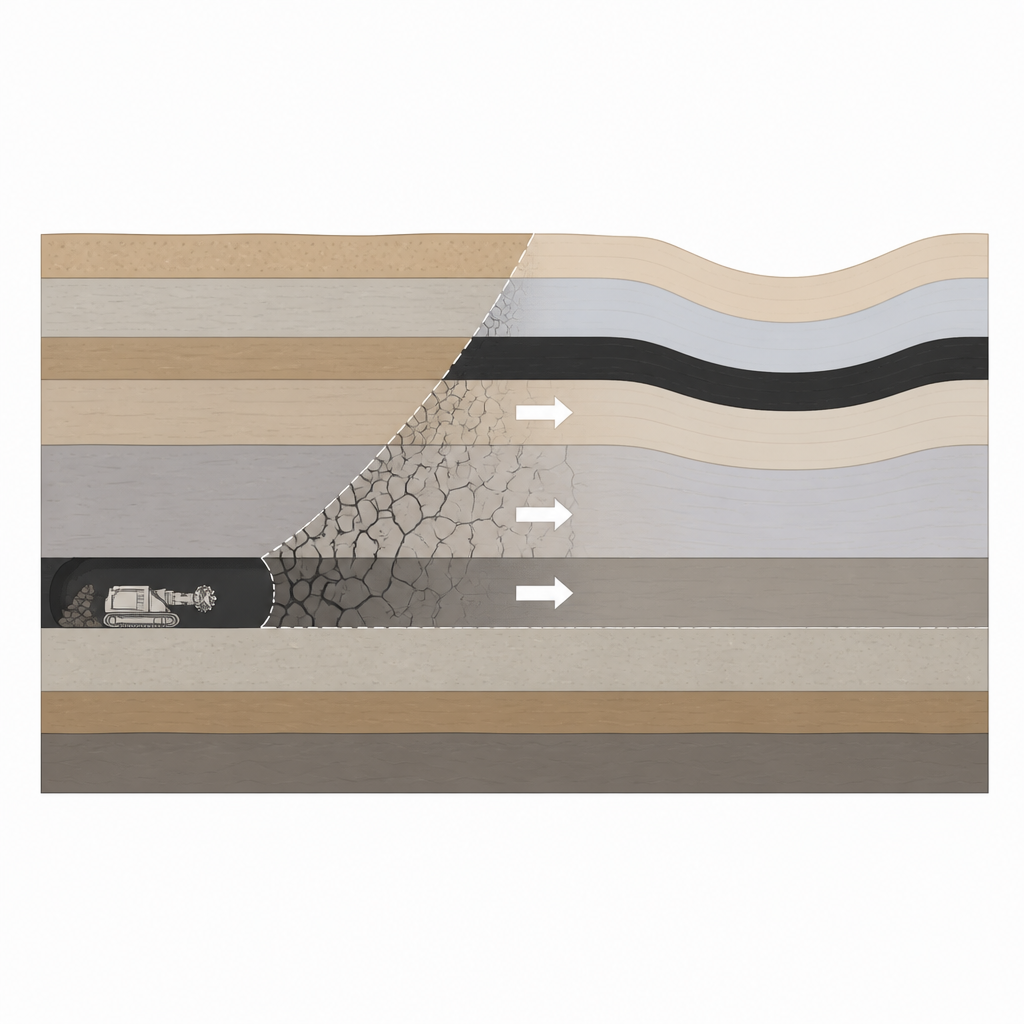
Scaled-down mine in the lab
To watch what happens out of sight underground, the team built a large physical model about three meters long and one and a half meters high that mimics the real rock layers above the Wu 8 seam. Using sand, gypsum, calcium carbonate, and mica to represent different rock types, they recreated the stacked layers and then “mined” the lower seam step by step. As the model’s working face advanced, they observed how the overlying rock caved in and where cracks opened. The fractures formed a broad trapezoid that grew upward and outward, passed through stages of initiation and growth, and then partly closed again as broken rock compacted.
Virtual rocks and invisible forces
Laboratory models cannot capture every detail, so the researchers also used three-dimensional particle-based computer simulations, known as PFC3D, to track stress and fracture patterns throughout the rock mass. In this virtual mine, the rock and coal are represented by thousands of small bonded particles whose interactions follow the laws of motion. As the simulated working face advances, the program records how vertical and horizontal stresses change at different heights, how fractures connect into networks, and how the upper coal seam moves. The results show that vertical stresses near the mined-out area spike to about four times the horizontal stresses, and then drop, carving out a pressure-relief zone that narrows with height and takes on a trapezoidal platform shape above the goaf.
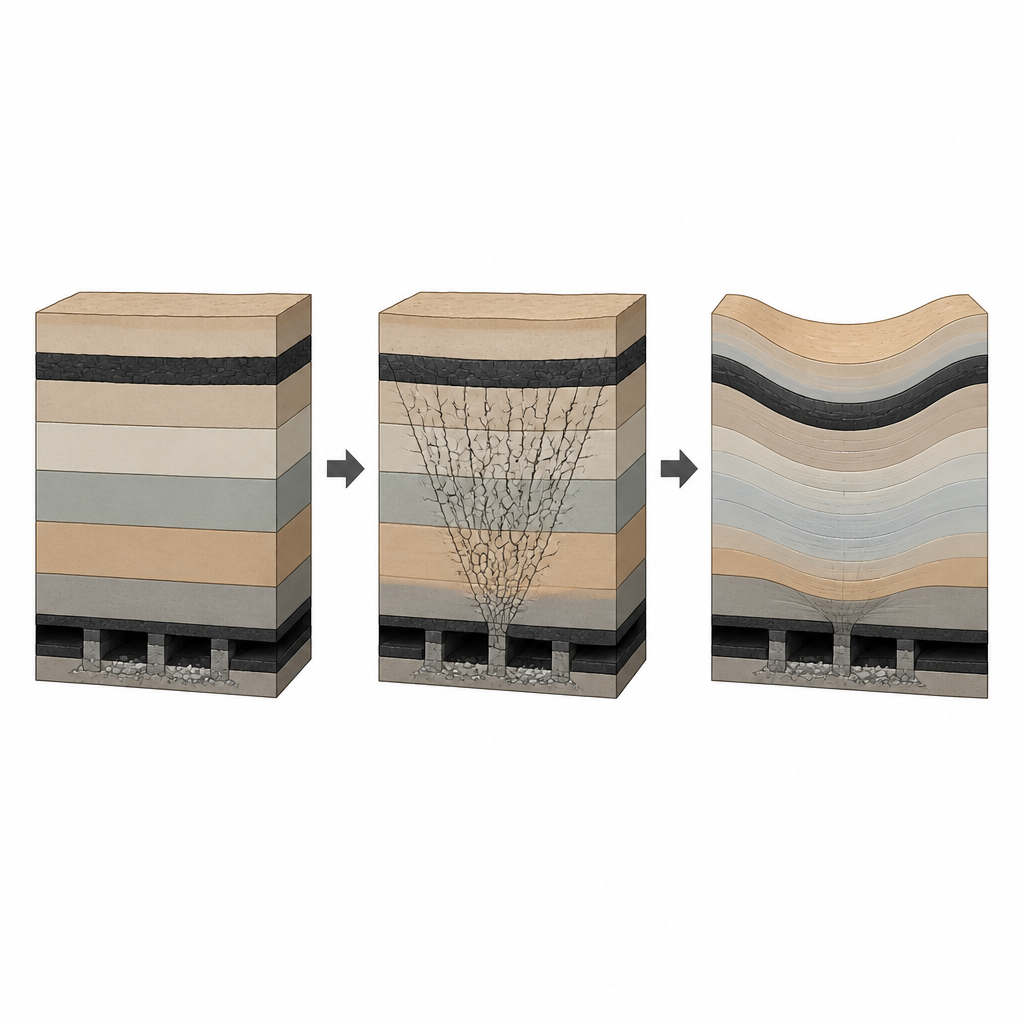
How the upper seam bends and stretches
The simulations also reveal how the protected Ding 5.6 seam deforms. Its displacement pattern gradually turns into a bowl-shaped sag above the mined-out lower seam. Early on, when the working face has advanced less than half its length, the subsidence is small and shaped like an ellipse. As mining continues, the sag deepens and widens, with the greatest drop directly above the center of the goaf. Eventually, the bottom of the “bowl” flattens as the overlying rock compacts and the rate of additional subsidence slows. By tracking the change in thickness of the protected seam, the team calculates an expansion deformation rate; when this rate exceeds a threshold value, the coal is considered fully pressure-relieved and much less likely to fail violently.
Drawing a safe zone underground
Combining deformation and stress results, the authors outline the three-dimensional shape of the effective pressure-relief protection zone. They find that the relaxed region in the upper seam does not extend exactly above the mined area but is shifted inward along both the length and the width of the working face. Along the length, the protected zone starts and ends about 35–40 meters inside the actual mining limits; along the width, it is set back by roughly 11–14 meters. Within this offset region, the vertical stress falls below a critical value of about 16.9 megapascals and the expansion deformation rate exceeds the standard used in Chinese safety rules. In practical terms, the study provides mine planners with clear angles and distances that mark where gas drainage and future extraction of the upper seam can proceed with reduced risk of coal and gas outbursts.
Citation: Zhan, K., Liu, Z., Wei, D. et al. Study on pressure-relief effect and protection scope of long-distance lower protective seam mining based on similar physical simulation and PFC3D. Sci Rep 16, 15927 (2026). https://doi.org/10.1038/s41598-026-47414-9
Keywords: coal seam mining, gas drainage, rock fractures, mine safety, numerical simulation