Clear Sky Science · en
Differential reservoir formation mechanisms of shale oil reservoirs in the Qingshankou Formation, Cretaceous system, Songliao Basin
Why rock pores matter for future oil
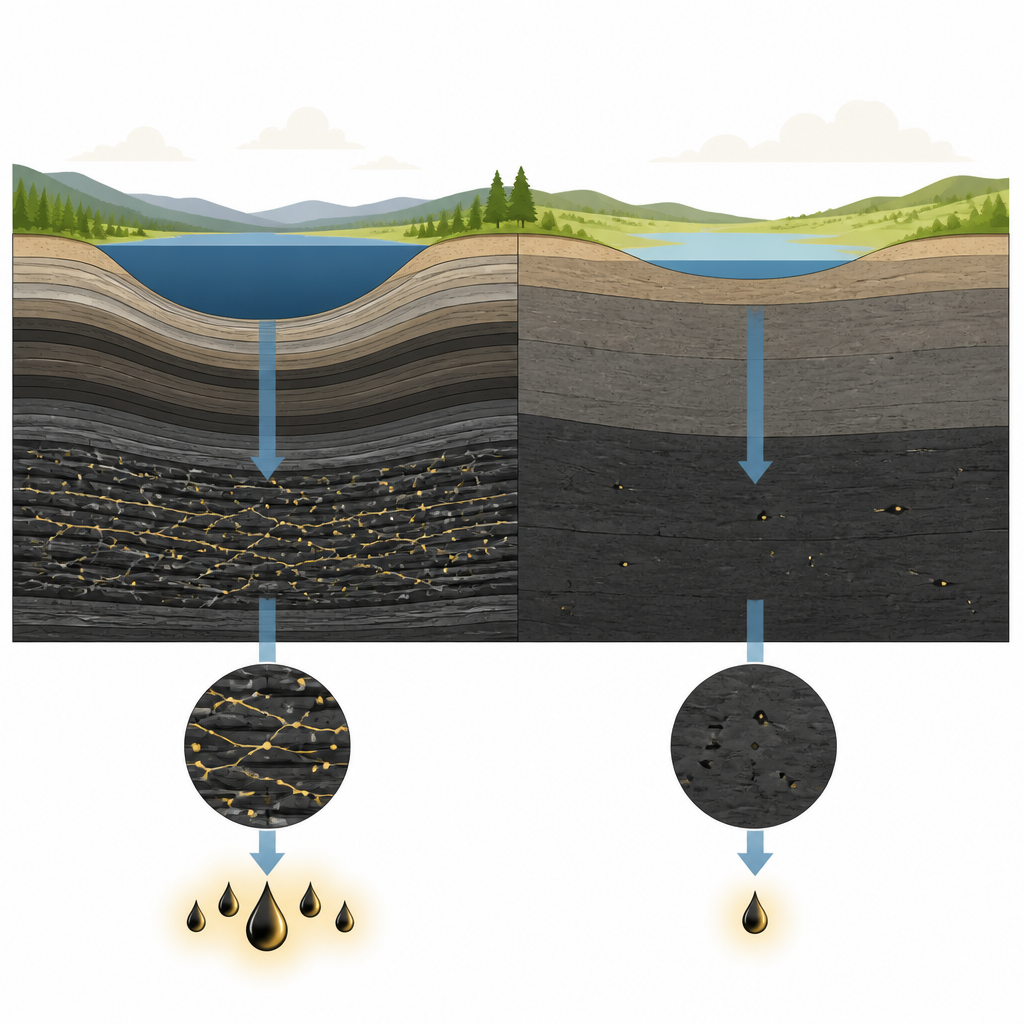
Far below northeastern China, two layers of the same ancient rock hold very different fortunes for shale oil. In one area, oil flows well enough to support industry. In a nearby field, the same rock unit is rich in organic matter but struggles to yield usable oil. This study looks closely at why these sibling rocks behave so differently, and what that means for finding and producing shale oil more efficiently and with fewer wasted wells.
Two neighboring rock stories
The research examines the Qingshankou Formation, a Cretaceous age package of mudstone and shale in the Songliao Basin. One focus is the well-known Gulong area, where deep lake deposits and fine layering have already produced stable oil flows. The other is the Lamadian Oilfield, on a nearby slope, which shows good resource potential on paper yet has not delivered similar results. By comparing these two settings, the authors aim to uncover which rock features truly control shale oil content and how easily that oil can move.
How minerals and layers shape the rock
Detailed imaging and chemical tests reveal that the Lamadian rocks contain abundant hard minerals such as feldspar along with plenty of clay and moderate amounts of carbonate. However, their internal layering is simple and often poorly developed. Most of the rock is massive felsic mudstone, with only a smaller portion made up of thinly layered shale. In contrast, the Gulong area formed in deeper, calmer water that favored many types of thin laminae rich in carbonates, clay, and organic matter. These subtle differences in how sediment arrived and settled on the lake floor created very different starting architectures for pores and fractures.
Pores, fractures, and trapped oil
At the scale of grains and pores, the contrast becomes sharper. In Lamadian, pore space is dominated by tiny gaps between clay particles. These nanopores are small, scattered, and often poorly connected, because the soft clay was squeezed during burial and later filled partly by new minerals. Fractures that could connect pores are rare. As a result, overall porosity is low, especially in the massive mudstone, and there are few pathways for oil to migrate. In the layered shale intervals, stiff mineral bands help preserve somewhat more pore space and allow some lamination-parallel cracks, but these better zones make up only part of the formation and still lag behind Gulong in pore size and connectivity.
Oil quality and movement in the rock
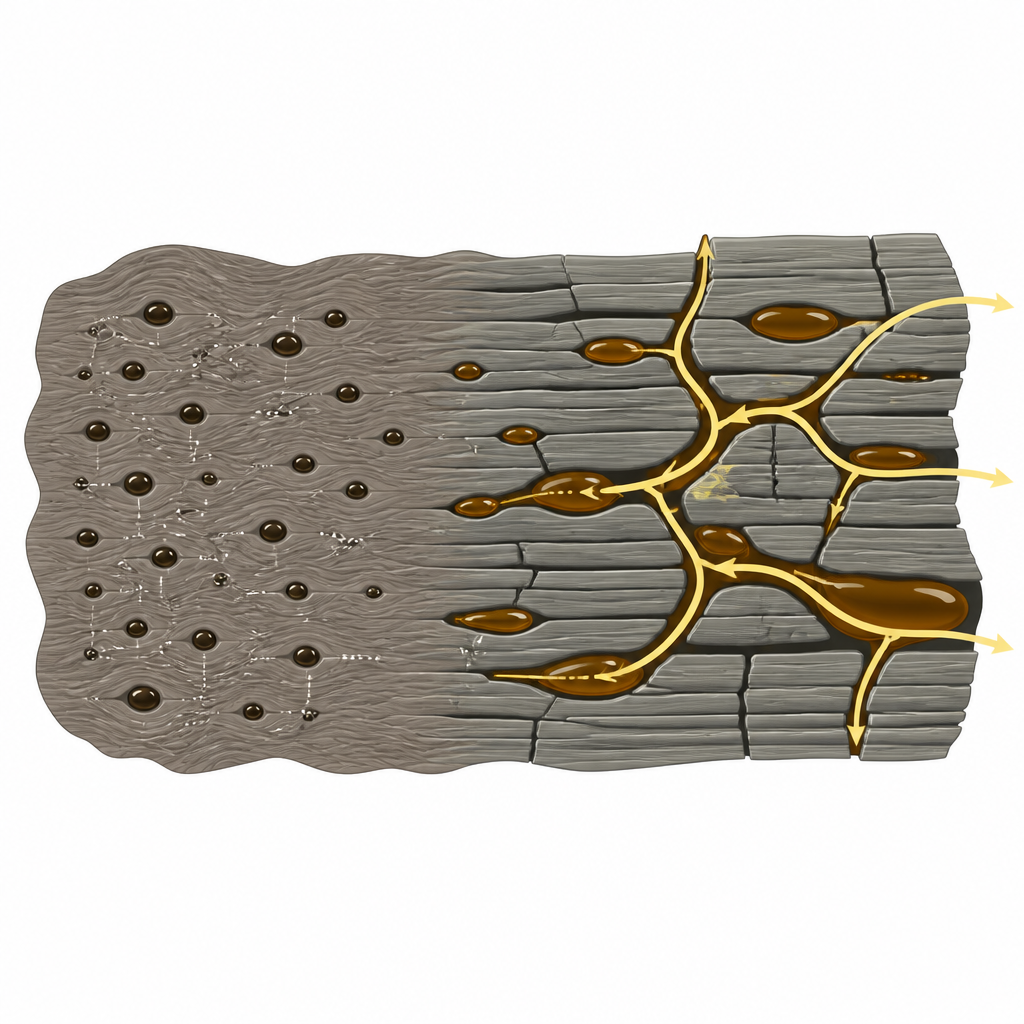
Using laser confocal microscopes, the team mapped where oil actually sits inside the rocks and how its lighter and heavier parts are arranged. In Lamadian, oil mainly occupies those tiny clay-related pores and appears as a dispersed, heavy blend with low proportions of light components. Very little free oil can move, and most hydrocarbons are effectively stuck. In Gulong, higher thermal maturity, larger pores, and better-developed fractures allow lighter oil to gather in micrometer-scale pores and microcracks. There, oil can migrate over short distances and concentrate in zones that produce well. The study also finds that while Lamadian has more organic carbon overall, that advantage is offset by its lower maturity and less favorable pore network.
Linked controls on a complex resource
Putting these pieces together, the authors describe four linked controls on shale oil behavior. The original lake environment sets the mix of minerals and layering. Later alteration of the rocks decides whether pores are preserved or destroyed. Tectonic forces determine how many fractures form and how well they connect to pores. Finally, the burial and heating history controls how much oil is generated and how light or heavy it is. In Gulong, these factors combine into a “pore and fracture working together” system that supports mobile oil. In Lamadian, they lead to a “nanopore dominated” system where oil is widely present but largely immobile. For industry, this means that the same named formation can behave like two very different reservoirs, and development strategies must be tailored to each rock story rather than copied from one field to another.
Citation: Qi, Y., Chengwu, X., Tingting, L. et al. Differential reservoir formation mechanisms of shale oil reservoirs in the Qingshankou Formation, Cretaceous system, Songliao Basin. Sci Rep 16, 16127 (2026). https://doi.org/10.1038/s41598-026-47411-y
Keywords: shale oil, reservoir pores, Songliao Basin, Qingshankou Formation, oil mobility