Clear Sky Science · en
A broadband Terahertz metamaterial absorber enabled by a water-assisted square-pyramid architecture with optical transmittance
Windows that hush invisible waves
Most people think of windows as things you see through, not as tools for taming invisible radiation. Yet in the terahertz range of the spectrum, where future radar and high-speed wireless links may operate, unwanted waves can leak through and cause interference. This research explores a way to build clear panels that still let visible light pass while quietly soaking up terahertz waves across a very wide range of frequencies.
Why we care about terahertz waves
Terahertz waves sit between microwaves and infrared light and are drawing attention for security scanners, short-range communication, and imaging systems. As these technologies spread, engineers need materials that block stray terahertz signals without turning into shiny mirrors or dark barriers. Conventional terahertz absorbers often rely on metals or other conductors that also block visible light, which makes them unsuitable for uses such as aircraft canopies, display covers, or smart windows that people still need to look through.
A clear pyramid forest made of water
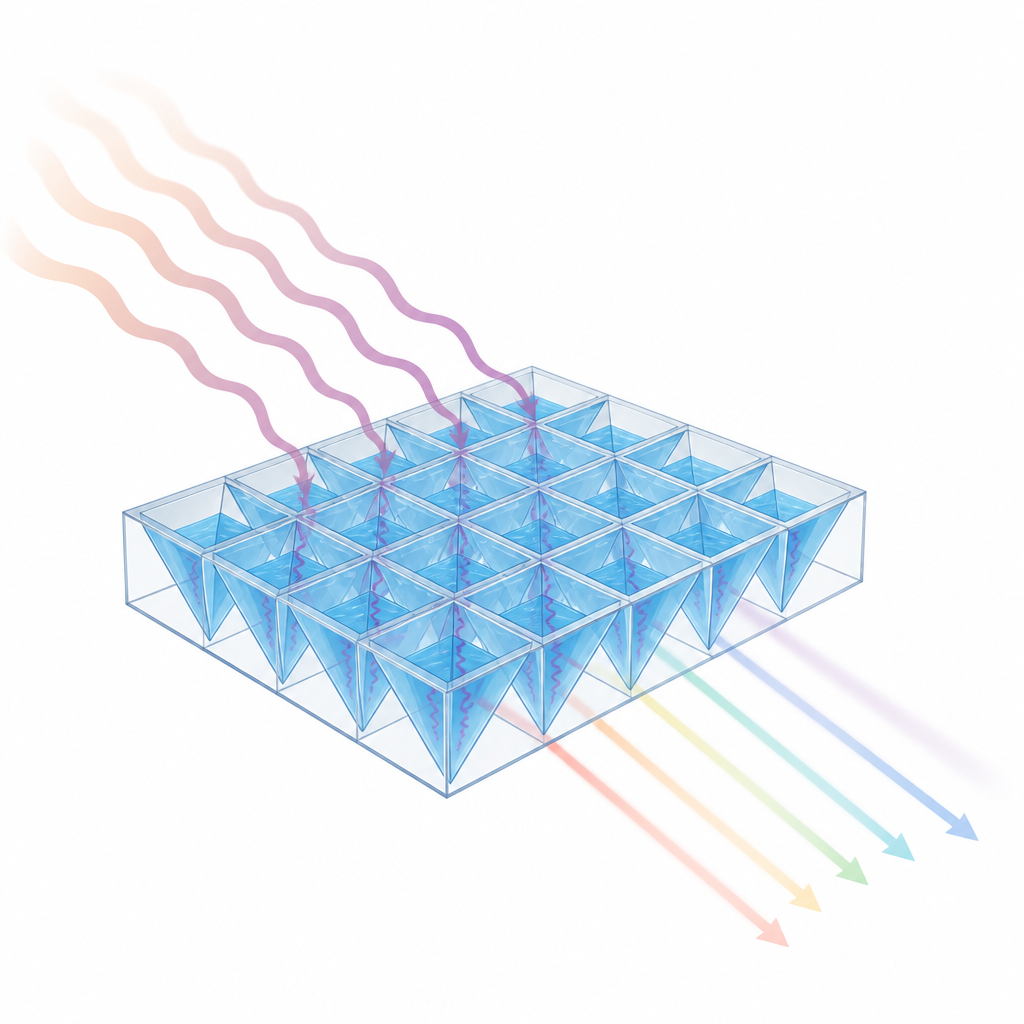
The team designed a new type of absorber that looks, in concept, like a flat sheet covered with tiny clear square pyramids. Each pyramid is a hollow shell made from transparent plastic, filled with ordinary liquid water, and backed by a thin layer of indium tin oxide, a see-through conductor widely used in touchscreens. All three ingredients are transparent in the visible part of the spectrum, so a person can still see through the panel, but together they interact strongly with terahertz waves.
How the tiny shapes trap invisible energy
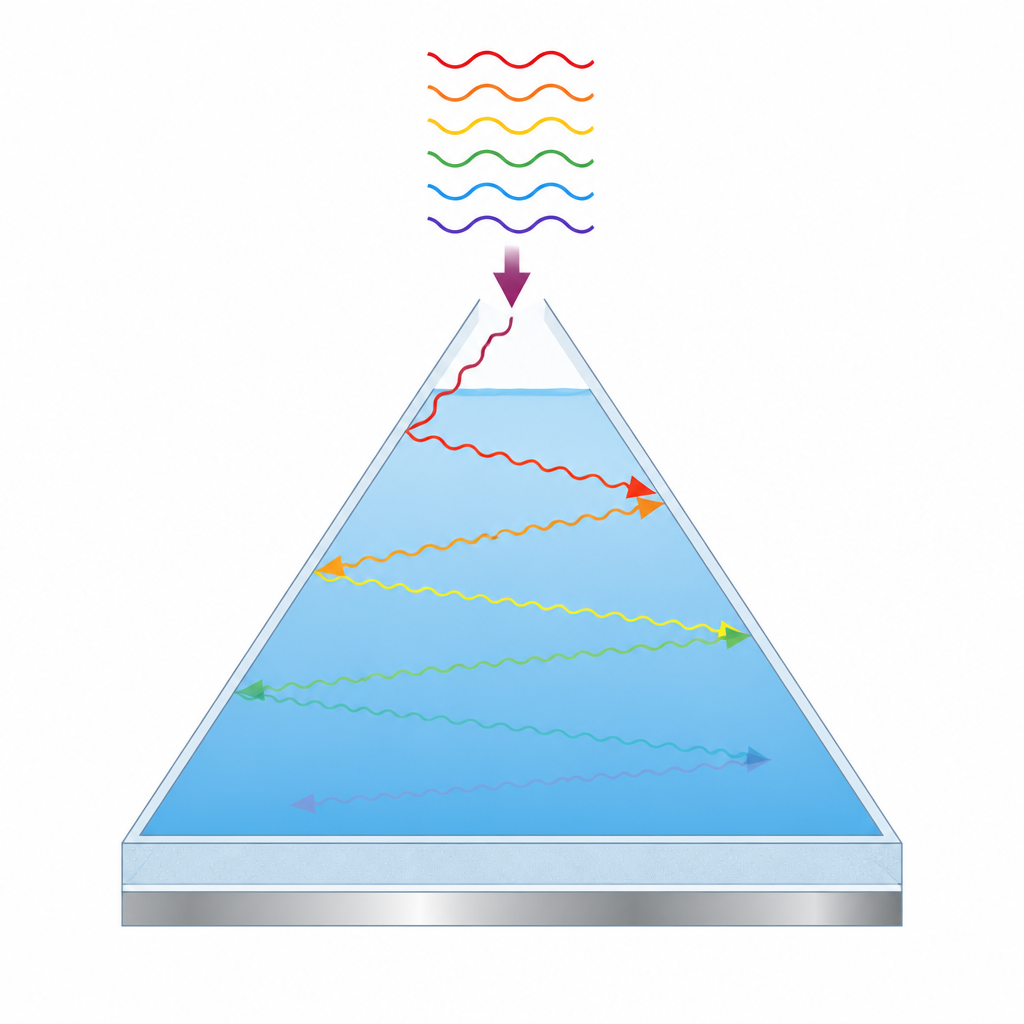
The pointed pyramid shape gently guides incoming terahertz waves from air into the water, rather than reflecting them like a flat surface would. As the waves travel down and up along the sloping sides, they bounce many times inside the water, overlapping and interfering in ways that keep more energy inside the structure. Water itself is naturally lossy in the terahertz range, meaning it turns the trapped wave energy into heat. Simulations show that this combination of graded shape and watery interior leads to extremely strong absorption across a huge band of frequencies, from 0.5 to 10 terahertz, with most of that range above 95 percent absorption.
Stable performance in the real world
For any shielding panel to be useful, it must work for waves coming in from many directions and with different polarizations, not just under ideal lab conditions. The square layout of the pyramids makes the absorber respond almost the same way to different polarization states, whether the electric field direction is rotated in the plane or the wave spins in a circular fashion. The structure also keeps more than 90 percent absorption across at least 7 terahertz of bandwidth even when waves strike at angles up to 70 degrees away from straight on. Tests that account for temperature changes within a typical outdoor range show only modest influence on performance, because the main effect comes from the geometry and multiple reflections rather than from narrow, delicate resonances.
What this could mean for future devices
By marrying simple materials like water and clear plastic with carefully shaped tiny pyramids, this work points to terahertz absorbers that are thin, broadband, and see-through to the human eye. Such panels could line the windows of vehicles, buildings, or instruments where designers want both a clear view and strong protection from stray terahertz radiation. While the study relies on computer simulations rather than large-scale prototypes, its results suggest a practical path toward transparent terahertz shielding that is easier to fabricate and more tolerant of viewing angle and temperature changes than many earlier designs.
Citation: Zhao, Y., Hu, P., Zhang, X. et al. A broadband Terahertz metamaterial absorber enabled by a water-assisted square-pyramid architecture with optical transmittance. Sci Rep 16, 15834 (2026). https://doi.org/10.1038/s41598-026-47406-9
Keywords: terahertz absorber, metamaterial, water-filled pyramid, optical transparency, electromagnetic shielding