Clear Sky Science · en
Modeling the association between illiteracy and poverty in Egypt: a comparative analysis of linear regression and ARDL approaches
Why Reading Skills Matter for Everyday Life
Being able to read and write is more than a classroom skill; it shapes who can get a decent job, follow health advice, or help children with homework. This study looks closely at Egypt over more than three decades to ask a simple but vital question: how closely are problems with basic reading and writing tied to the struggle to escape poverty? By tracking national data from 1990 to 2023 and applying two different statistical lenses, the authors show that illiteracy and poverty move together over time in ways that matter for policy, planning, and ordinary lives.
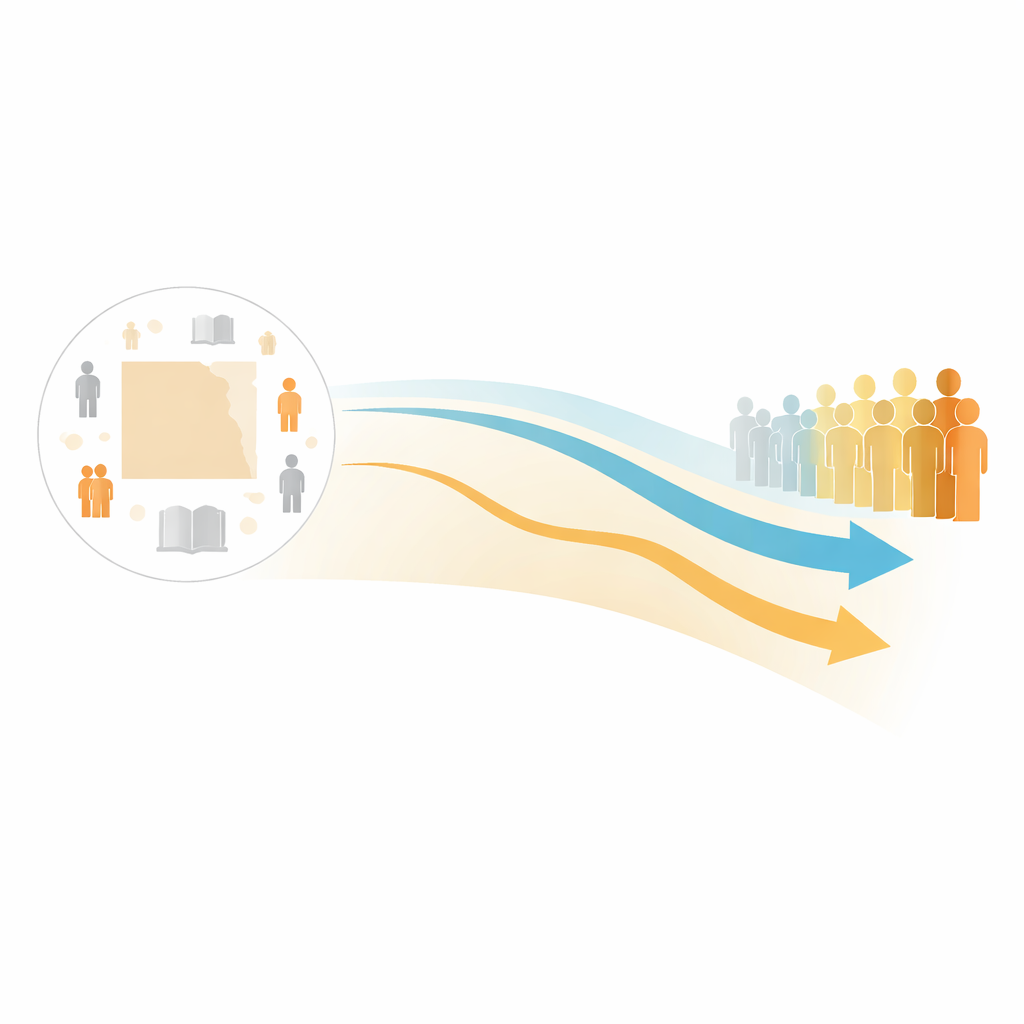
Three Pillars of a Better Future
The research is grounded in the broader idea of sustainable development, which balances economic progress, social well-being, and protection of the environment. In Egypt, stubborn poverty and high illiteracy sit right at the heart of the social pillar. The study notes that while economic indicators such as total national income and income per person have improved since the 1990s, poverty has remained a major concern. At the same time, efforts to expand schooling and adult education have pushed illiteracy rates down. When the authors place both trends on the same timeline, they find that falling illiteracy and changing poverty rates often move in tandem, hinting at a tight link between education and living standards.
Following Poverty and Illiteracy Across Time
To turn these patterns into evidence, the authors build a simple picture of the relationship between the share of Egyptians who cannot read or write and the share living below the national poverty line. First they use a basic straight-line model, which treats each year as if it were independent from the previous one. This approach suggests an apparent negative link, but it fails key statistical checks because it ignores the fact that poverty in one year is heavily influenced by what happened in earlier years. The large leftover patterns in the errors warn that this first model is misleading and that any quick conclusion based on it should be treated with caution.
Looking at Delayed and Lasting Effects
The second approach, called an autoregressive distributed lag model, is designed specifically to handle data that unfold over time. It allows today’s poverty level to depend both on earlier poverty and on current and past illiteracy rates. With this dynamic lens, a clearer and more intuitive picture emerges: higher illiteracy is associated with higher poverty, not just immediately but also as its effects accumulate. In the short run, a rise in illiteracy is linked to a noticeable increase in poverty over the next couple of years. In the longer run, the model suggests that sustained differences in reading and writing skills are tied to sustained differences in poverty, even though the formal test for a perfectly stable long-term bond is not fully decisive.

How Quickly Setbacks Are Corrected
A key feature of the dynamic model is an adjustment term that measures how fast the system moves back toward its typical path after a shock—such as a sudden change in schooling policies or an economic crisis. In Egypt’s case, the study finds that around one-fifth of any short-term gap between actual and typical poverty levels is corrected each year. This means that education-related shocks do not vanish overnight; their imprint on poverty can last many years, but the system does slowly pull back toward its long-run course. Careful diagnostic checks show that this richer model behaves well statistically: its errors are stable over time, roughly bell-shaped, and not strongly linked from one year to the next.
What It All Means for Ordinary Lives
For non-specialists, the core message is straightforward: in Egypt, difficulty with basic reading and writing is closely tied to the likelihood of being poor, both now and in the years ahead. While the study stops short of claiming that illiteracy alone causes poverty, it shows that changes in literacy levels help explain why poverty rises or falls and that quick, static snapshots miss much of this story. Because the dynamic model predicts poverty more accurately and captures delayed effects, the authors argue that efforts to cut poverty should treat literacy programs—not only income support or growth policies—as central tools. In practical terms, investments in schools, adult education, and fair access to learning can ripple forward through time, steadily shrinking poverty and supporting more stable, sustainable development.
Citation: Alsebai Mohamed, M., Mohamed, A. Modeling the association between illiteracy and poverty in Egypt: a comparative analysis of linear regression and ARDL approaches. Sci Rep 16, 12740 (2026). https://doi.org/10.1038/s41598-026-47365-1
Keywords: illiteracy, poverty, Egypt, education policy, time-series analysis