Clear Sky Science · en
Design of a user-centered intelligent shoe cabinet for smart home hygiene using Kano–AHP–TRIZ
Cleaner homes start at the front door
Most of us think of the front door as the line between the outside world and the safety of home, but our shoes quietly carry dirt, bacteria, and moisture across that line every day. This study explores how an intelligent shoe cabinet can act as a hygiene gatekeeper, using sensors and smart controls to dry, disinfect, and neatly store shoes while still fitting into tight entryways and everyday routines.
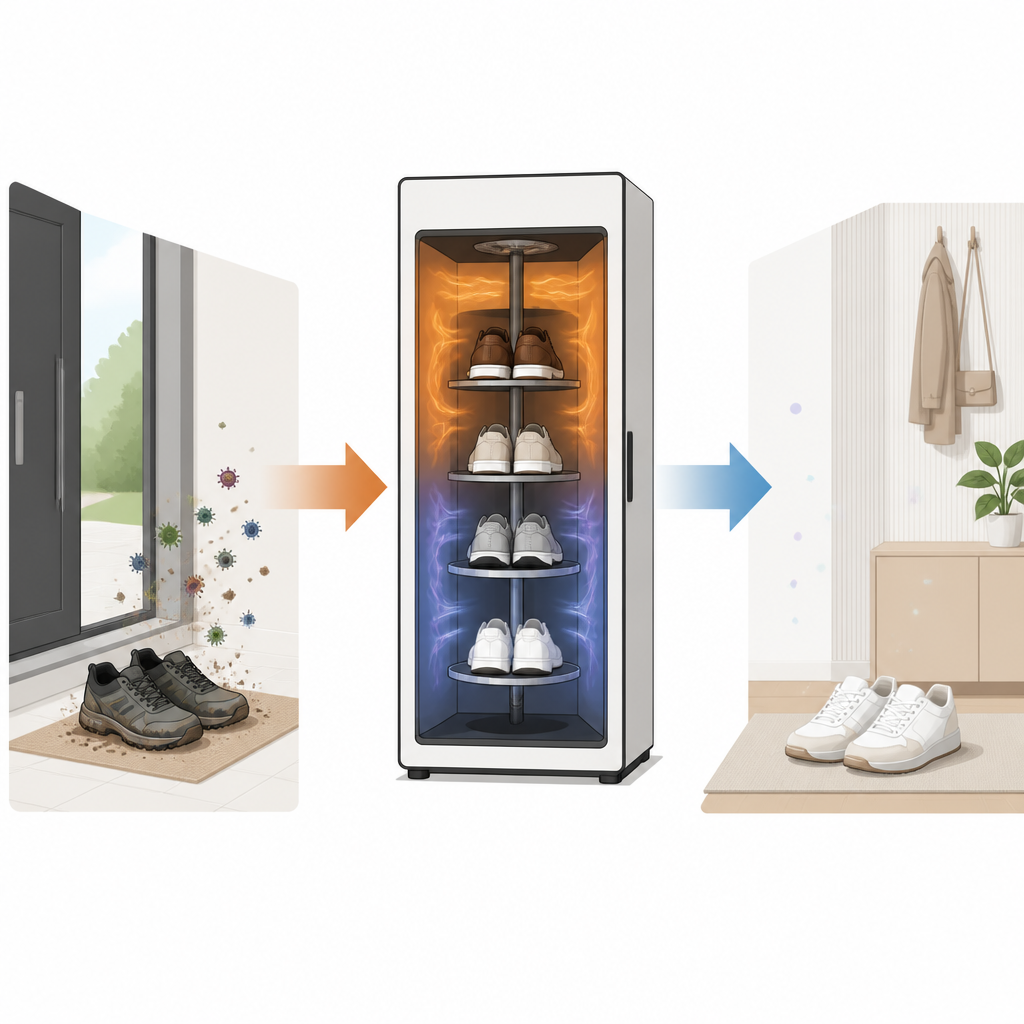
Why shoe storage now matters for health
The authors begin by outlining how smart home technology is spreading rapidly and how the entrance has become a key yet overlooked zone for hygiene. In many East Asian homes, people remove shoes at the door to keep floors clean and reduce exposure to germs that cling to soles. The COVID-19 pandemic and growing awareness of indoor air quality have strengthened this habit, while shrinking apartments and busy lifestyles have raised expectations for storage that saves space, controls odor, and works quietly in the background. Existing smart shoe cabinets add features such as heating or simple ultraviolet lights, but they are often noisy, waste energy, and feel like separate gadgets rather than well-thought-out parts of the home.
Listening carefully to what users really want
To avoid designing around technology alone, the team first mapped out what different groups of people actually expect from a shoe cabinet. They interviewed families with children and older adults, workers living alone, gym and care-center staff, allergy sufferers, and people who had abandoned earlier smart products. From these conversations they distilled 16 kinds of needs, from core ones like safety, quietness, and space efficiency to more advanced ones like automatic shoe retrieval and health monitoring. Using a method called the Kano model, they sorted each need into basics that must be present, features that directly boost satisfaction as they improve, and pleasant surprises that delight users but are not strictly required.
Turning wish lists into design choices
Next, the researchers had a panel of design experts compare these needs in pairs to judge which matter more when tradeoffs are necessary, a process known as analytic hierarchy weighting. This revealed that basic expectations carry the most weight, especially clear status prompts, safe construction, quiet and energy-saving operation, and clever use of space. Among the more exciting ideas, automatic shoe recognition and retrieval and strong sterilization and deodorization ranked highly, as did app-based remote control. This ranking gave the design team a structured roadmap: guarantee the basics first, then invest remaining resources in the features that most improve daily experience, while trimming low-impact extras.
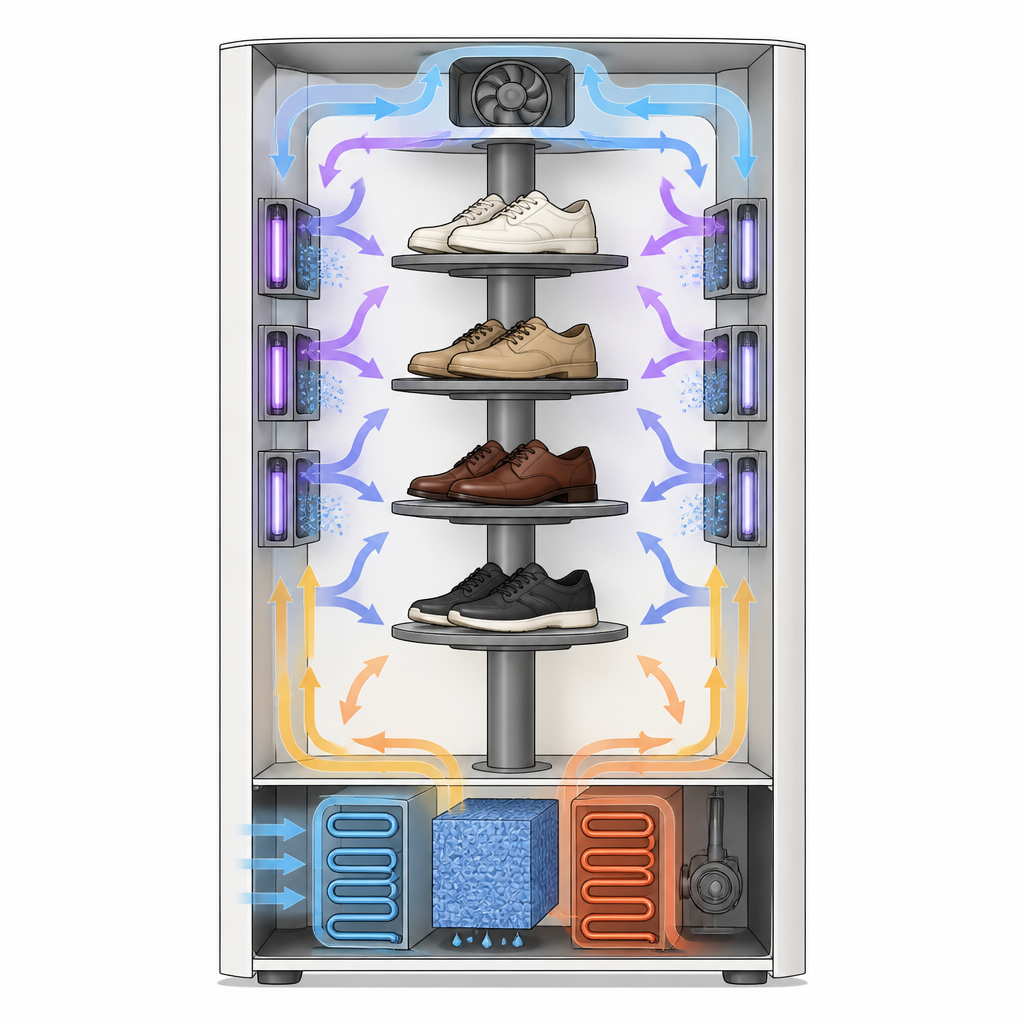
Solving clashes between comfort, space, and hygiene
Even with priorities set, some needs pulled in opposite directions. Powerful disinfection and fast drying usually mean more heat, air movement, and chemicals, which can raise energy use, noise, and safety concerns. Automatic shoe picking mechanisms make life easier but can eat up space and introduce new chances for failure or injury. To tackle these clashes, the authors used an innovation toolbox that catalogs common engineering conflicts and patterns of solution. Guided by this, they proposed a cabinet with a vertical rotating rack and sliding trays that pack many shoes into a small footprint, a hybrid low-temperature drying system that uses heat pumps and heat-storing materials, and a modular ultraviolet plus low-ozone unit placed inside sealed channels so that germs are exposed but people are not. Multi-layer safety checks, distance sensing, and gentle haptic feedback are used to keep voice and gesture control from triggering dangerous movements.
From concept sketches to everyday scenes
Drawing on the priorities and solution patterns, the team sketched a full product: a slim, modern cabinet with a front touchscreen and subtle lighting, housing a cylindrical rotating rack inside. Shoes can be recognized and delivered automatically to a pickup opening, and a spring-loaded heel support at the base helps users put on or remove shoes without bending deeply or needing assistance. Sensors track temperature, humidity, and air quality while an app allows remote control, scheduling, and maintenance reminders. The same core design can be placed in homes, gyms, or medical facilities to provide contact-free disinfection and drying where many people change footwear, turning the cabinet into a small environmental health station rather than simple furniture.
What this work means for future smart homes
To see how appealing their concept might be in practice, the authors asked experienced users and experts to rate the design on a five-level scale, then analyzed the results using fuzzy mathematics. The intelligent shoe cabinet scored in the “welcome” range, suggesting that people find the combination of safety, cleanliness, and convenience attractive. While the work stops at the conceptual and evaluation stage rather than testing full prototypes, it offers a reusable method for linking user wishes to technical solutions in a clear chain. In everyday terms, the study shows how a humble piece of furniture can evolve into a quiet, smart helper that keeps outdoor grime at the door and supports healthier, more comfortable homes.
Citation: Xu, R., Ma, L., Liu, J. et al. Design of a user-centered intelligent shoe cabinet for smart home hygiene using Kano–AHP–TRIZ. Sci Rep 16, 15493 (2026). https://doi.org/10.1038/s41598-026-47333-9
Keywords: smart shoe cabinet, home hygiene, smart home, user-centered design, IoT appliances