Clear Sky Science · en
Application of the LightGBM algorithm in cross-border supply chain risk management: prediction and mitigation strategy development
Why global supply chains need smarter risk tools
When you order a product from overseas, a hidden web of ships, warehouses, banks, and rules must all work together. Strikes, new trade policies, or wild swings in currency values can quickly turn this web into a tangle, delaying deliveries and costing companies money. This study explores how advanced data tools can watch that web in real time, spot trouble early, and suggest quick, cost aware responses to keep goods flowing.
Seeing the whole network, not just one link
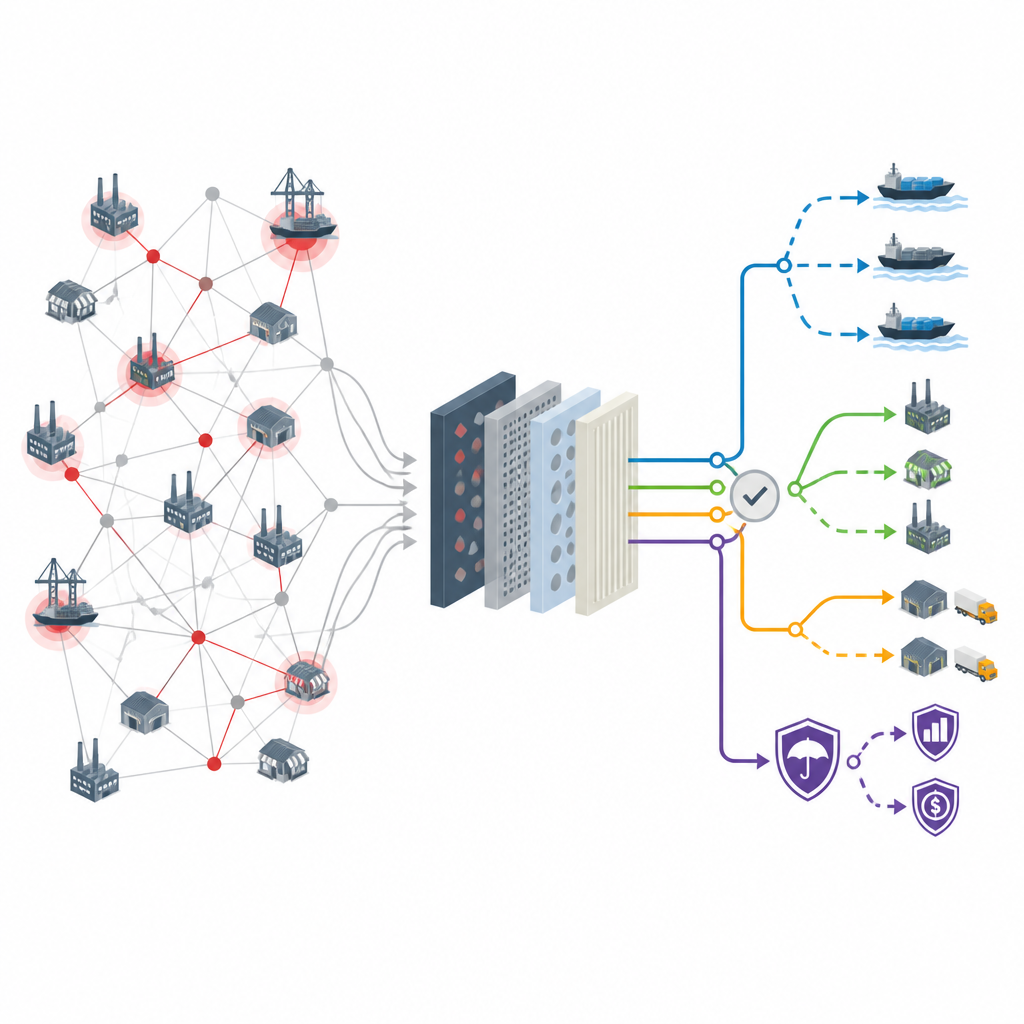
The authors focus on cross border supply chains, where goods move between countries and are exposed to many kinds of risk at once. Traditional methods often look only at past numbers or treat each supplier or warehouse as if it were isolated. In reality, a delay at one port or a sudden policy change in one country can ripple through many partners. To better reflect this, the study models the supply chain as a living network of suppliers, transport hubs, and sales regions, connected by flows of orders, money, and risk.

Turning messy data into early warnings
Using order records from a large Brazilian retailer, the researchers combine several modern algorithms into a single risk assessment system. One part focuses on the shape of the network and how problems can move from one partner to another. Another part studies how events unfold over time, using sliding time windows to pay attention to recent changes without forgetting the past. These pieces are blended and then fed into a specialized decision tree model that is good at handling many mixed types of data, such as delivery delays, exchange rates, and past compliance issues.
Finding weak points and paths of trouble
Beyond predicting whether a disruption is likely, the system also aims to explain where and how risk travels. To do this, it calculates how much each company, route, or factor contributes to an overall warning score, using a method borrowed from game theory. It then traces the most sensitive paths through the network, highlighting the nodes and links where a problem is most likely to spread. This helps managers see which suppliers, ports, or regions act as hubs of vulnerability, rather than treating the output as a black box alert.
From warning to action in minutes
Prediction alone is not enough, so the authors add a strategy engine that suggests concrete responses. This engine treats each moment as a decision step: it looks at the latest risk signals, the shape of the network, and outside conditions, then chooses among actions such as rerouting shipments, switching to backup suppliers, or adjusting currency hedging. Using a trial and feedback method, it learns to balance three goals at once: cutting expected losses, reacting quickly, and staying within policy rules. In tests, it cut the average response time to about fifteen minutes and reduced estimated losses more than simpler rule based systems.
What the results mean for everyday trade
The framework outperformed several common models, reaching about ninety two percent accuracy in predicting risk and showing clear gains when it used all types of data together. Case studies involving port strikes, currency swings, and tariff shifts suggest that the approach can shorten outages and control extra costs in realistic settings. For non specialists, the key message is that treating the supply chain as a connected, evolving system and letting algorithms both forecast risk and propose responses can make international trade more resilient, even as the world grows more uncertain.
Citation: Xi, D., Nie, V. & Li, W. Application of the LightGBM algorithm in cross-border supply chain risk management: prediction and mitigation strategy development. Sci Rep 16, 16194 (2026). https://doi.org/10.1038/s41598-026-47327-7
Keywords: supply chain risk, cross border trade, machine learning, logistics disruption, risk mitigation