Clear Sky Science · en
Synthesis and biological study of thiopheneyl/piperazinl-α-aminophosphonate-chitosan conjugates as biologically active carriers for controlled delivery of curcumin
Why this matters for future medicines
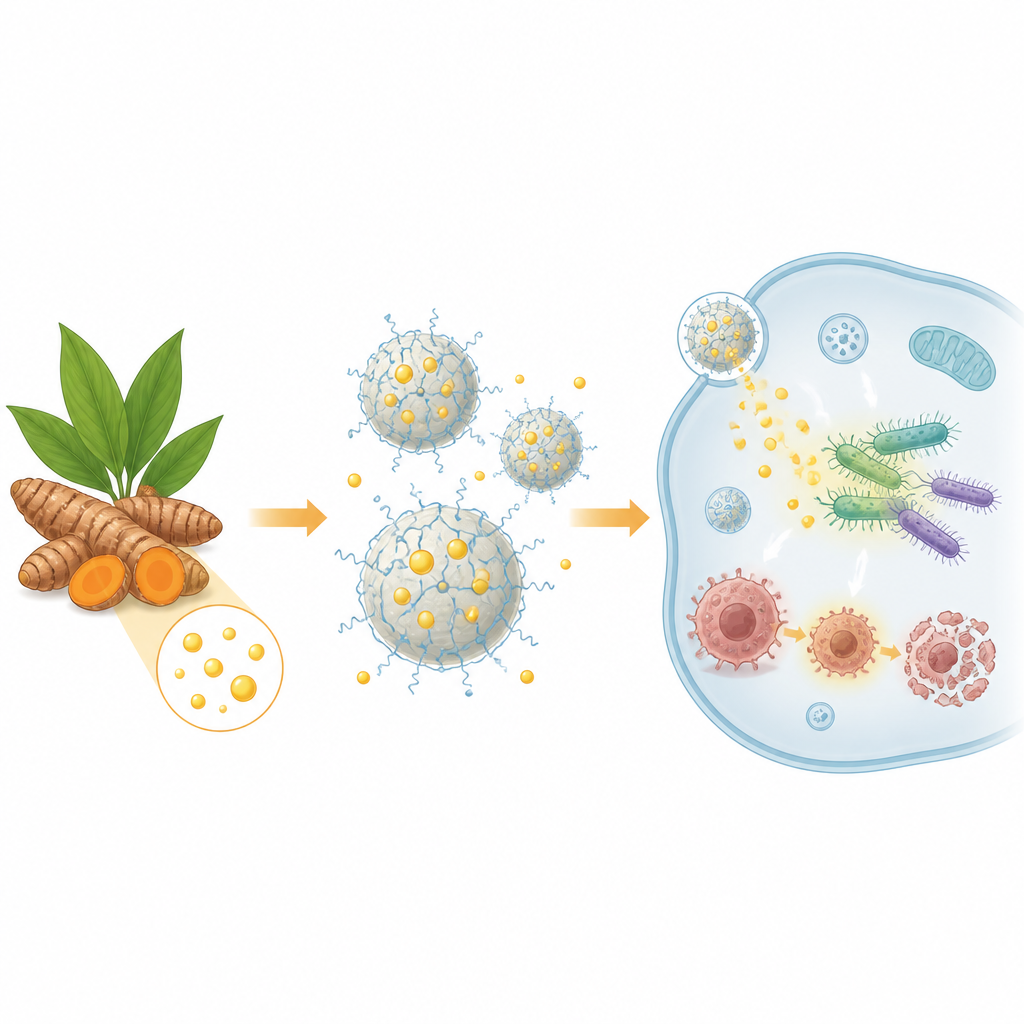
Many powerful natural compounds, such as the yellow spice ingredient curcumin, struggle to reach diseased tissues in the body because they dissolve poorly in water and break down too quickly. This study explores a new way to package curcumin inside a biopolymer derived from crustacean shells, aiming to deliver it more steadily to cancer cells while also fighting harmful bacteria.
Building smarter carriers from a natural sugar
The researchers started with chitosan, a sugar-based material already used in wound dressings and experimental drug carriers. On this backbone, they chemically attached special side groups known to interact well with biological targets and metals. By reacting chitosan with two types of small linkers, based on thiophene and piperazine rings, and with different phosphorus-containing building blocks, they created six new versions of chitosan. Laboratory techniques that probe how molecules vibrate and how their atoms are arranged confirmed that these side groups were firmly attached and that the new materials were more resistant to heat than plain chitosan, an advantage for processing and storage.
Trapping and releasing curcumin over time
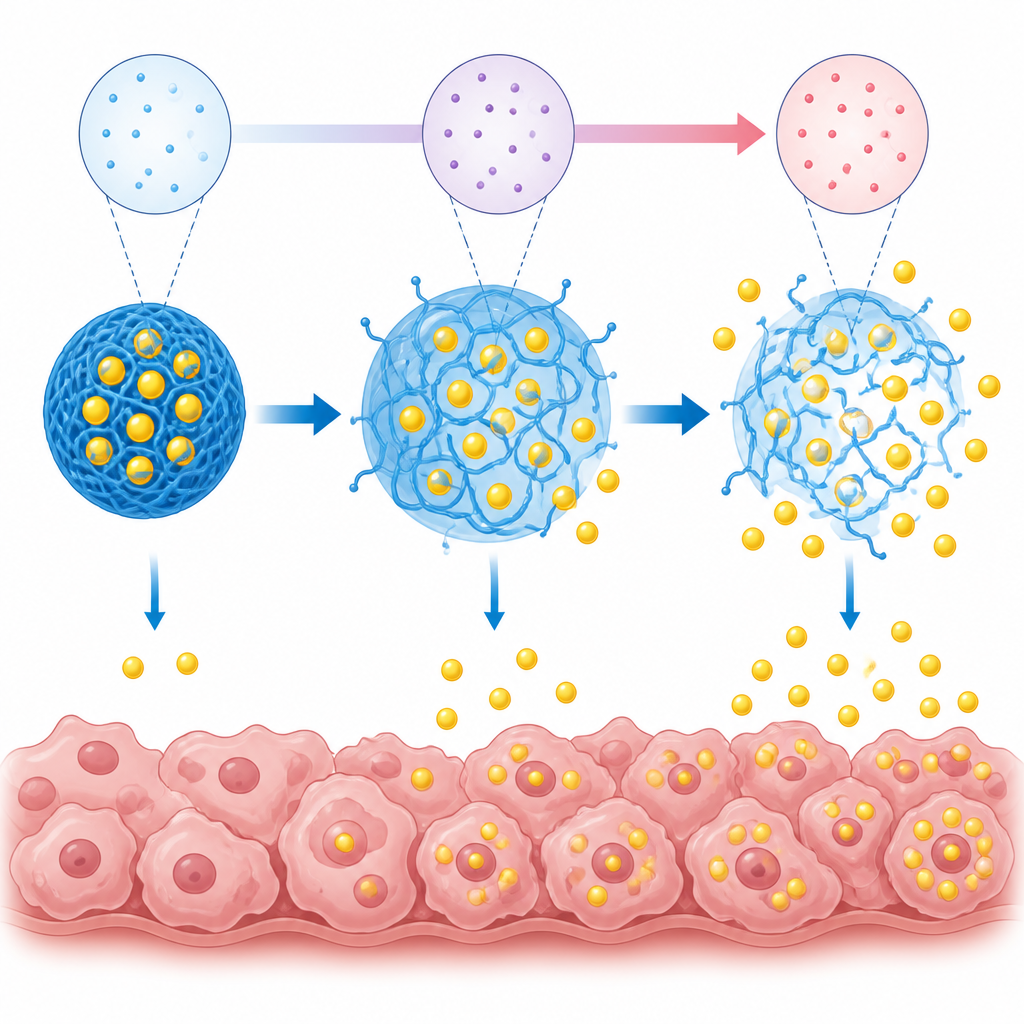
The team then tested how well each material could hold curcumin and let it go in a controlled way. Four of the six new chitosan versions were able to take up meaningful amounts of curcumin from solution. One piperazine-based version stood out, loading more than three quarters of its weight in curcumin, higher than many earlier chitosan systems. Experiments in water-like salt solutions that mimic blood and the slightly acidic environment often found around tumors showed that these carriers swell when exposed to water, and that the extent of swelling depends strongly on the exact chemical groups on the chains. The best-loading carrier swelled the most, especially under acidic conditions, and released curcumin faster as a result, while other versions released the drug more evenly over many days.
pH sensitivity and steady release
To understand how curcumin leaves the carriers, the scientists compared the release data with mathematical models commonly used in pharmacy. For most of the thiophene-based carriers, the amount of drug released increased almost linearly with time, indicating a nearly constant release rate largely driven by slow diffusion through the material. The standout piperazine-based carrier behaved differently: its release followed a pattern expected when drug molecules move through a swollen, water-filled network. Across all systems, a key feature was pH sensitivity. At the mildly acidic level typical of many tumors and inflamed tissues, swelling and release were generally higher than at normal blood pH, suggesting that these carriers could deliver more curcumin where it is most needed while remaining relatively stable elsewhere.
Fighting germs while targeting cancer cells
Beyond drug delivery, the new chitosan materials showed their own biological activity. When tested against several disease-causing bacteria, especially species that are problematic in food safety and hospital infections, all of the materials showed some ability to slow growth. One thiophene-based version was particularly strong, in some cases approaching the effect of a standard antibiotic at the same test conditions. The researchers also exposed a panel of human cancer cell lines and a normal cell line to curcumin-loaded carriers. Here, one thiophene-based system carrying curcumin most strongly slowed the growth of colon, liver, breast and prostate cancer cells, yet was markedly less harmful to normal cells. Another carrier, the highly swelling piperazine-based version, was even gentler toward normal cells while still affecting cancer cells, hinting at a balance between safety and impact.
What the findings mean for real-world use
Taken together, the work shows that modest chemical tweaks to a natural material can turn it into a multipurpose platform that both ferries curcumin in a slow, tunable way and adds its own antibacterial punch. Although these results are from laboratory tests and not yet from animals or people, they suggest that such chitosan-based carriers could one day help deliver plant-derived anticancer agents more precisely, while at the same time helping to control infections around tumors or wounds. The most promising candidates from this study now provide a starting point for further refinement, safety testing, and eventually, exploration in real treatment scenarios.
Citation: Elkholy, H.M., Mousa, M., Rabnawaz, M. et al. Synthesis and biological study of thiopheneyl/piperazinl-α-aminophosphonate-chitosan conjugates as biologically active carriers for controlled delivery of curcumin. Sci Rep 16, 14745 (2026). https://doi.org/10.1038/s41598-026-47314-y
Keywords: chitosan drug delivery, curcumin carriers, controlled release, anticancer materials, antibacterial polymers