Clear Sky Science · en
Potential of sustainable, ecofriendly sterol derivatives as additives for water and oil repellency
Why keeping liquids off surfaces matters
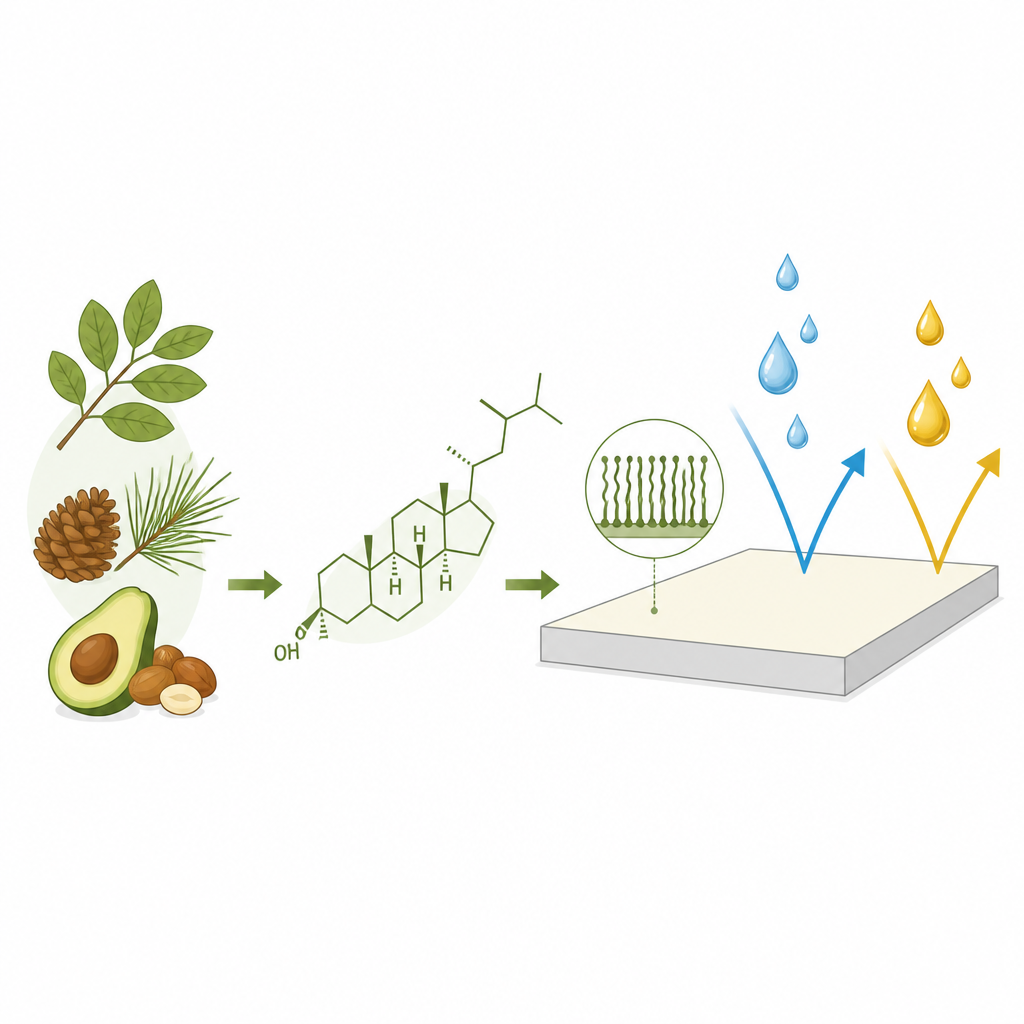
From burger wrappers to phone parts, many everyday products rely on coatings that keep water and oil from soaking in. Today, the most effective of these coatings often come from fluorinated chemicals that do not break down easily in the environment and can accumulate in living things. This study looks for safer options made from naturally occurring molecules called sterols, which are found in plants and animals, to see whether they can repel both water and oil well enough for real-world uses such as food packaging and protective films.
Nature’s waxy molecules as liquid shields
The researchers focused on a family of plant and animal compounds known as isoprenoids, and especially on sterols like cholesterol, ergosterol, β-sitosterol, and stigmasterol. These waxy molecules already help build cell membranes and tend to avoid water. Because they come from renewable sources and can be broken down by microbes, they are attractive candidates to replace long-lasting synthetic coatings. The team examined whether thin layers of these sterols and related derivatives could make a solid surface repel both water and a model oil, hexadecane, without needing fluorine-based chemistry.
Testing how well droplets bead up
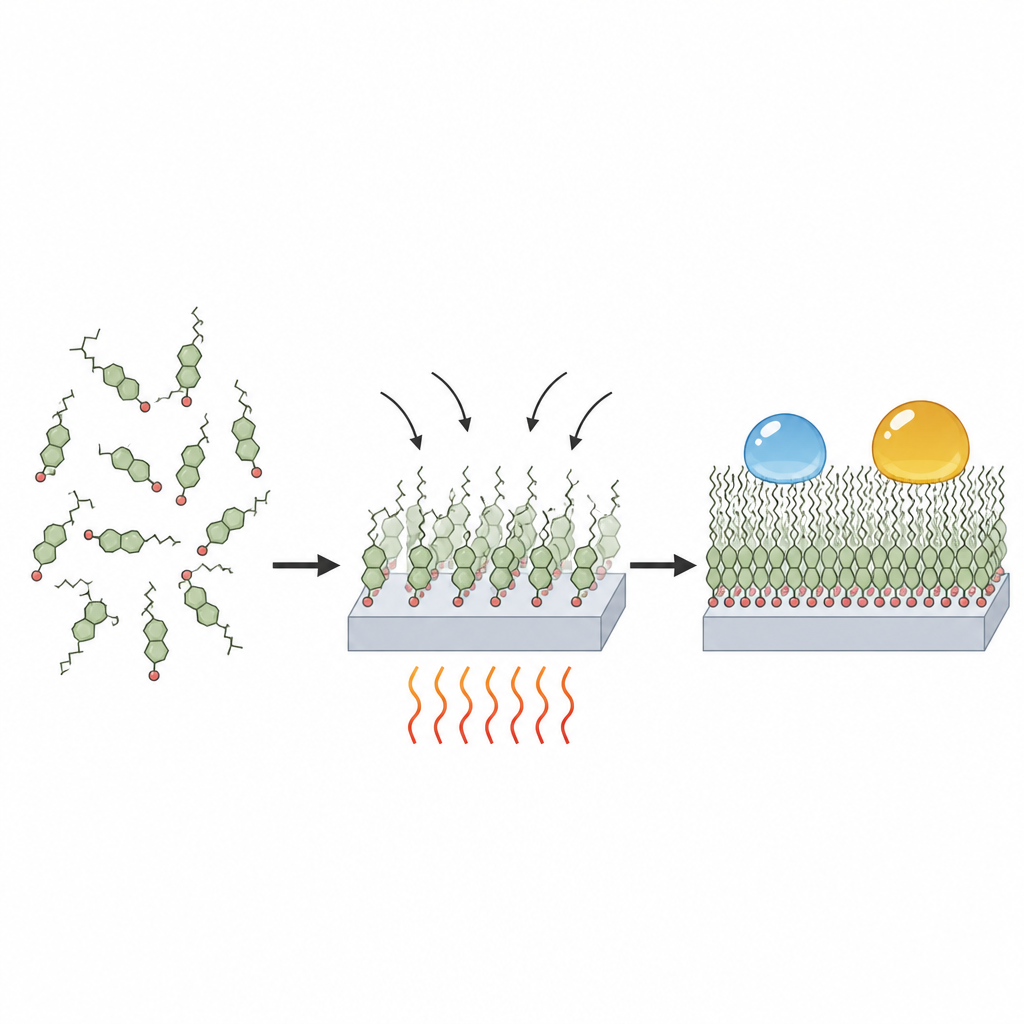
To measure water and oil repellency, the scientists coated smooth silicon wafers with solutions of different sterols and sterol-based molecules, then gently heated the coatings. They placed tiny droplets of water or hexadecane on the surface and recorded the contact angle, which describes how much a droplet beads up rather than spreads out. Angles above 100 degrees for water signaled good water repellency, while angles above 40 degrees for hexadecane indicated meaningful oil repellency. By comparing measurements at two heating levels, a mild 60 °C and a hotter 140 °C, they could see how heat treatment changed the way the coating arranged itself and how that affected droplet behavior.
How structure and heat tune liquid repellency
Several plain sterols formed highly water-repellent coatings when heated to 140 °C, with water contact angles just over 100 degrees. Small tweaks to their side chains, such as adding extra carbon groups, often improved how tightly they packed and how uniform the surface became, which helped water bead up. However, these changes did not consistently boost resistance to oil, and oil droplets still tended to wet the surface more than desired. For specially modified forms of cholesterol, the length and bulk of added fatty chains and other groups were crucial. Cholesterol myristate and a related compound, stearyl glycyrrhetinate, stood out: even at the lower heating temperature of 60 °C, they showed both strong water repellency and moderate oil repellency, suggesting that their ordered yet flexible layers present a particularly unfavorable surface for both kinds of liquids.
Finding the right processing window
Microscope images revealed that heating conditions had a major influence on how smooth and even the coatings became. For sterols with higher melting points, the hotter treatment helped them flow and spread into a consistent layer, which boosted water repellency. For compounds that soften at lower temperatures, too much heat likely disturbed their structure, reducing performance. In these cases, gentler heating produced better-organized films and higher contact angles, especially against oil. The study suggests that each natural molecule has an optimal processing window, tied to its melting point and how its chains pack together, that must be respected to get reliable, high-quality coatings.
What this means for greener packaging
Overall, the work shows that sterols, cholesterol-based derivatives, and stearyl glycyrrhetinate can create water-repellent, and in some cases oil-repellent, coatings without relying on persistent fluorinated compounds. While their oil repellency does not yet match that of leading synthetic polymers, their good performance as simple small molecules hints that further tuning, such as linking them into new polymers or blending them into mixed films, could improve results. For a layperson, the takeaway is that researchers are learning how to turn natural waxy ingredients into smarter coatings that help keep food packages dry and clean while reducing long-term environmental impact.
Citation: Suhaimi, N., Shamsol Anuar, N., Higashi, M. et al. Potential of sustainable, ecofriendly sterol derivatives as additives for water and oil repellency. Sci Rep 16, 15979 (2026). https://doi.org/10.1038/s41598-026-47313-z
Keywords: sterol coatings, water repellency, oil repellency, biobased packaging, isoprenoids