Clear Sky Science · en
Non-invasive continuous versus intermittent oscillometric arterial pressure monitoring and maternal hypotension during cesarean delivery: a randomized controlled trial
Why this study matters for new mothers
Many women who have a planned cesarean birth receive a spinal anesthetic, which can cause a sudden drop in blood pressure. This drop can make mothers feel sick and, if severe or prolonged, may affect the baby. Doctors usually track blood pressure with an arm cuff that inflates every minute or few minutes. A newer device uses a small cuff on the finger to follow blood pressure beat by beat. This study asked whether that more detailed, continuous method actually keeps mothers’ blood pressure steadier than the standard arm cuff during cesarean delivery.
Two different ways to watch blood pressure
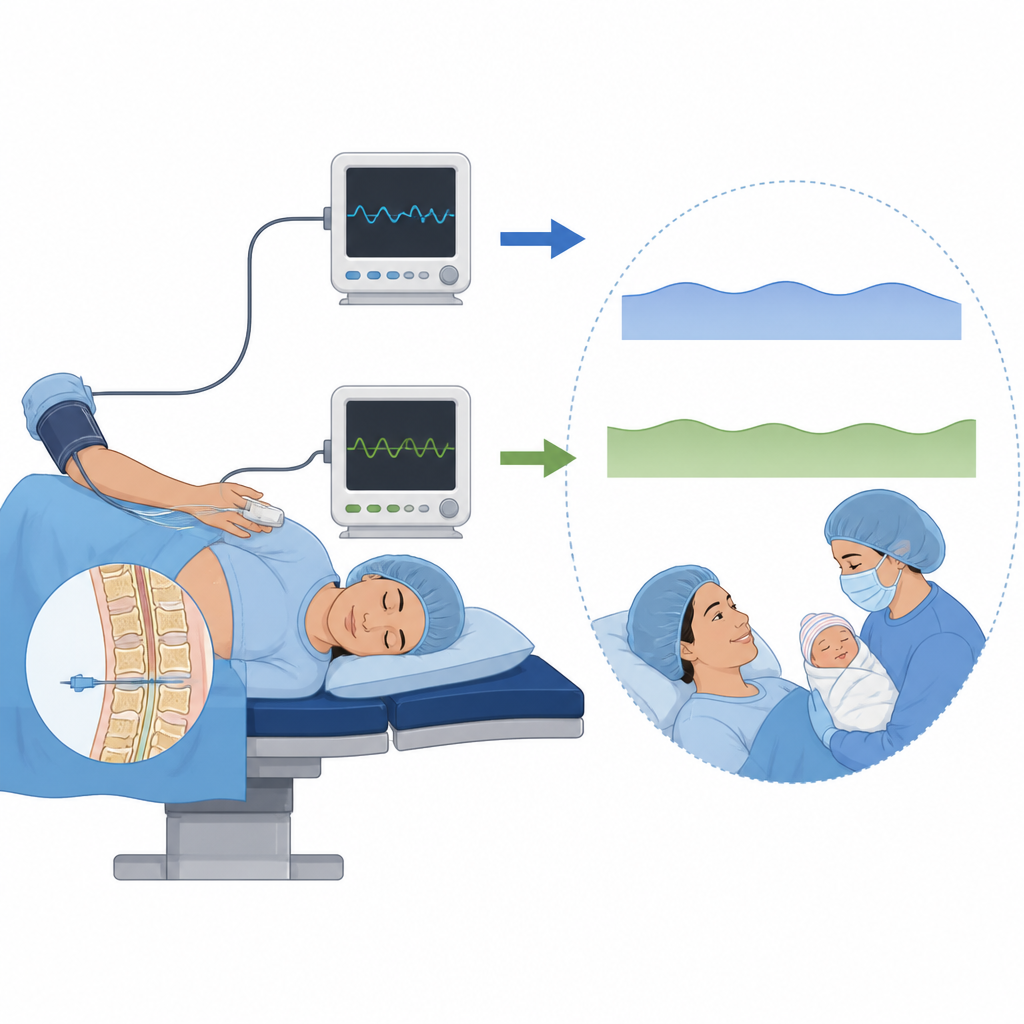
Researchers in South Korea enrolled healthy women with single pregnancies who were scheduled for cesarean delivery under spinal anesthesia. All women wore both an upper arm cuff and a finger cuff, but the anesthesiologist could see only one of them, depending on the group. In the control group, doctors used the usual arm cuff, which measured blood pressure every minute. In the treatment group, doctors relied on the finger cuff, which followed blood pressure continuously and showed its changes in real time. In both groups, the other device was hidden from view and used only for data collection and comparison.
How doctors tried to prevent low blood pressure
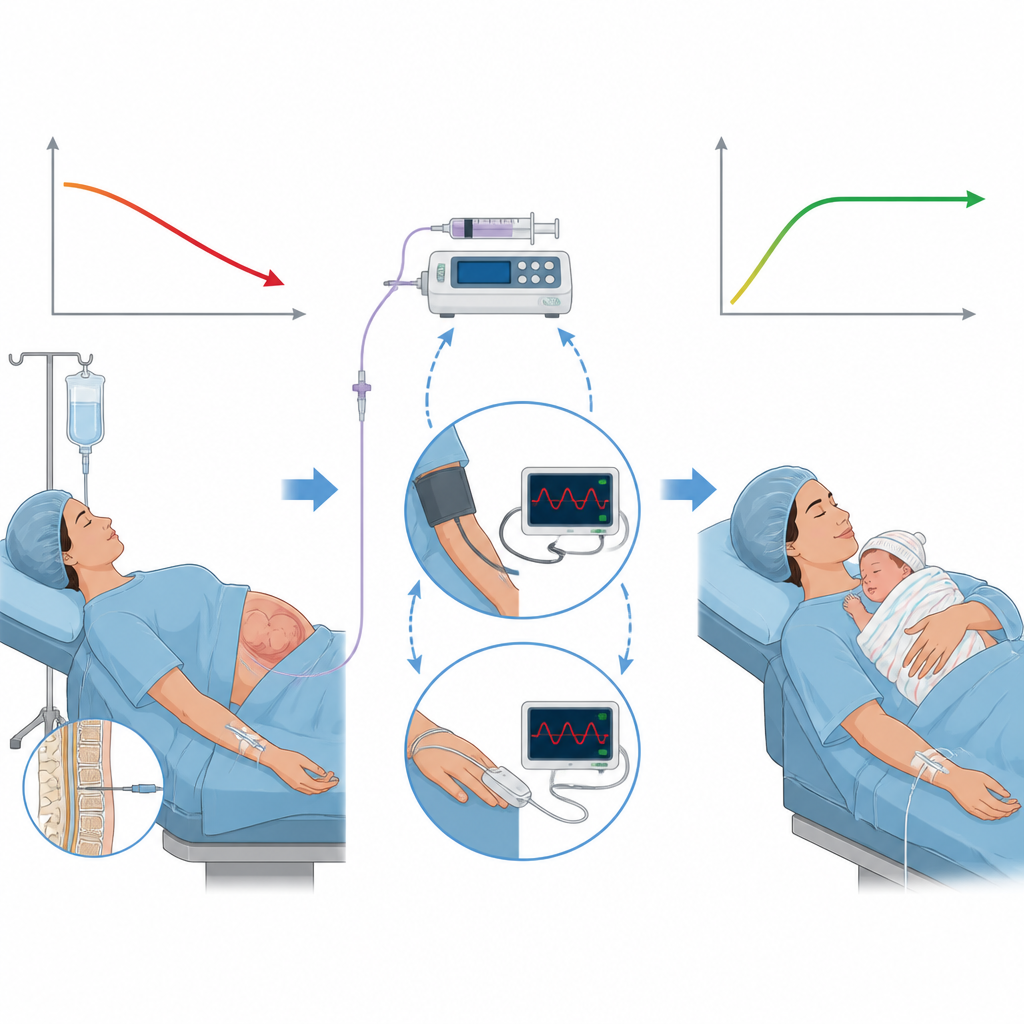
Every woman received a standard spinal anesthetic and a steady drip of a drug called phenylephrine, which helps prevent blood pressure from dropping too low. The dose of this drug was adjusted by the anesthesiologist following a strict protocol. If blood pressure began to fall, the infusion was increased step by step, and extra medicine was given if needed. The key measure was how often systolic blood pressure, the top number, fell below 80 percent of each woman’s personal starting level between the end of the spinal injection and the birth of the baby. The team also looked at how long and how deeply blood pressure stayed low, and at side effects in mothers and health measures in newborns.
What the researchers found
Out of 151 women studied, about half in each group experienced at least one episode of low blood pressure. The rate was 50.7 percent with the continuous finger cuff and 58.1 percent with the standard arm cuff, a difference that could have occurred by chance. Measures that captured how long and how far blood pressure dipped, such as the area under the curve and time-weighted averages, were also very similar between groups. Mothers’ symptoms like nausea and vomiting, the amount of blood pressure medicine used, and babies’ Apgar scores and blood tests showed no meaningful differences.
Limits of the new technology in this setting
The continuous finger cuff did not clearly outperform the arm cuff when everyone received careful drug treatment and very frequent arm-cuff readings. Additional analyses also showed that the two devices often disagreed on the exact blood pressure values, especially during the unstable period after the spinal injection. Because the study was designed to detect only a fairly large benefit, it might have been too small to pick up a more modest improvement. The authors calculated that several hundred more patients would be needed in future studies to be sure whether a small but important advantage exists.
What this means for mothers and clinicians
This trial suggests that, in healthy women having planned cesarean deliveries with modern drug management, continuous finger-cuff monitoring does not markedly reduce episodes of low blood pressure compared with a well-run arm cuff used every minute. The results do not rule out a smaller benefit, and continuous monitoring may still prove useful in more complex pregnancies or in settings with different drug strategies. For now, the standard arm cuff, used thoughtfully and frequently, remains a reliable tool for keeping mothers and babies safe during cesarean birth.
Citation: Kim, Y., Kim, H., Yoo, S. et al. Non-invasive continuous versus intermittent oscillometric arterial pressure monitoring and maternal hypotension during cesarean delivery: a randomized controlled trial. Sci Rep 16, 16124 (2026). https://doi.org/10.1038/s41598-026-47307-x
Keywords: cesarean delivery, maternal blood pressure, spinal anesthesia, noninvasive monitoring, phenylephrine