Clear Sky Science · en
Insights into the functional coordination of LigD and Ku in bacterial nonhomologous end joining
How bacteria fix dangerous DNA breaks
Every cell’s DNA is under constant attack, and one of the worst injuries it can suffer is a double break in the DNA strand. If not repaired, such breaks can kill the cell or scramble its genetic information. This article explores how the common soil bacterium Bacillus subtilis uses two proteins, called Ku and LigD, to quickly patch these breaks when no backup copy of the DNA is available, revealing a finely tuned molecular partnership that keeps bacterial genomes intact.
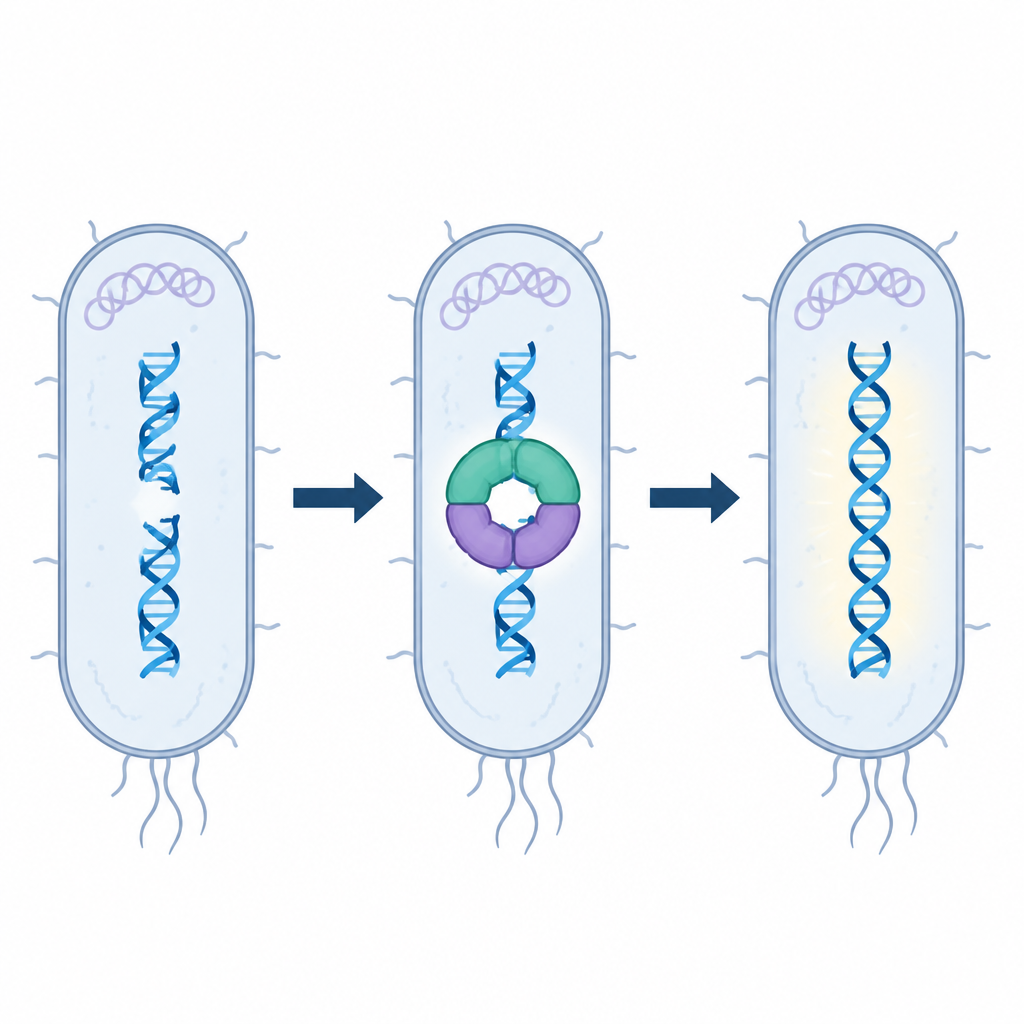
A backup repair kit for hard times
Cells normally prefer to repair broken DNA by copying from an intact twin strand, a process that is accurate but only works when a second copy is nearby. Many bacteria, especially those in a dormant or slow-growing state, often have just one chromosome, so they cannot rely on this strategy. Instead they use nonhomologous end joining, in which the broken DNA ends are simply cleaned up and rejoined. In Bacillus subtilis, this job is carried out by two partners: Ku, which grips and aligns the broken ends, and LigD, which can both add missing building blocks to the DNA and glue the pieces back together. The study asks whether a single LigD molecule can perform all of these steps in one continuous run, and how Ku helps guide this process.
A three step repair job on one protein scaffold
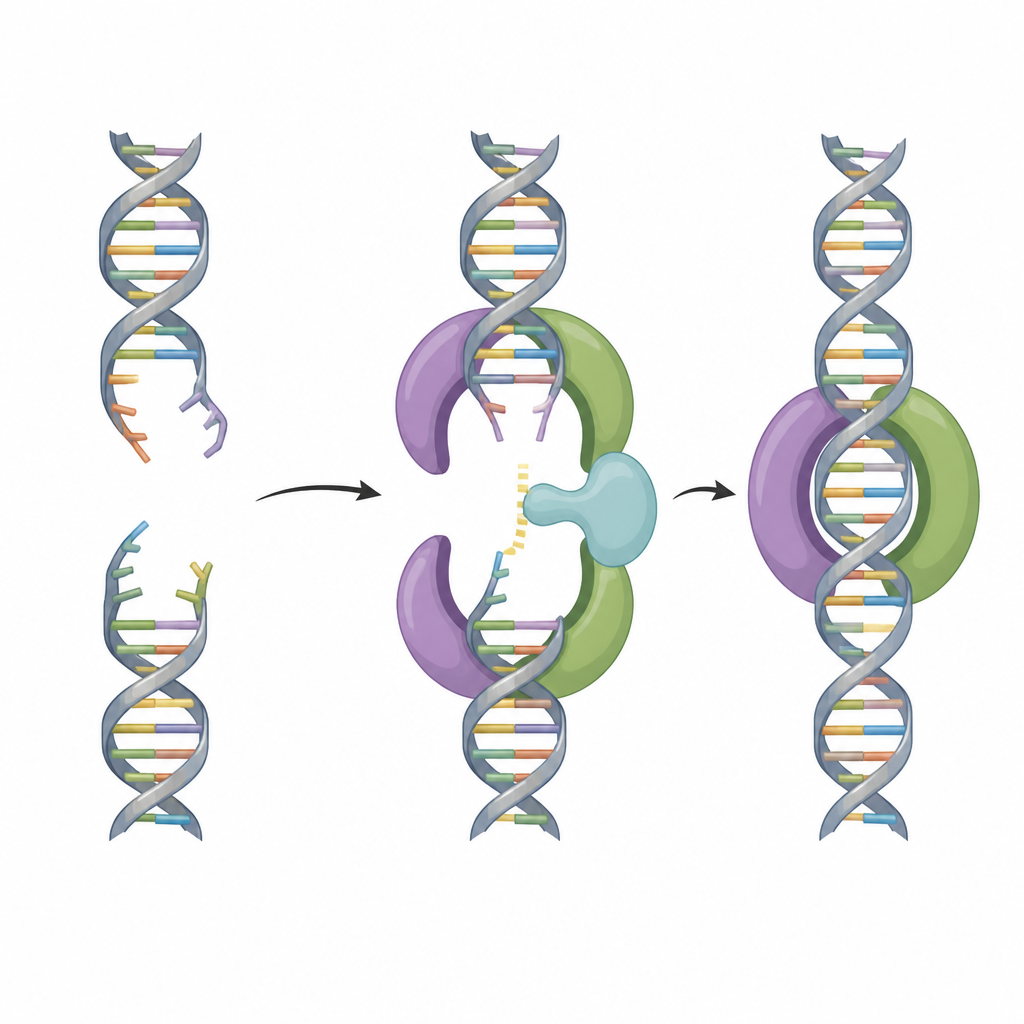
The authors designed DNA molecules that mimic broken ends with small gaps or damaged sites near the break. They then followed how Ku and LigD acted on these pieces in test tube reactions, using extra DNA in the mixture as a “trap” to capture LigD if it let go. The experiments showed that when Ku brings two compatible ends together, one LigD molecule can cut away a damaged site, insert the correct new building block, and finally seal the break, all without leaving the DNA. This processive behavior means that the repair is efficient and less likely to stall midway, which could otherwise leave the chromosome vulnerable.
Stopping DNA from tying itself in knots
However, DNA ends are flexible and can fold back on themselves, allowing a single loose end to pair with nearby bases on the same strand and form a small loop. The team found that LigD is surprisingly good at using such snap back loops as if they were normal broken ends, joining them into tiny hairpin like structures. If this happened inside a cell, it could block proper repair or remove pieces of genetic information. By systematically shortening and altering the sequences at the overhanging ends, the researchers discovered that at least six bases and certain patterns of matching letters are needed for these loops to form.
Ku keeps repair on the right track
Ku’s role turned out to be more than simply holding DNA ends in place. When Ku was present and the two broken ends shared enough matching bases, it strongly favored bringing different DNA molecules together over allowing a single end to fold back on itself. In other words, Ku promoted true end joining and suppressed self ligation. To understand how Ku and LigD interact physically, the authors built hybrid versions of Ku by swapping parts between species, and versions truncated at one end. These tests showed that a short tail region of Ku is crucial for recruiting LigD to start the repair, while the central core of Ku becomes more important in the final sealing step, hinting at a handoff between different contact points as the reaction progresses.
Why this teamwork matters
In simple terms, this work shows that Bacillus subtilis relies on a tightly choreographed duet between Ku and LigD to mend dangerous DNA breaks when no perfect template is available. One LigD molecule can carry out cutting, filling, and sealing in sequence, while Ku not only aligns the ends but also prevents the DNA from joining to itself in unhelpful ways. By dissecting which parts of Ku talk to LigD at different stages, the study offers a clearer picture of how bacterial cells preserve their genetic material under stress, and provides clues that could inform the design of new tools or treatments that target bacterial DNA repair.
Citation: del Prado, A., Buitrago, A., de Rus-Moreno, A. et al. Insights into the functional coordination of LigD and Ku in bacterial nonhomologous end joining. Sci Rep 16, 16190 (2026). https://doi.org/10.1038/s41598-026-47294-z
Keywords: DNA repair, bacterial NHEJ, Ku protein, LigD enzyme, double strand breaks