Clear Sky Science · en
Genomic insights into the admixture and diversity of Kerala crossbred cattle
Why Kerala’s family cows matter to all of us
Across the tropics, millions of small farmers depend on cows for milk and income. In the Indian state of Kerala, most dairy animals are not traditional village cows or familiar European dairy breeds, but a mix of both. This study looks inside the DNA of these crossbred cows to ask a simple question with big consequences for food security and animal welfare: have decades of crossbreeding boosted milk without sacrificing resilience to heat, disease, and other local stresses?
A long breeding journey in a hot, humid land
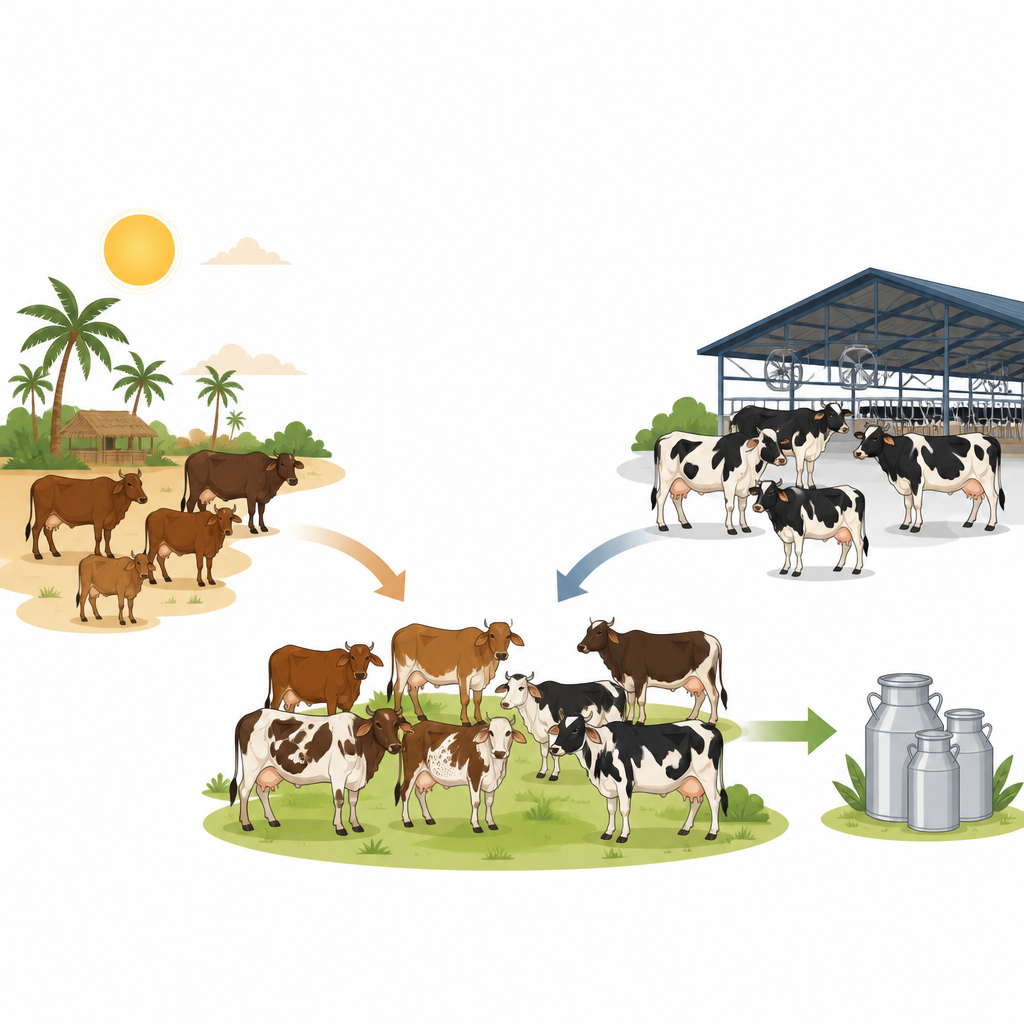
Kerala’s main crossbred cattle, often called Sunandini, were created by mating hardy local cows with high-yielding foreign breeds such as Holstein Friesian, Brown Swiss, and Jersey. The goal was to combine rich milk flow with the toughness needed for the state’s hot, humid climate and small family farms. Over sixty years, breeding programs steadily added more foreign blood, often aiming for animals with around five-eighths exotic ancestry or more. Yet, because these cows are genetic mosaics of several breeds, it has been hard to know exactly how mixed they are or whether hidden inbreeding is building up beneath the surface.
Reading diversity from tiny DNA markers
The researchers genotyped 2,273 Kerala crossbred cattle, examining about 45,000 single-letter DNA markers spread across the genome. They used these markers to measure how much genetic variety the herd holds, how closely related animals are, and how different ancestral breeds are woven together. By comparing an animal’s two copies of each DNA region, they estimated observed and expected heterozygosity, simple yardsticks for diversity. They also tracked how often markers near each other tended to stay together, a pattern known as linkage disequilibrium; its decay over distance provides clues about past mixing and the power of future DNA-based selection programs.
Plenty of genetic variety, little recent inbreeding
The crossbred cows showed moderate to high diversity, with observed and expected heterozygosity around one third of sites. This means many animals carry two different versions of many genes, raw material that helps populations respond to disease, climate shifts, and breeding efforts. Linkage between nearby DNA markers dropped sharply within a few thousand bases, a sign that the herd carries a rich mixture of ancestries and has experienced many reshufflings of genes. Estimates of effective population size, a genetic measure of how many animals are truly contributing to the next generation, were comfortably above international minimum guidelines, suggesting little immediate danger from inbreeding. When the team looked for long stretches of identical DNA, which signal close inbreeding in the recent past, they mostly found short tracts. That pattern points to ancient shared ancestry rather than frequent mating of close relatives today.
How much foreign blood is in the herd
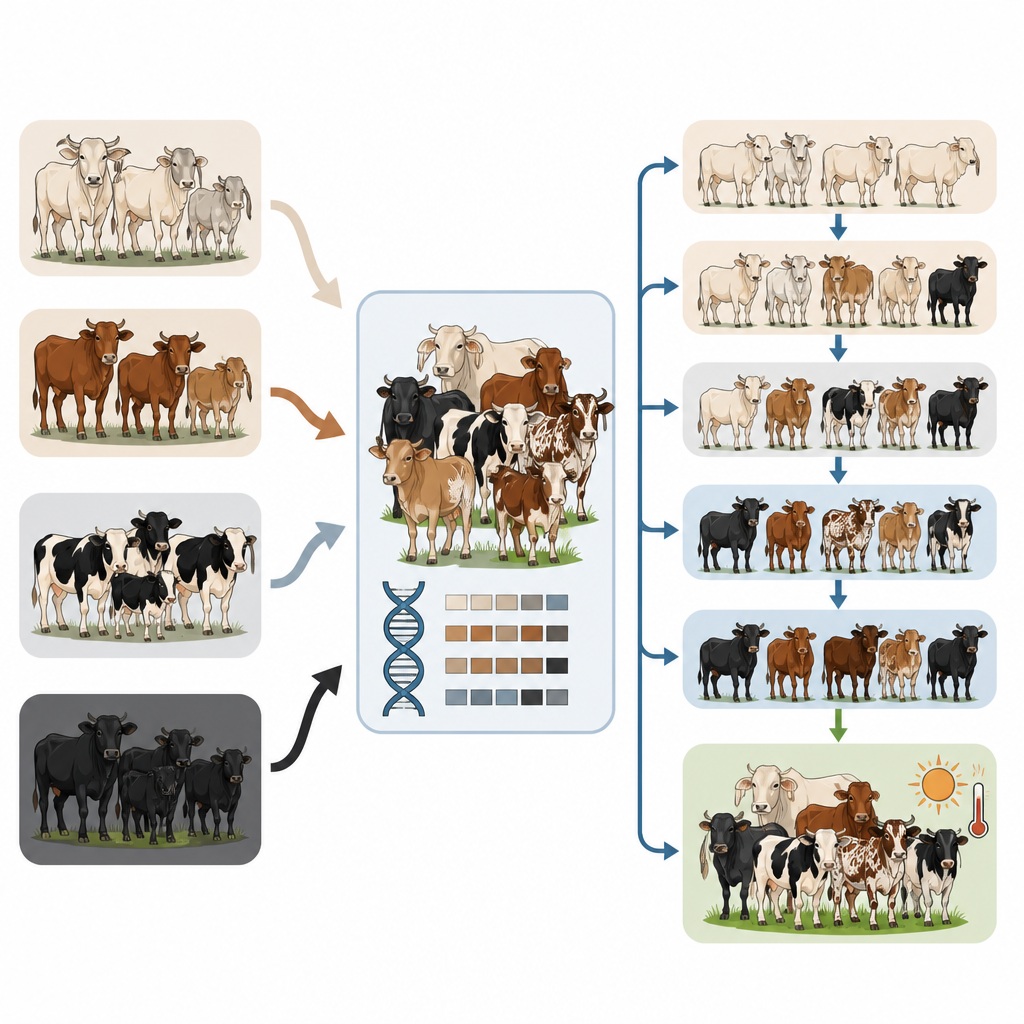
By comparing Kerala cows with reference animals from European and Indian breeds, the team teased apart the mix of origins in each cow. On average, about 37 percent of the genome traced back to Holstein Friesian, 31 percent to Brown Swiss, 13 percent to Jersey, and only 19 percent to indigenous Indian cattle. In other words, these cows are roughly four-fifths foreign in genetic terms. This aligns with policies that encouraged high-exotic animals for commercial milk production, but it nudges the population above the 50 to 75 percent foreign share that many experts consider safer for hot, smallholder systems. The study also spotted clusters of shared DNA segments on one chromosome that carry genes tied to milk yield, metabolism, and tolerance to heat, hinting at regions that selection may have favored as Kerala farmers pushed for both productivity and survival under tropical stress.
Finding the sweet spot between milk and resilience
For non-specialists, the core message is straightforward: Kerala’s crossbred cows are genetically diverse and not yet heavily inbred, which is good news for their long-term health and productivity. However, their DNA now leans strongly toward European dairy breeds, which can weaken natural defenses against heat, disease, and low-quality feed that local cattle evolved over centuries. The authors argue that future breeding plans should gently steer the herd back toward a better balance, protecting local genes that confer toughness while still making use of foreign genes that boost milk. Using genomic tools to track ancestry and inbreeding can help breeders fine-tune this balance, keeping these mixed-breed cows productive, healthy, and well suited to the tropical farms that rely on them.
Citation: Khan, K.D., Yadav, A., Sahana, V.N. et al. Genomic insights into the admixture and diversity of Kerala crossbred cattle. Sci Rep 16, 15815 (2026). https://doi.org/10.1038/s41598-026-47282-3
Keywords: crossbred cattle, genetic diversity, Kerala dairy, cattle breeding, tropical adaptation