Clear Sky Science · en
Enhancing 5G uplink communications through efficient PCC-OFDM with neural network-based channel estimation
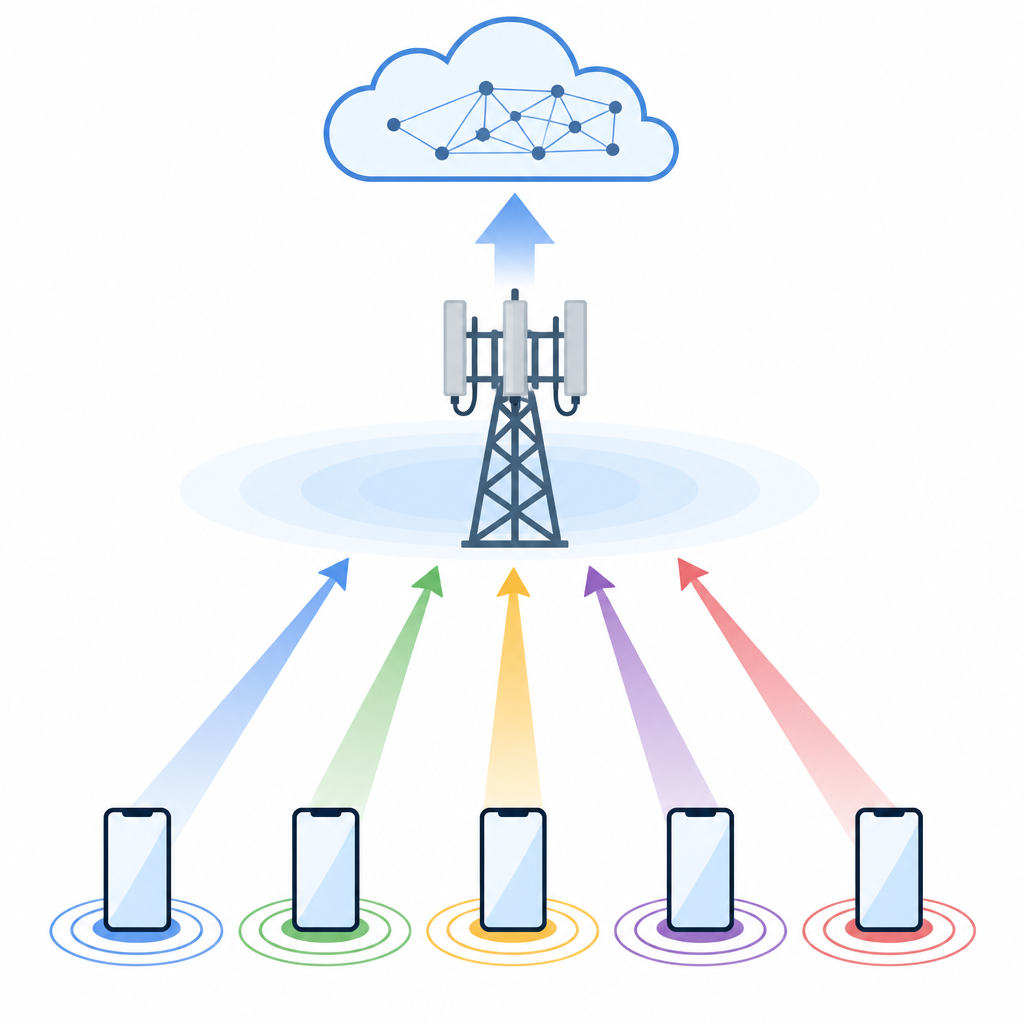
Why your phone’s upload speed matters
When you send a video, join a live call, or guide a self-driving car, your device must push data back to the network quickly and reliably. This paper looks at how to make that “uplink” in 5G smarter and more efficient by combining a clever radio signal design with a learning computer model that can adapt to messy real-world airwaves.
Making better use of the airwaves
Modern mobile networks slice data into many tiny pieces and send them over a set of closely spaced radio tones, a method widely used in 4G and 5G. The authors focus on a refined version called PCC-OFDM, which arranges these tones so that they cancel out some of each other’s weaknesses. This layout helps squeeze more information into the same chunk of spectrum, cuts down on interference between tones, and tolerates some timing and frequency errors that usually plague wireless links.
The hard problem of reading a noisy channel
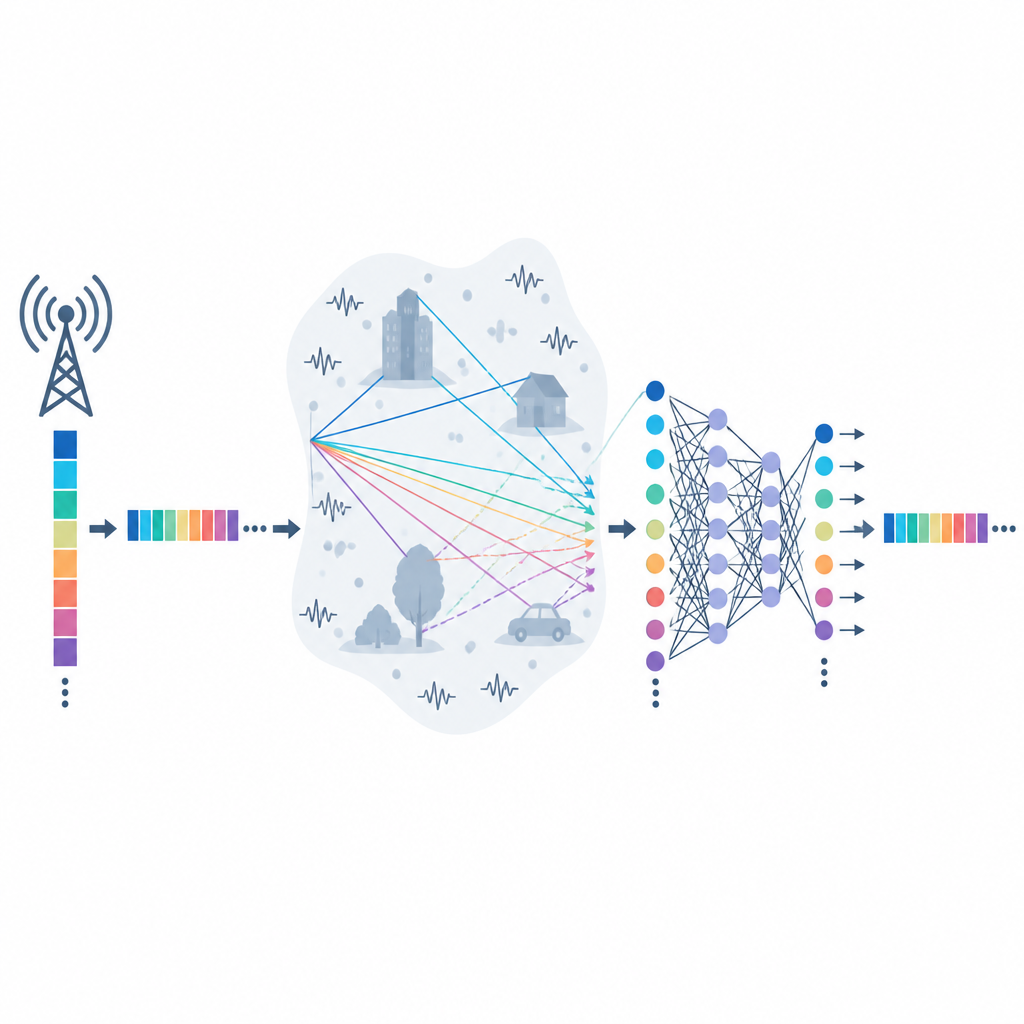
To decode what your phone sends, the base station needs a good picture of what the airwaves are doing at that moment. Signals bounce off buildings, cars, and people, creating echoes and distortions that constantly change. Traditional tools try to estimate this “channel” with simple mathematical formulas, but they struggle when users move quickly, when many paths exist, or when very wide bands are used. PCC-OFDM’s special pairing of tones makes this task even trickier, because the received signal on each tone depends on its neighbors as well.
Teaching a neural network to hear through the noise
The authors propose a compact neural network, called a multilayer perceptron, to improve how the system senses the channel. First, a standard method makes a rough guess of the channel using known reference tones. Then the neural network takes the real and imaginary parts of these rough guesses as input and learns to map them directly to the best correction values for each tone. Unlike deeper or more specialized designs, this network uses only fully connected layers, which keeps the number of adjustable parameters modest and cuts down on computing cost and memory use while still capturing complex, non-linear patterns.
From lab setup to performance gains
In simulations of 5G uplink scenarios with many antennas and different kinds of analog-to-digital converters, the new estimator was compared with several popular approaches, including classic linear methods and deeper learning models such as convolutional and recurrent networks. The proposed design produced lower estimation error across a wide range of signal-to-noise conditions and did so with fewer arithmetic operations. It also supported “mixed” converter setups, where some receivers use high precision and others use coarse precision, which is attractive for cutting hardware cost and power use in large antenna arrays.
Turning better estimates into faster links
Better knowledge of the channel can be turned into higher data rates by steering and shaping signals more effectively. The authors used their neural network based estimates inside a signal shaping step called precoding and measured how many bits per second per hertz the system could carry. Across many antenna sizes, user counts, movement speeds, and channel types, the proposed method delivered higher spectral efficiency than competing learning based schemes, while also running faster and using less memory. Accuracy reached about 98 percent in classification tests related to the channel, and the training process remained stable without signs of overfitting.
What this means for everyday users
In plain terms, this work shows that a carefully designed, relatively simple neural network can help 5G base stations “listen” to the radio environment more clearly and react to changes more quickly. When combined with a smarter way of arranging radio tones, it allows more data to be pushed through the same slice of spectrum and keeps connections stable even when users move fast or the signal path becomes cluttered. For future networks that must support dense cities, industrial sensors, and connected vehicles, such approaches could translate into smoother video calls, quicker uploads, and more reliable links without proportionally higher hardware cost or energy use.
Citation: J., M.J., S., S. Enhancing 5G uplink communications through efficient PCC-OFDM with neural network-based channel estimation. Sci Rep 16, 15662 (2026). https://doi.org/10.1038/s41598-026-47256-5
Keywords: 5G uplink, channel estimation, neural network, OFDM, spectral efficiency