Clear Sky Science · en
Theoretical study on the pressure relief range of the upper protected coal seam in protective layer mining
Why safer coal mining matters
Deep coal mines help power modern life but can be dangerous places. High rock pressure and trapped gas can trigger sudden outbursts that threaten miners and equipment. This study looks at a way to make deep mining safer by using one coal seam to protect another. By carefully mining a lower seam first, the authors show how pressure and gas in an overlying, more hazardous seam can be relieved in a controlled way.
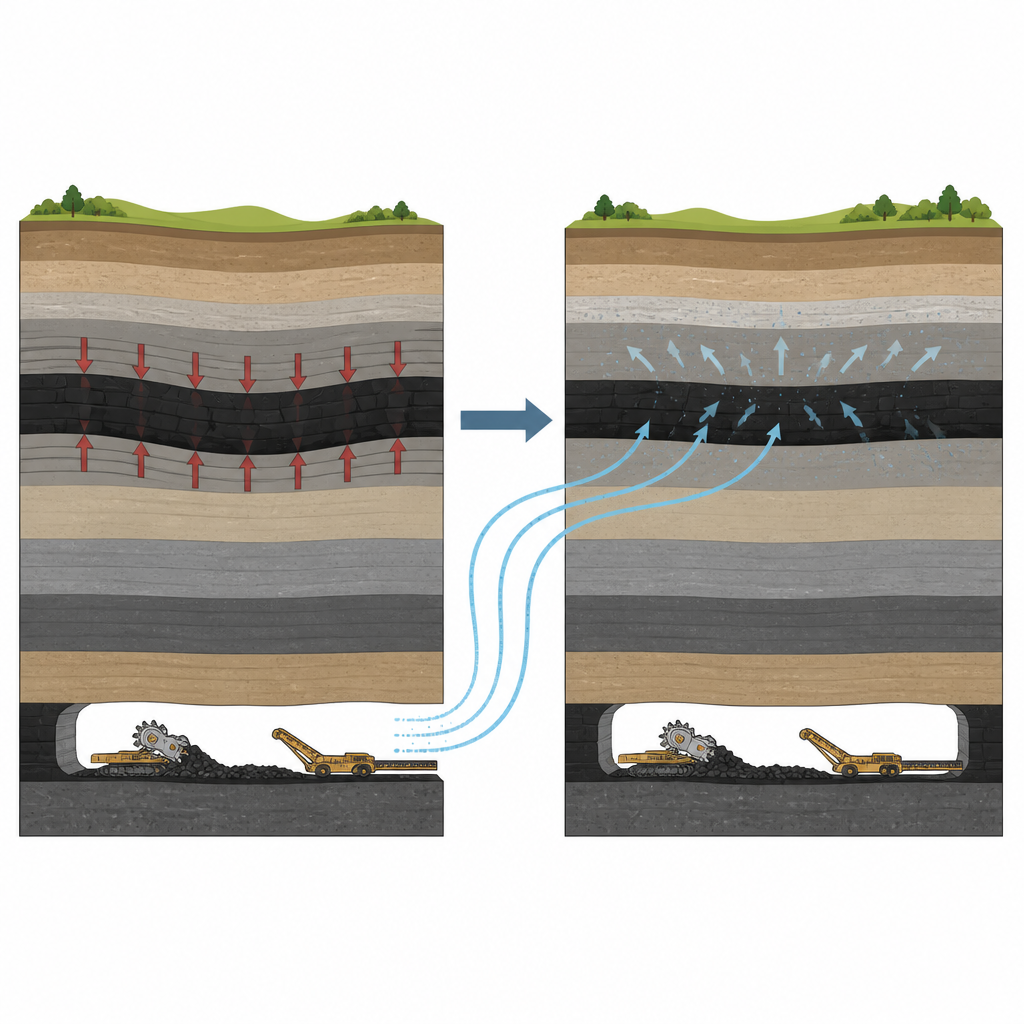
Using one coal seam to protect another
The idea behind a protective layer is simple in concept: mine a safer coal seam to gently "let off steam" in a riskier seam above or below it. When the lower protective seam is mined, the overlying rocks bend, crack, and shift toward the emptied-out zone. This movement changes how stress is distributed and opens new pathways for gas to escape. In this study, the Wu9−10 coal seam in China’s Pingmei No.6 Mine serves as the lower protective seam, while the overlying Ding5−6 seam is the one at risk of gas outbursts.
Choosing the right protective seam
Not every coal seam can safely act as a protective layer. The authors first worked out whether Wu9−10 was suitable. They checked that the seam was thick and continuous enough to mine, that the distance up to the Ding5−6 seam was not too large, and that the rocks in between were not so stiff that they would block the pressure relief. A key measure is the ratio between the distance separating the two seams and the thickness of the protective seam. For this mine, that ratio was far below the safety limit set by Chinese technical standards, indicating that mining Wu9−10 should be able to relieve pressure in Ding5−6 without damaging its future mining conditions.
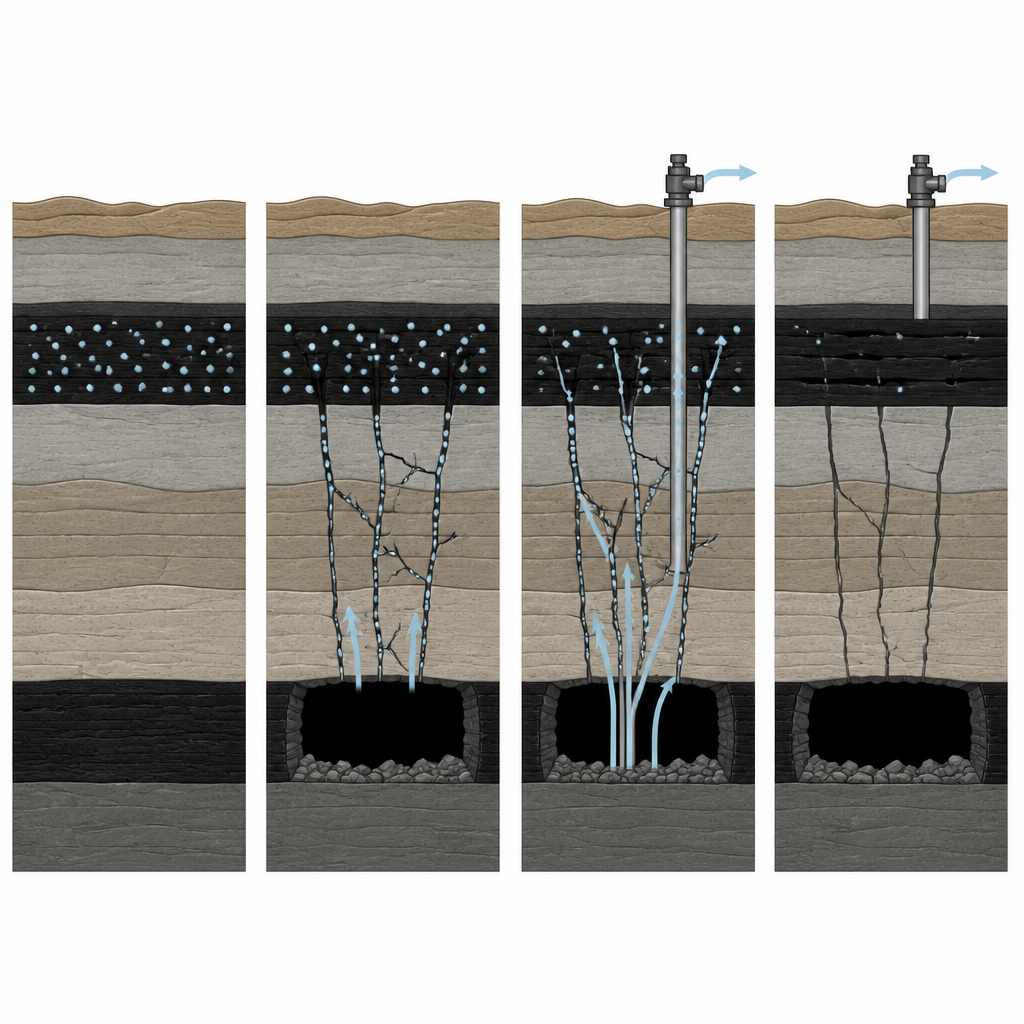
Mapping the zone of protection
The team then used established rules and formulas to predict how far the protective effect should extend around the working face of the mine. They calculated pressure relief angles that show how the protected zone fans out above the mined seam in different directions: along the slope of the coal, along its length, and straight upward. From these angles, they estimated how far the safe zone should be shifted inward from tunnels and boundary lines, and how high above the protective seam the pressure relief should reach. Their results indicated that the real spacing between the two seams lay well inside the expected vertical protection range.
Testing the theory underground
To check these predictions, the researchers carried out an extensive field experiment while the Wu9−10 seam was being mined. They drilled dozens of boreholes into the upper Ding5−6 seam to measure gas pressure and gas content before and after mining. They also installed instruments to track how much the protected seam swelled as stress was relieved, and they collected detailed records of gas pumped out through boreholes and pipes. The data showed that inside the calculated protection zone, gas pressure in Ding5−6 dropped by up to about four-fifths, gas content roughly halved, and the coal seam expanded by many times the threshold linked with effective pressure relief. The overall volume of gas removed matched what would be expected from such a strong reduction.
What this means for mine safety
In plain terms, the study confirms that carefully planned mining in the lower Wu9−10 seam can safely "defuse" the overlying Ding5−6 seam by lowering stress and draining gas over a well-defined area. The measured safe zone in the real mine closely matched the theoretical one, and all safety criteria for gas pressure and content were met. For deep, gently inclined coalfields with similar rock layers, this work offers a practical blueprint for using protective seams to cut the risk of dangerous gas outbursts while keeping future mining options open.
Citation: Zhan, K., Zhang, B. & Wang, M. Theoretical study on the pressure relief range of the upper protected coal seam in protective layer mining. Sci Rep 16, 15688 (2026). https://doi.org/10.1038/s41598-026-47249-4
Keywords: protective layer mining, coal seam gas, pressure relief, deep coal mining, mine safety