Clear Sky Science · en
Effective plasmonic enhancement of up-conversion photoluminescence from $$\alpha$$ -NaGdF4:Yb3+,Er3+ nanoparticles by gold dendrites
Turning Invisible Light into Useful Glow
Much of the light that reaches us, especially from the Sun, lies in the invisible near‑infrared part of the spectrum. Most materials simply warm up when they absorb this light. This study shows how to convert that “wasted” invisible light into bright visible colors far more efficiently by combining specially designed nanoparticles with intricate gold structures. The advance could help make better medical imaging probes, more efficient lighting, and solar cells that harvest light more cleverly.
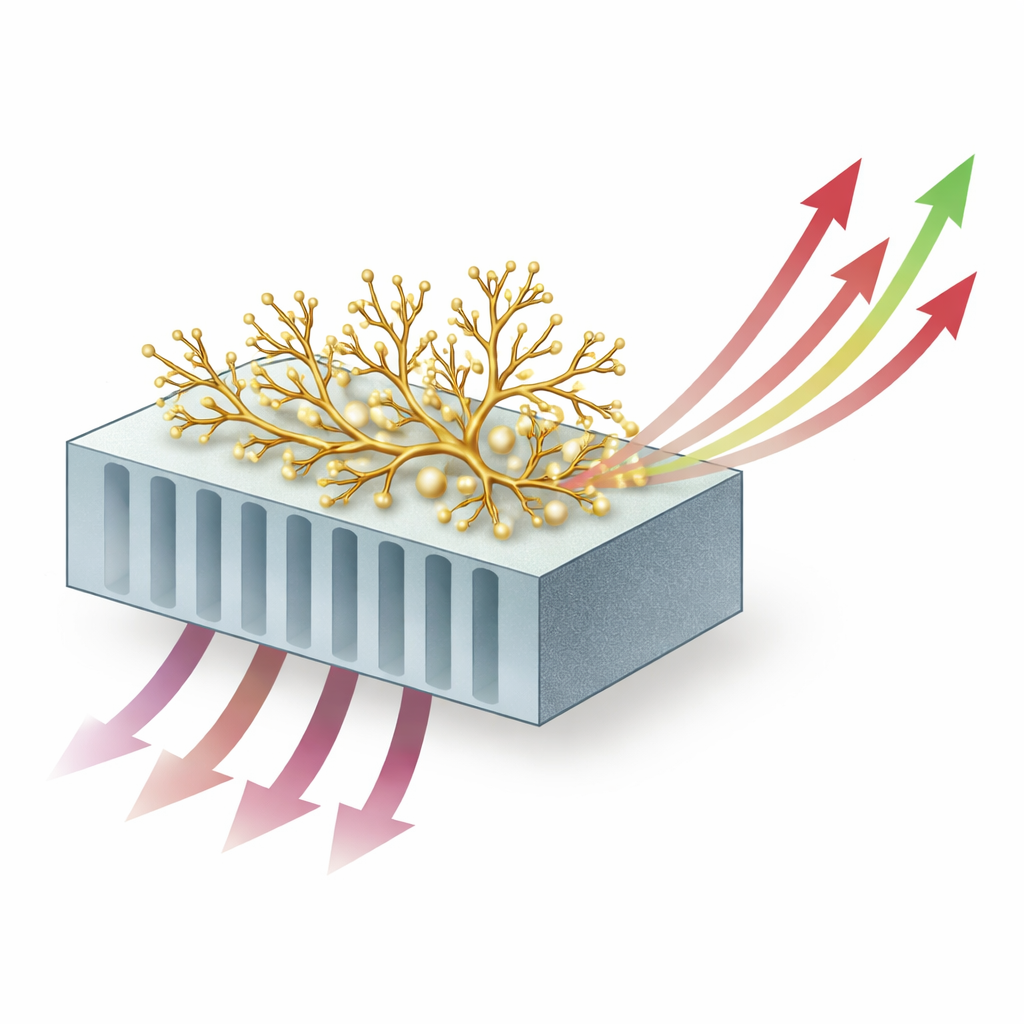
Tiny Particles That Trade Low-Energy for High-Energy Light
At the heart of the work are up‑conversion nanoparticles. These are tiny crystals containing rare‑earth elements that can absorb two or more low‑energy infrared photons and re‑emit a single higher‑energy visible photon, often as green or red light. This trick is useful in biology, because invisible infrared light can penetrate tissue deeply with little background glow, and in energy technology, where it can tap parts of the solar spectrum that ordinary solar cells miss. The problem is that, by themselves, these nanoparticles shine only weakly. Boosting their brightness without changing their chemistry is a major goal in nanophotonics.
Gold Branches on a Sponge-Like Silicon Scaffold
The researchers tackled this challenge by growing elaborate gold “dendrites” – branching, tree‑like metal structures – on a sponge‑like silicon layer full of regular, micrometer‑sized pores. This macroporous silicon not only provides a large surface area where metal can grow, it also helps control how the gold branches form. By carefully tuning the chemistry of the solution, especially the amount of hydrofluoric acid, the team produced three distinct types of gold dendrite coatings, ranging from short, thorny protrusions to long, intricately branched networks that spread across the pore mouths. Measurements of how these samples reflected light revealed that one design, termed AuDNs‑02, had surface resonances that overlapped especially well with both the colors emitted by the nanoparticles and the infrared light used to excite them.
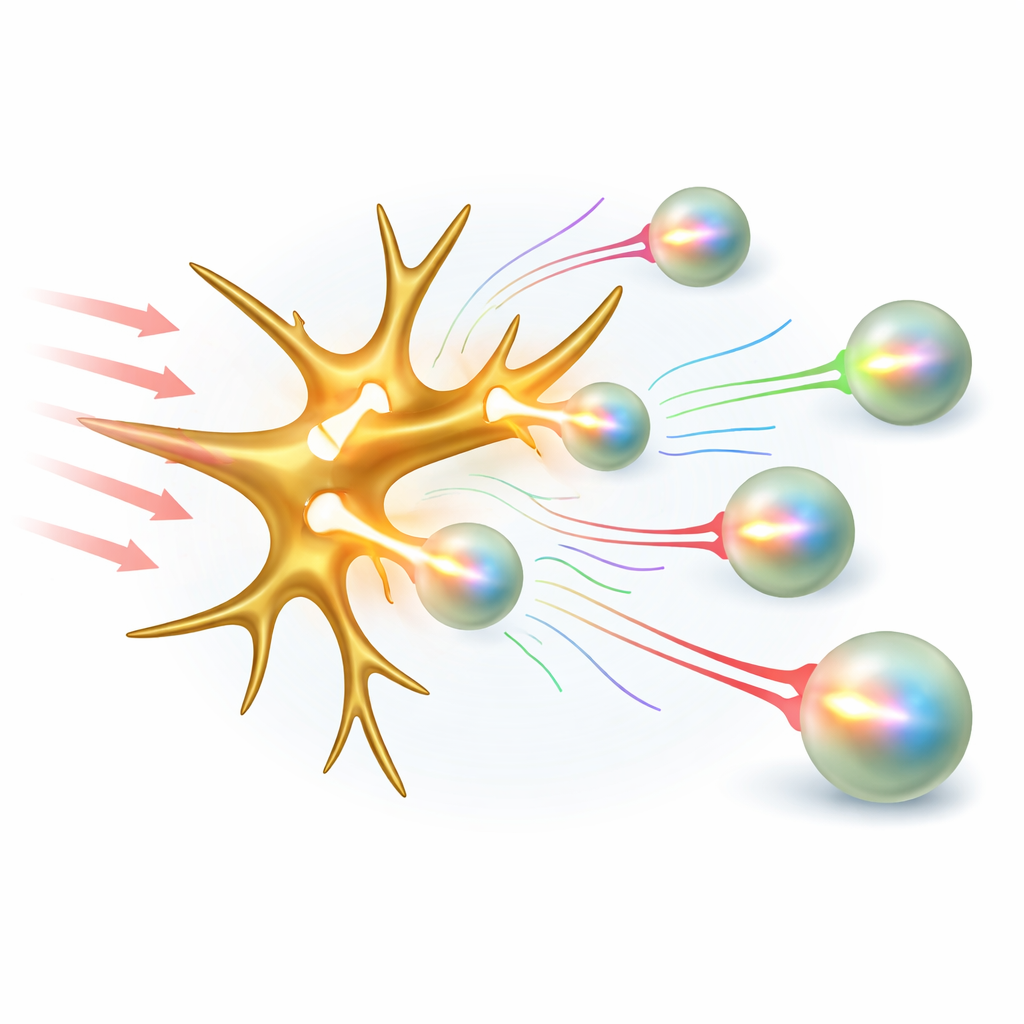
How Metal “Hot Spots” Supercharge the Glow
When light hits nanostructured gold, the metal’s electrons can oscillate collectively, creating surface plasmons—highly concentrated electric fields near sharp tips and narrow gaps. The team placed the up‑conversion nanoparticles directly on and around the gold dendrite branches, where such “hot spots” are strongest. Computer simulations of an idealized dendrite, built to match the real structures seen in electron microscope images, showed that the electric field can be amplified more than forty‑fold at specific tips and gaps, particularly for infrared light around 780–850 nanometers. As the wavelength shifts deeper into the infrared, the hot regions migrate along the branches and weaken, but remain strong enough to influence the nearby nanoparticles over a broad range of excitation colors.
From Weak Flicker to Strong Red and Green Emission
Experiments confirmed that this intense local field dramatically boosts the nanoparticles’ brightness. Under infrared excitation at 800 nanometers, particles on plain silicon barely glow, but the same particles on the optimized gold dendrites shine tens of times brighter. In the best case, red emission increased by about 35‑fold and green by about 26‑fold. The enhancement is not uniform: the spectral overlap between the gold’s resonances and the nanoparticles’ energy levels favors red light, which becomes particularly strong. By scanning the laser power, the authors also observed that the presence of the metal changes how many photons effectively participate in the up‑conversion process, indicating that the gold not only gathers light but also alters how energy flows through the nanoparticles’ internal levels.
Why This Matters for Imaging and Energy
To a non‑specialist, the key message is that shaping metal into controlled, tree‑like branches on a porous silicon base lets scientists place dim light‑converting nanoparticles right where electromagnetic energy naturally concentrates. This smart pairing turns feeble infrared‑to‑visible conversion into a robust glow without changing the particles themselves. Such platforms could help doctors see deeper into tissue with less background, enable solid‑state lighting that taps invisible light, and allow solar cells to turn more of the Sun’s spectrum into usable electricity—all by sculpting metals and light at the nanoscale.
Citation: Pham, N.B.T., Burko, A., Murashka, V. et al. Effective plasmonic enhancement of up-conversion photoluminescence from \(\alpha\)-NaGdF4:Yb3+,Er3+ nanoparticles by gold dendrites. Sci Rep 16, 11664 (2026). https://doi.org/10.1038/s41598-026-47244-9
Keywords: upconversion nanoparticles, plasmonic gold dendrites, near-infrared light, nanophotonics, bioimaging and solar energy