Clear Sky Science · en
Magnesium- and biopolymer-stabilized ACC and ACP form the body-wall spicules of Baptodoris cinnabarina (Doridida, Gastropoda)
Hidden skeletons in soft sea slugs
At first glance, the bright sea slug Baptodoris cinnabarina looks like a soft, jelly-like creature with no hard parts at all. Yet inside its skin lies a lightweight internal skeleton made of countless tiny needles. This study uncovers what those needles are made of, how they are built, and why nature chose an unusual, glass-like mineral instead of ordinary crystal to support the animal’s body.
A soft animal with a secret framework
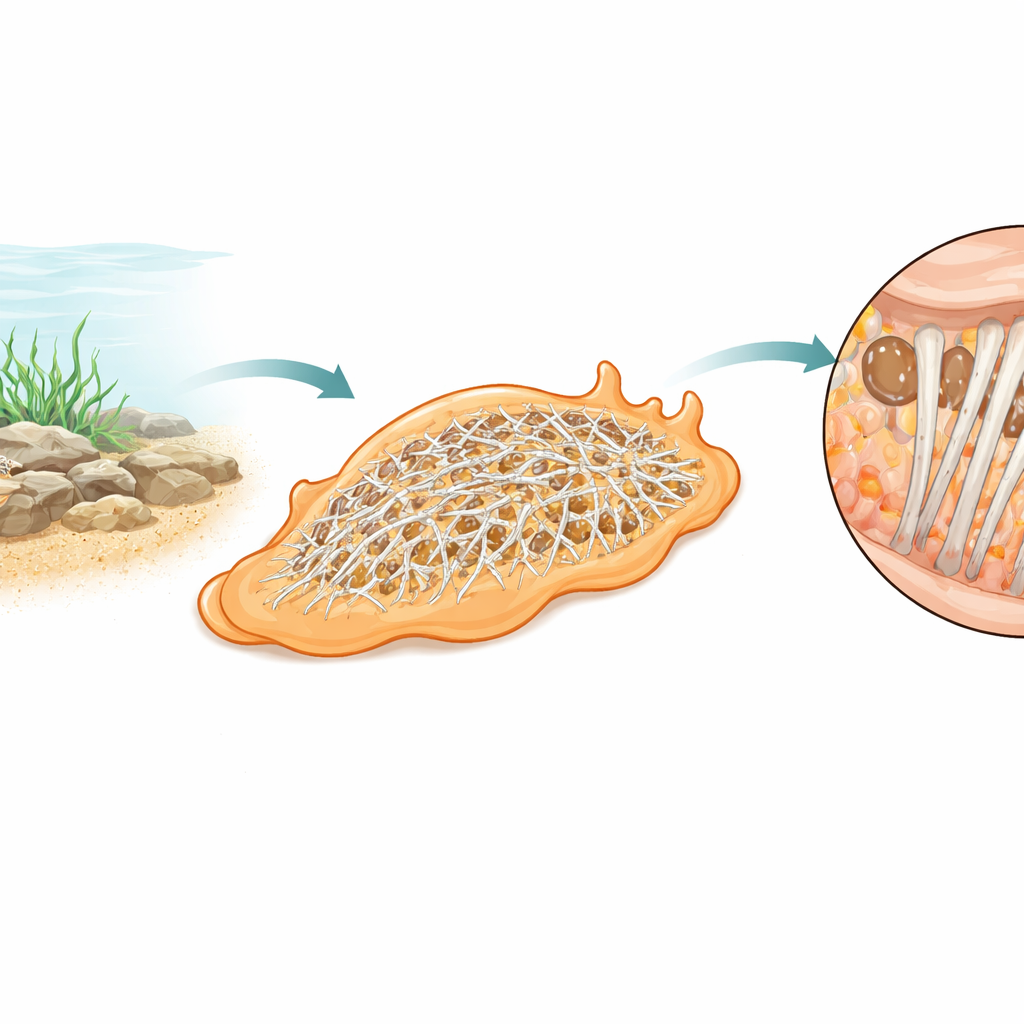
Baptodoris cinnabarina is a flat, vividly colored sea slug that crawls over rocky and muddy seafloors in the Mediterranean and nearby Atlantic. Unlike many relatives that carry a solid shell, this species hides its mineral parts within the body wall. Using high-resolution 3D X-ray scans, the researchers show that the slug’s skin is packed with slender, rod-shaped elements called spicules. These spicules form a continuous internal mesh that wraps around the animal like a flexible cage, especially dense in small bumps on the back that serve as sensory structures. The arrangement turns soft tissue into a reinforced layer without the need for an external shell.
How the tiny rods are built
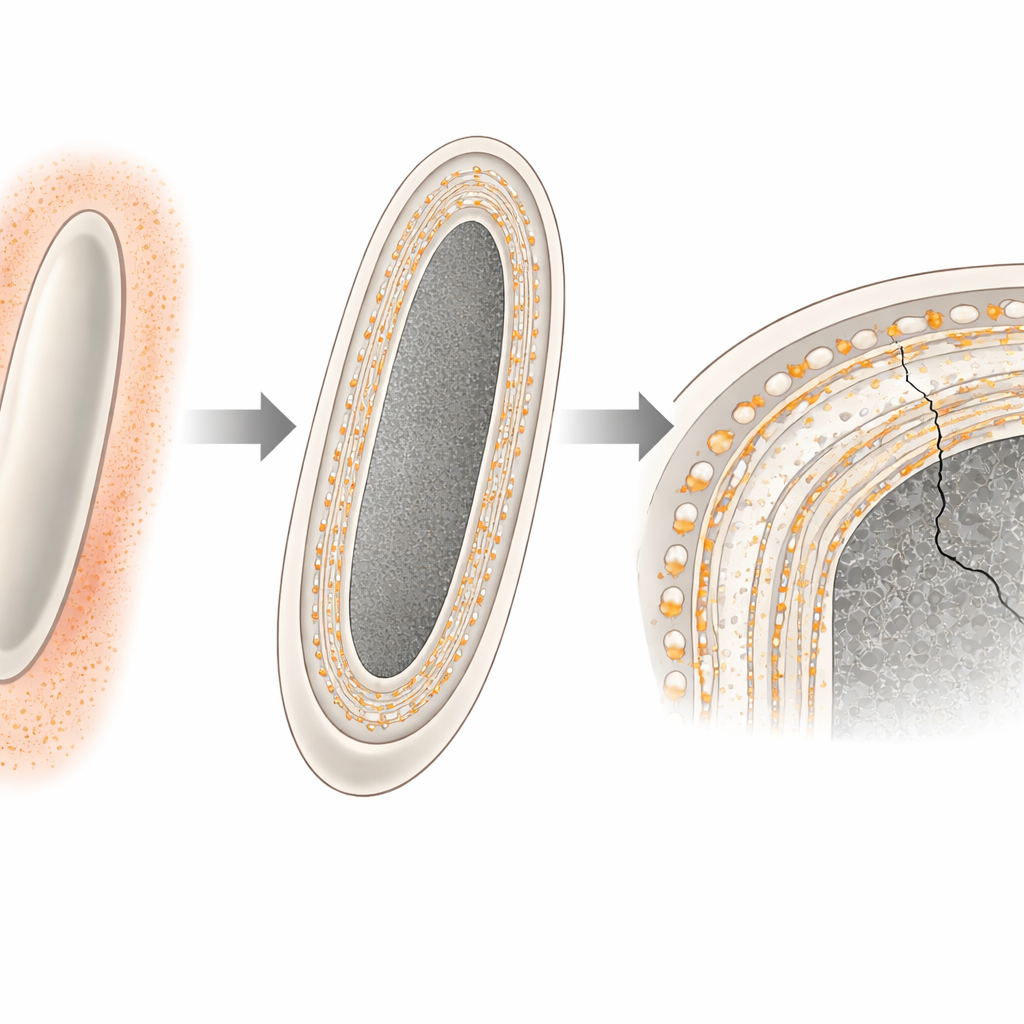
When the scientists zoomed in with electron microscopes, each spicule revealed a sophisticated design. Every rod has a distinct outer rim and inner core. The rim contains many thin, concentric sheets of organic material, like tree rings, interleaved with small mineral grains. The core, in contrast, is more uniform and heavily mineralized, with only sparse traces of organic layers. Cracks observed during sample preparation tended to form in the inner part of the spicule but stopped abruptly at the rim, suggesting that the rim’s layered structure acts as a built-in barrier against fracture and helps keep the rods tough yet slightly flexible.
Glass-like minerals instead of crystals
To find out what these spicules are made of, the team combined several advanced techniques, including X-ray diffraction, electron diffraction, elemental mapping, and solid-state nuclear magnetic resonance. All these methods converged on a striking result: the mineral inside the spicules is not crystalline, like common shell materials, but amorphous—more like a frozen liquid or glass. The main component is amorphous calcium carbonate, accompanied by amorphous calcium phosphate. This combination is unusual but highly stable: even intense electron beams that normally trigger crystallization did not change it. Detailed measurements show that the spicule core is rich in magnesium-bearing amorphous calcium carbonate, while the rim contains more phosphate and organic matter, creating a gentle gradient in composition from outside to inside.
Why a disordered material is an advantage
Amorphous minerals give the slug important mechanical benefits. Because they lack the ordered structure of crystals, they do not have weak planes along which they can easily split. That makes them less brittle and better at stopping cracks. Their isotropic nature means they respond similarly to forces from any direction, ideal for an animal whose body bends, twists, and contracts as it moves. The structured pairing of a tougher, phosphate- and organic-rich rim with a stiffer, magnesium-rich core allows each spicule to be both strong and damage-resistant. Together, countless such rods create a lightweight internal skeleton that stiffens the skin, supports movement, and may also make the surface less palatable to predators, all while keeping the animal agile.
A lightweight internal skeleton by design
In the end, the study shows that Baptodoris cinnabarina relies on a carefully engineered composite material: organic sheets plus two different amorphous minerals whose ingredients are distributed differently from rim to core. Rather than building a heavy outer shell, this sea slug uses a hidden, mesh-like scaffold under its skin to reinforce its soft body. The work highlights how nature can exploit disordered, glass-like minerals to create internal skeletons that are strong, flexible, and remarkably stable—offering fresh inspiration for designing new lightweight, fracture-resistant materials.
Citation: Griesshaber, E., Salas, C., Castro-Claros, J.D. et al. Magnesium- and biopolymer-stabilized ACC and ACP form the body-wall spicules of Baptodoris cinnabarina (Doridida, Gastropoda). Sci Rep 16, 12895 (2026). https://doi.org/10.1038/s41598-026-47236-9
Keywords: biomineralization, sea slugs, amorphous minerals, lightweight skeletons, marine invertebrates