Clear Sky Science · en
Analytically tractable model of synaptic crowding explains emergent small-world structure and network dynamics
Why crowded brain connections matter
Our brains are wired by billions of tiny junctions called synapses, but space and resources are limited. This paper asks a simple question with far-reaching consequences: what happens to brain-wide wiring and activity if each neuron gradually becomes less willing to accept new synapses as it gets more crowded? From that single idea, the author shows how realistic large-scale network patterns and dynamic behaviors can arise without assuming any complicated design rules.
A simple rule for building busy neurons
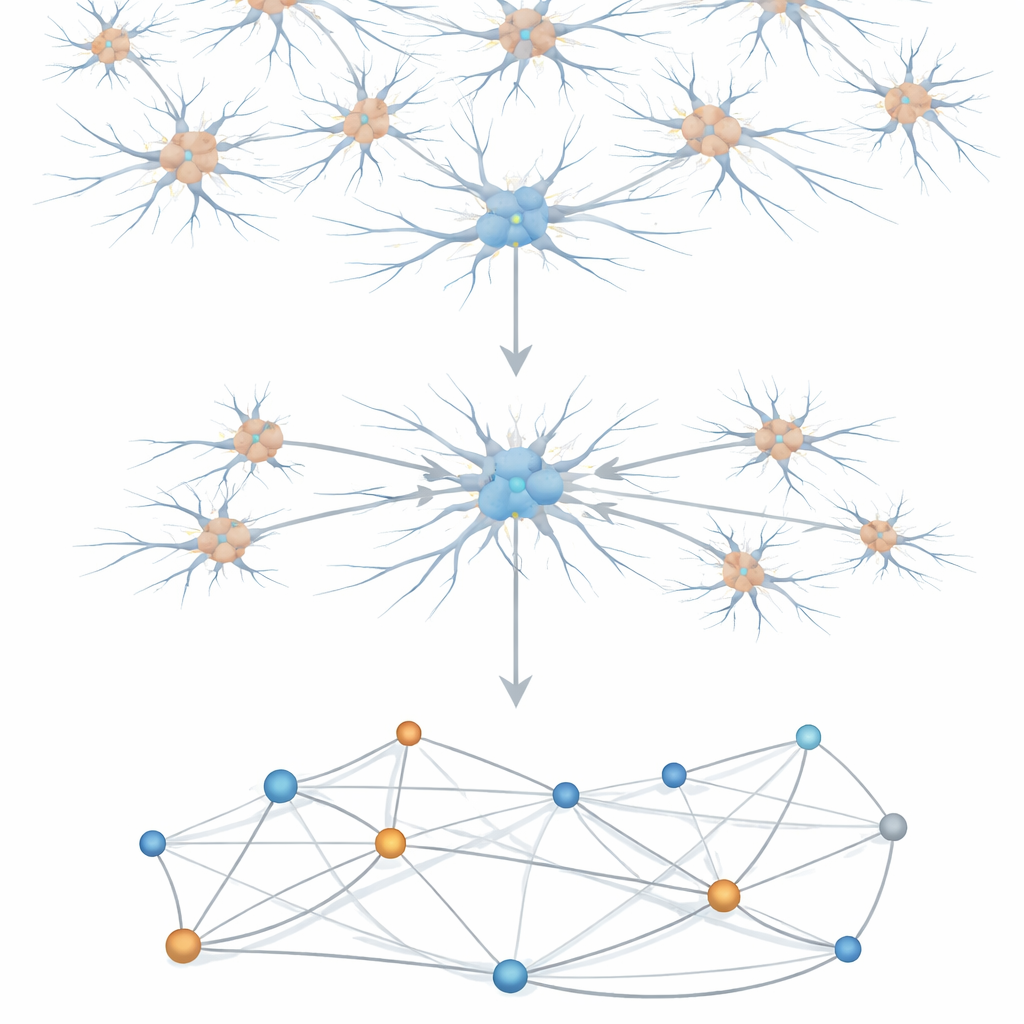
The study introduces a minimalist recipe for forming connections in a network of neurons. Imagine picking a target neuron and offering it potential incoming synapses, one source neuron at a time. The first offer is always accepted, but each additional one is harder to add than the last. A single parameter controls how steeply this willingness to accept new contacts drops. Despite its simplicity, this rule lets the author work out, exactly and for any finite network size, how many inputs each neuron tends to receive and how variable those counts are. As the network gets larger, the typical number of inputs per neuron grows only as fast as the logarithm of network size, and the spread around that typical value stays bounded. In plain terms, the rule automatically prevents neurons from becoming wildly over-connected even as the system scales up.
Emerging patterns of wiring length and shortcuts
The crowding rule itself does not mention physical distance, yet real brains are embedded in space and most synapses are local. To capture this, the model assumes that potential partners are considered in order of how close they are. Strikingly, when the same crowding penalty is applied to this distance-ordered list, the resulting connections span a wide range of lengths in a very specific way: the probability of a connection at distance d is roughly proportional to 1/d. That means there are many short links, but also a steady trickle of longer ones at each spatial scale. Viewed pair by pair, the effective chance of connecting two regions falls off with distance in much the same way as in famous “small-world” models that were originally defined by hand. Here, that behavior appears automatically from local crowding plus spatial ordering, not from an imposed distance formula.
How local wiring shapes global activity
Beyond static wiring, the paper explores what these networks actually do when neurons update their on/off states using a simple threshold rule: each neuron turns on if enough of its inputs are on. The author uses a combination of analytical tools and simulations to track how the overall fraction of active neurons evolves and which final patterns of activity are most likely. A key insight is that the detailed shape of the input-count histogram—not just its average—strongly affects where the tipping point lies between activity dying out and spreading to almost the whole network. By comparing to classic random networks with the same mean number of inputs, the study shows that the crowding-induced distribution shifts these “basin boundaries,” leaving a recognizable fingerprint of the underlying wiring rule on the large-scale dynamics.
Clustering, shortcuts, and long-lived patterns
Because the acceptance rule only cares about how many inputs a neuron already has, the model can rearrange the order of candidate partners without changing input statistics. The author exploits this to build networks that range from highly local, grid-like layouts to more shuffled, shortcut-rich ones, all with the same input counts per neuron. Structural measures show that the spatially ordered version displays the hallmarks of a small-world network: strong local clustering alongside short paths between distant nodes, thanks to a few long-range links generated by the broad length distribution. Dynamically, however, these geometric details mainly influence the behavior near the tipping point. Locally clustered networks tend to sustain long-lived, nontrivial activity patterns—such as cycles or mixed states—whereas heavily rewired versions more cleanly fall into one of two uniform outcomes (all on or all off), as predicted by simplified analytical approximations.
From microscopic limits to macroscopic brain patterns
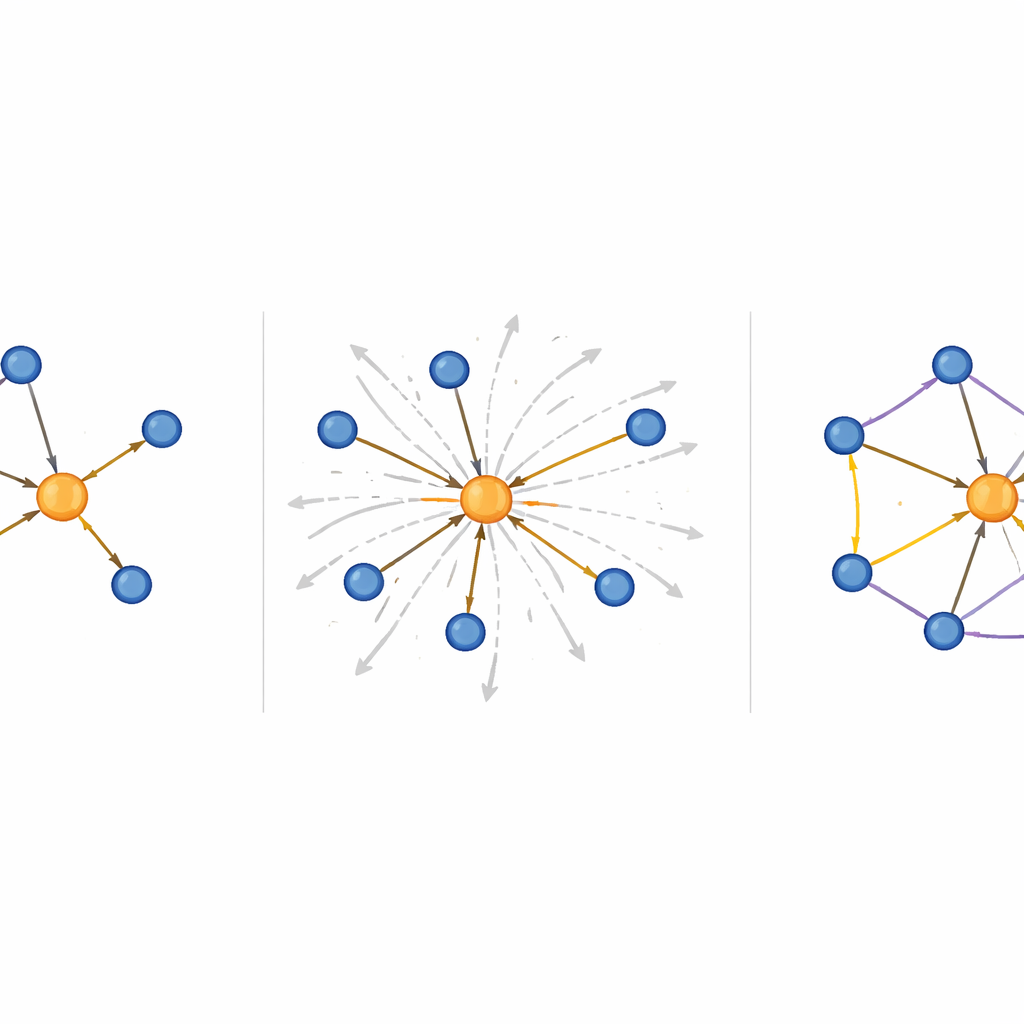
Overall, the work suggests that a basic crowding effect—each neuron’s diminishing capacity to host new synapses—can help explain how real nervous systems remain sparsely yet robustly connected, how they acquire multi-scale, small-world wiring without hard-coded distance rules, and how their large-scale activity responds to perturbations. The model yields concrete, testable predictions for the distribution of synaptic inputs, the spread of connection lengths, and the sensitivity of network activity to initial conditions. For readers, the key message is that global organization and rich dynamics need not require elaborate instructions: they can emerge from a single, biologically plausible constraint applied uniformly during growth.
Citation: Fukushima, M. Analytically tractable model of synaptic crowding explains emergent small-world structure and network dynamics. Sci Rep 16, 11748 (2026). https://doi.org/10.1038/s41598-026-47213-2
Keywords: synaptic crowding, small-world networks, brain connectivity, network dynamics, threshold models