Clear Sky Science · en
Predicting unconfined compressive strength of geopolymer-stabilized clays using a sector fruit fly–based extreme learning machine
Stronger ground with less environmental cost
Across the world, engineers need to turn soft, clay-rich soils into firm foundations for roads, buildings, and embankments. Traditionally, this has meant adding large amounts of ordinary Portland cement, a major source of carbon dioxide emissions. This study explores a cleaner path: using industrial by‑products called geopolymers to strengthen clay, and applying a clever form of artificial intelligence to predict how strong the treated soil will become without having to run endless lab tests.
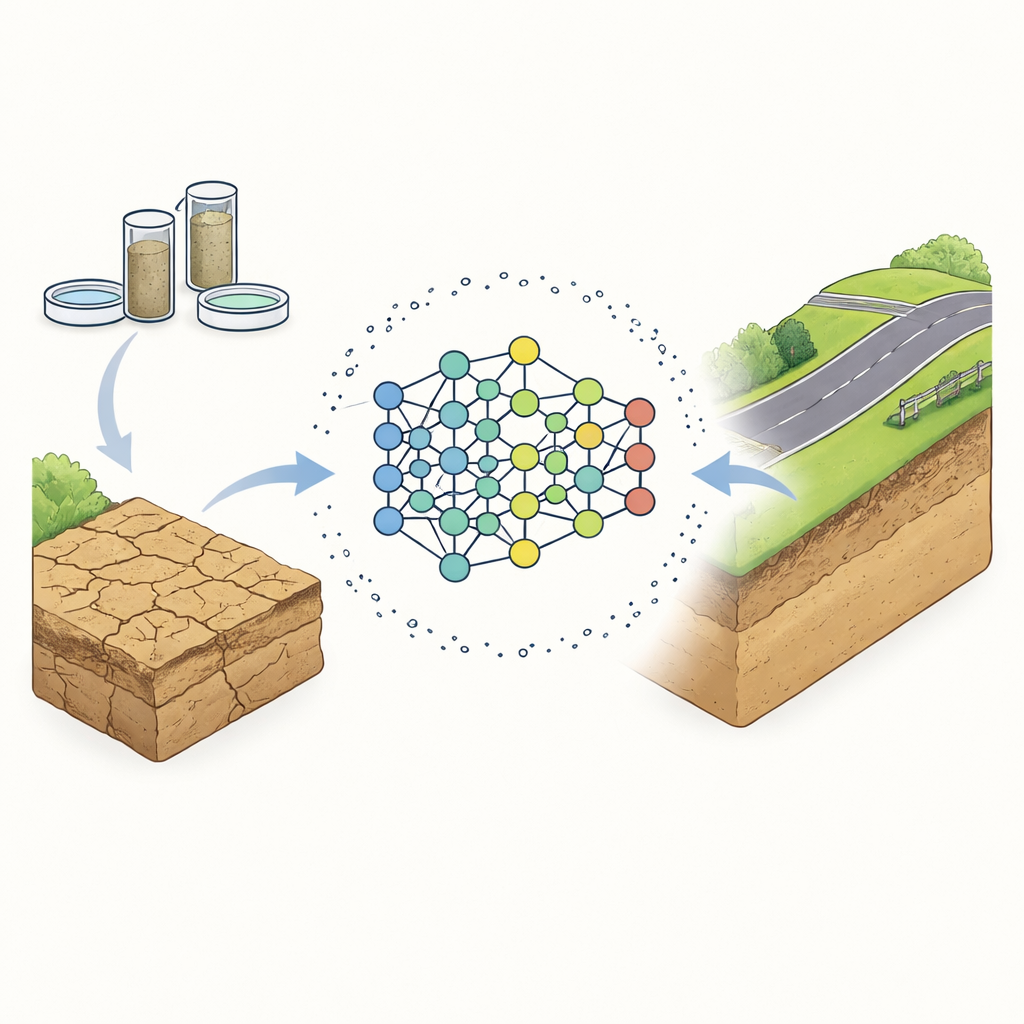
Turning industrial waste into useful binders
Geopolymers are binders made by activating aluminosilicate-rich powders—such as ground granulated blast furnace slag (GGBS) and fly ash—with alkaline solutions. When mixed with clay, they form rigid, stone‑like networks that can deliver high strength, low shrinkage, and good durability, while emitting far less CO₂ than conventional cement. Past experiments have shown that geopolymer-stabilized clays can reach strengths ranging from almost zero up to more than 40 megapascals, depending on the mix. But the outcome depends sensitively on many ingredients at once: the clay’s natural plasticity, how much slag or ash is added, the strength of the alkaline solution, and the balance of key elements like sodium, silicon, and aluminum.
Why predicting soil strength is so challenging
To design a practical mix, engineers would like to know in advance how strong a particular recipe will be. Running full laboratory programs for every candidate blend is slow and expensive. Traditional statistical formulas also fall short because the relationships among soil type, geopolymer composition, and resulting strength are highly non‑linear. Modern machine‑learning tools—such as neural networks and support vector machines—have improved predictions, but they can require heavy tuning, may overfit small datasets, and often behave like opaque “black boxes” that do not clearly show which ingredients matter most.
A smarter learning machine guided by a digital swarm
The authors assembled 270 test results from previous studies on geopolymer-stabilized clays, spanning different soil types, binder blends, alkaline concentrations, and curing conditions. They then trained three related prediction models. The core engine, called an extreme learning machine, is a fast neural network that sets most of its internal settings in one analytical step instead of slow trial‑and‑error training. To refine those internal settings, the team coupled the network to a “fruit fly optimization” routine that mimics how fruit flies search for food. In their enhanced version, sector fruit fly optimization, the virtual swarm does not wander randomly; instead, it explores the search space in evenly spaced sectors, improving stability and helping the algorithm settle more quickly on a good solution.
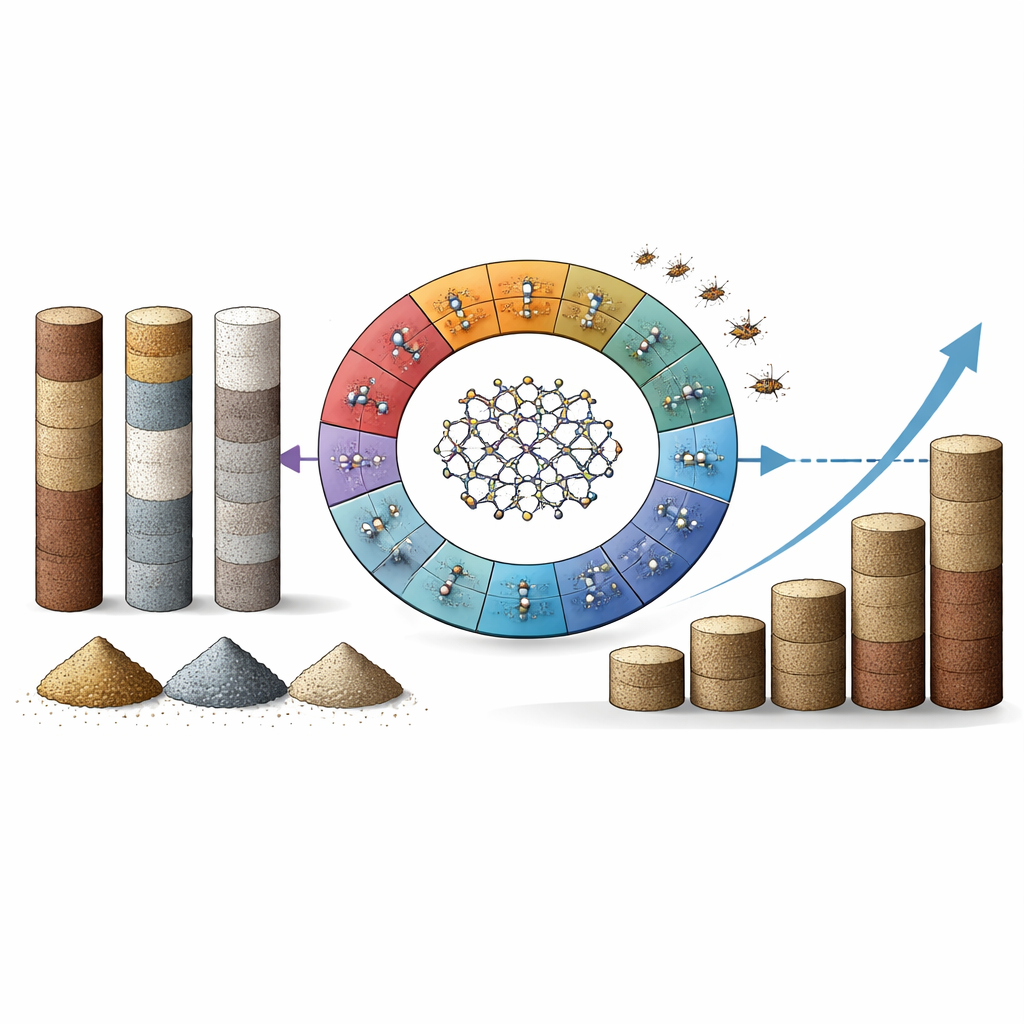
Better predictions and clearer insight into what matters
When tested on unseen data, the basic learning machine already predicted unconfined compressive strength—how much squeezing the treated clay can withstand—reasonably well. Adding the original swarm search improved accuracy further. The sector-based swarm performed best of all, cutting prediction error by about 42 percent compared with the baseline model and by 19 percent compared with the earlier fruit fly version, while keeping computation light enough for an ordinary laptop. Most predicted strengths fell close to the measured values, and error patterns suggested the model generalized well rather than merely memorizing the training data.
Translating complex models into practical soil recipes
To open the “black box,” the researchers applied a technique called SHAP analysis, which assigns each input a contribution to the final prediction. This revealed that the slag content (GGBS) was the single most influential factor in boosting strength, with the clay’s plasticity and liquid limit also playing major roles. Certain mix parameters—like excessive fly ash or very high plasticity—tended to lower strength, while appropriate alkali concentration and sodium-to-aluminum balance provided more modest positive effects. These insights, combined with the accurate predictions, make the sector fruit fly–enhanced learning machine a promising tool for guiding geopolymer mix design, helping engineers choose recipes that produce strong, stable ground with fewer tests and a smaller environmental footprint.
Citation: Abdellatief, M., mortagi, M. Predicting unconfined compressive strength of geopolymer-stabilized clays using a sector fruit fly–based extreme learning machine. Sci Rep 16, 12723 (2026). https://doi.org/10.1038/s41598-026-47208-z
Keywords: geopolymer-stabilized clay, soil strength prediction, machine learning in geotechnics, sustainable ground improvement, extreme learning machine