Clear Sky Science · en
Topology modeling and energy efficiency prediction of parallel chillers based on deep learning
Why smarter cooling matters
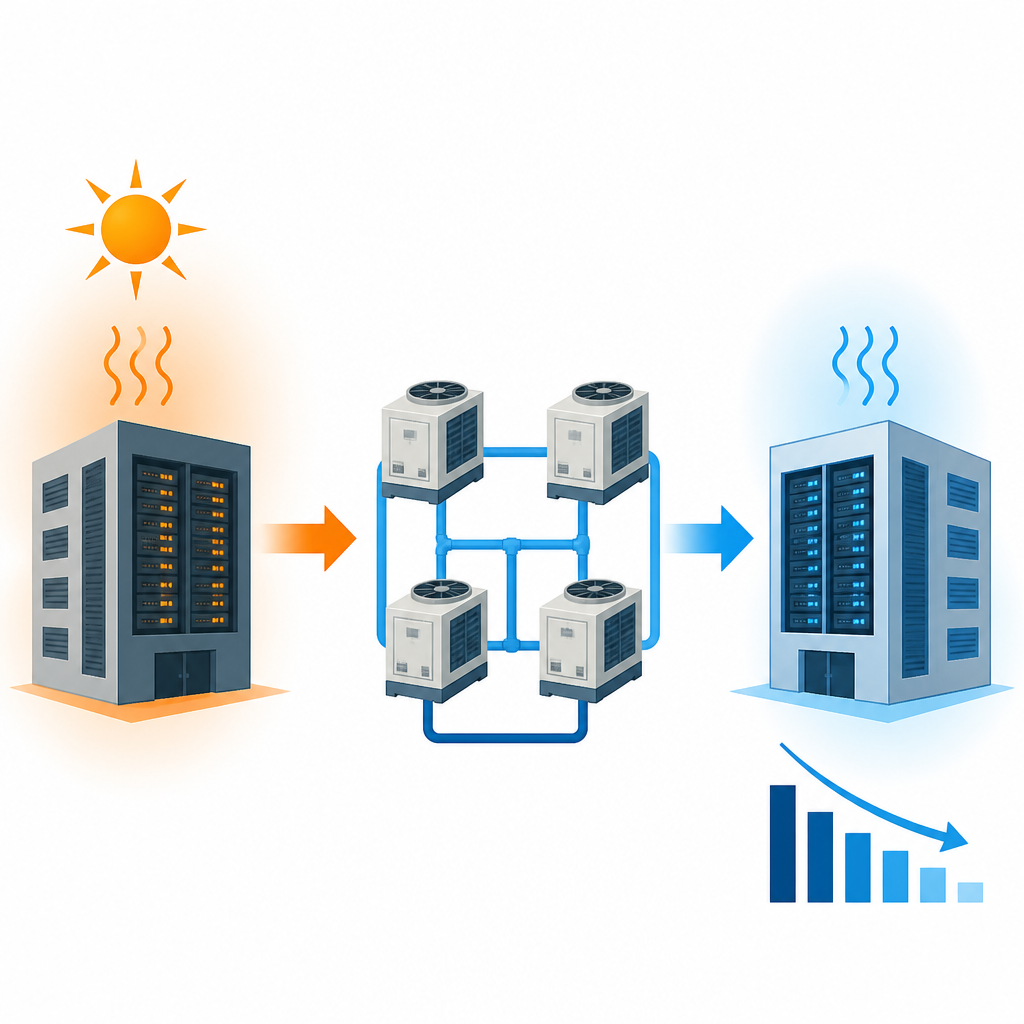
Behind every data center, factory, and large ship sits a cooling system that quietly eats a huge share of the world’s electricity. Many facilities run several chillers in parallel to keep servers and machines at safe temperatures, but small changes in how these chillers share the workload can waste large amounts of energy. This study shows how a new type of artificial intelligence can "see" both the layout of a cooling system and its changing behavior over time, so operators can predict energy use more accurately and run their chillers far more efficiently.
How big cooling systems waste power
Cooling stations in industry account for a large slice of global energy use, and up to a third of that can be wasted through poor operation and load sharing. In a typical plant or data center, several chillers, pumps, and cooling towers work together, linked by a maze of pipes. When one chiller starts, stops, or changes load, it affects flow and pressure throughout the network, which in turn changes how hard all the other machines have to work. Traditional control rules and simple prediction models treat each chiller almost as if it were on its own, so they often miss these hidden links and struggle when conditions or equipment status change.
Teaching a model to follow time and connections
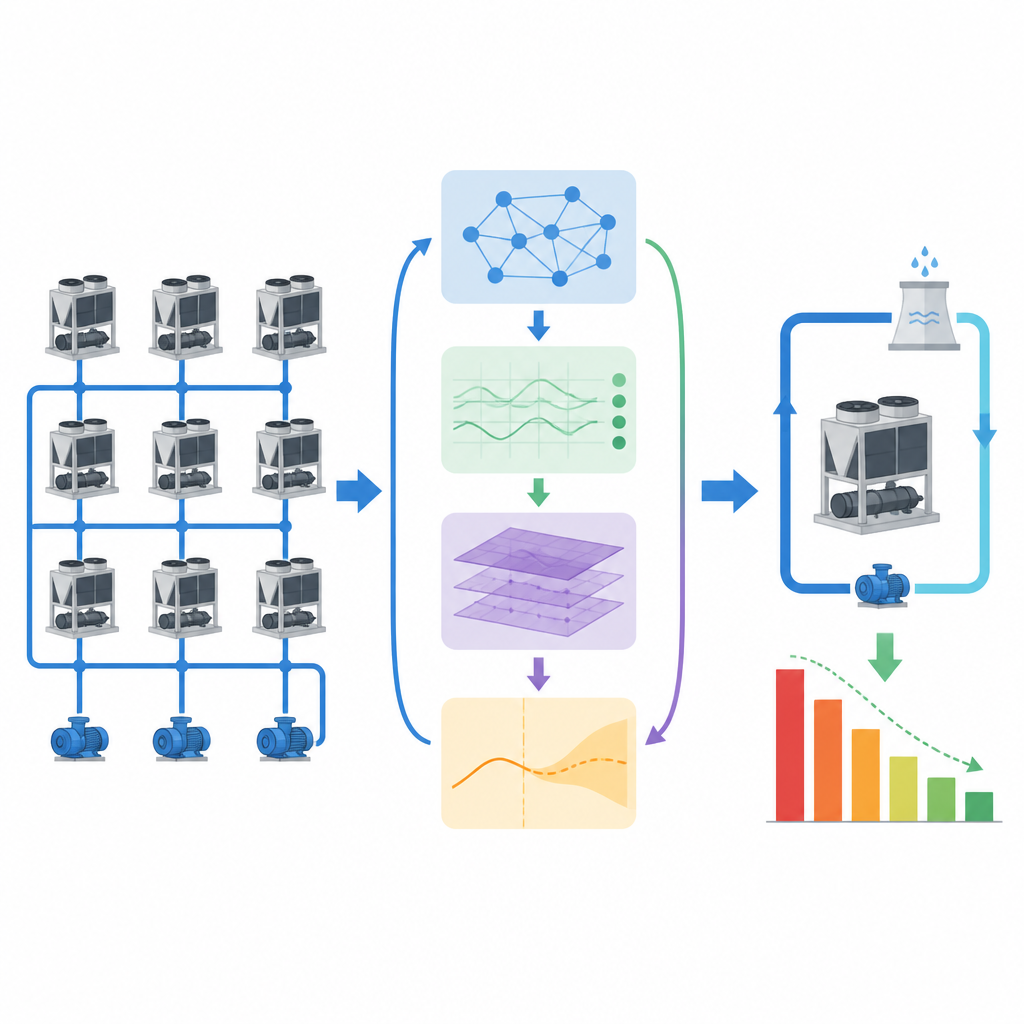
The researchers built a hybrid deep learning model that combines two key ideas. The first is a sequence model called LSTM, which is good at spotting patterns in time series, such as how power draw and water temperature change minute by minute. The second is a graph-based model, GCN, which treats every chiller, pump, and cooling tower as a node in a network and learns how they influence one another through the physical pipe layout and current load sharing. By fusing these two views, the model can track both the history of each device and the way all devices are tied together.
Using physics and digital twins as a guide
Instead of feeding raw sensor signals directly into the network, the team first converts them into quantities that have clear physical meaning, such as cooling power per unit of electricity and the effectiveness of heat exchange. They also add a regularization term that gently nudges predictions to respect basic energy and heat-balance laws, which helps avoid unrealistically sharp jumps. To widen the range of situations the model sees, they pair real data from a large data center with thousands of hours of simulated data from a digital twin of the cooling station. This twin lets them explore changing loads, outdoor conditions, and even different ways of connecting equipment that would be hard or risky to test in the real plant.
Testing on data centers, factories, and ships
The model is trained on about 128 million historical records from a data center with five large centrifugal chillers and then tested on fresh data. At a 30-minute prediction window, it cuts the root-mean-square error in power forecasts by 19.4 percent and trims percentage error by just over 2 points compared with a strong LSTM baseline that ignores the network layout. The authors also check how well the approach transfers to an automobile factory and to the central cooling system of a container ship. With limited fine-tuning for the factory and no retraining at all for the ship, the model still clearly outperforms conventional methods, showing that the learned representation of cooling behavior is not tied to one site.
What this means for saving energy
By combining knowledge of how equipment is connected, how it behaves over time, and how physics constrains it, the proposed GCN–LSTM system can forecast chiller energy use with high accuracy and stability, even when equipment ages or the operating pattern changes. These more reliable predictions allow control software to choose better load-sharing strategies, shifting work between chillers to keep comfort and cooling capacity while using less electricity. In practical terms, this approach points to a new, transferable way to cut energy waste in large cooling systems across data centers, factories, and ships without rebuilding the hardware.
Citation: Liu, Y., Yang, X., Zhang, L. et al. Topology modeling and energy efficiency prediction of parallel chillers based on deep learning. Sci Rep 16, 15813 (2026). https://doi.org/10.1038/s41598-026-47180-8
Keywords: chiller energy efficiency, deep learning, graph neural network, industrial cooling, intelligent control