Clear Sky Science · en
Dynamic mechanical thermal analysis (DMTA) of the hybrid epoxy/carbon-fibers nanocomposites for satellite structures
Why stronger, calmer satellites matter
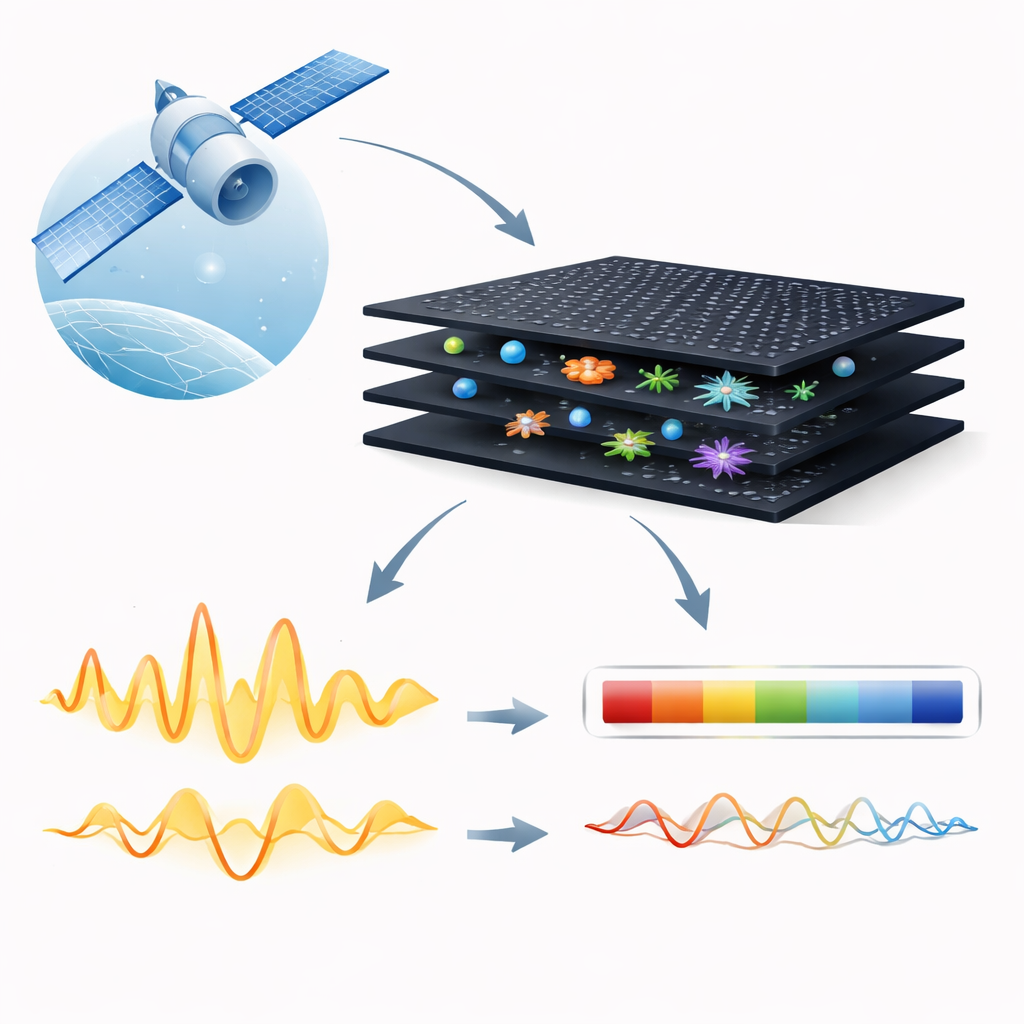
Every satellite is shaken, baked, and frozen as it rockets into space and circles Earth. To keep working, its lightweight panels and brackets must stay stiff enough not to warp, yet soft enough to soak up vibrations that could blur images or damage electronics. This study explores a new recipe for such structures: thin carbon-fiber/epoxy shells sprinkled with tiny ceramic and carbon particles. The researchers ask a practical question with big implications for space hardware: which type of nanoparticle, and in what amount, best improves how these materials handle heat and vibration?
Building better space-ready materials
The team focused on common satellite building blocks: carbon fibers embedded in an epoxy resin, stacked into a 30-layer laminate similar to real spacecraft panels. Into the epoxy, they mixed one of four nanoscale additives—titanium oxide (TiO2), zirconium oxide (ZrO2), silicon oxide (SiO2), or graphite—at low weight fractions, mostly 1.5% or 3%. These particles are thousands of times smaller than a grain of sand, yet large enough to change how the material responds when bent, heated, or shaken. The goal was not just to boost strength, but to tune how the composite stores and dissipates energy over the temperatures a satellite might see, from room temperature to well above the boiling point of water.
Testing how the material moves and heats
To probe this behavior, the researchers used dynamic mechanical thermal analysis, a technique that gently flexes a small beam of material while its temperature is slowly raised. From this single test, they extracted several key properties: how stiff it is, how easily it deforms, how viscous or “sticky” its motion is, and how much vibration energy it turns into harmless heat. They also tracked the glass transition temperature—the point where the material shifts from stiff and glassy to soft and rubber-like. For satellite parts, pushing this transition to higher temperatures and controlling how the material damps out vibrations are both critical to avoid warping, rattling, or failure.
What different nanoparticles actually do
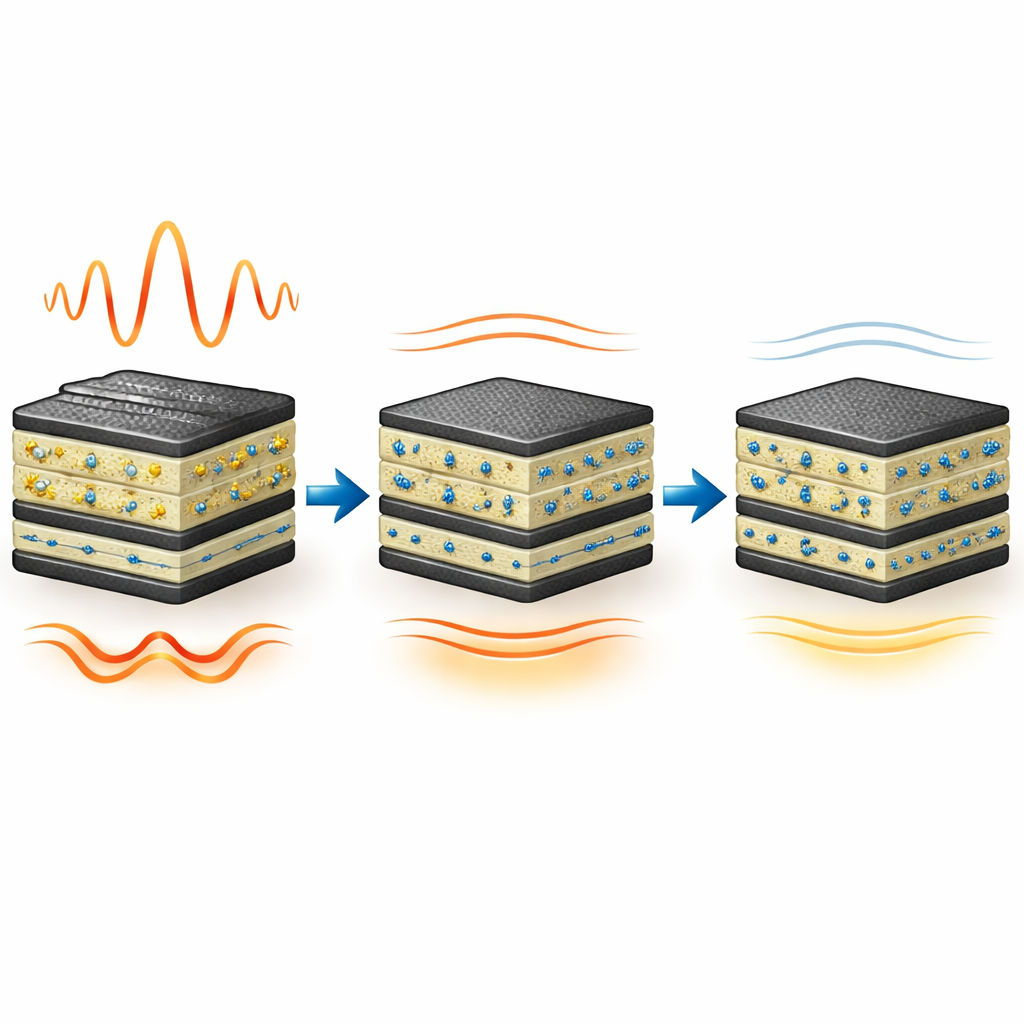
The results show that there is no one-size-fits-all filler. A small amount of graphite (1.5%) produced the largest jump in thermal resistance, raising the glass transition temperature from about 40 °C to nearly 56 °C, meaning the composite stays rigid over a wider temperature range. Titanium oxide stood out among the ceramic additives: at 3% loading it increased both the transition temperature and the effective stiffness, while also boosting the damping factor, making the material better at soaking up vibrations. Zirconium oxide behaved differently; at 3% it provided stiffer, more stable behavior at high temperatures and improved resistance to deformation, but its impact on overall vibration damping was more moderate. Silicon oxide at 3% gave a balanced response, offering added stiffness up to the transition temperature and the highest measured viscosity, consistent with strong bonding at the interface between particles and epoxy.
Looking inside the material
Microscopes revealed why these tiny additives matter. Optical and electron images showed that the base carbon-fiber/epoxy laminates were well made, with good bonding and few voids. When nanoparticles were added, their shape and distribution changed how the composite behaved. Finely dispersed titanium oxide particles, largely spherical, were well integrated into the resin, promoting good stress transfer. Silicon oxide flakes were mostly well spread, with only modest clustering. In contrast, zirconium oxide and graphite tended to form larger clumps and elongated structures in some cases, which can either help by deflecting cracks or hurt by concentrating stress, depending on how uniformly they are dispersed. Elemental mapping confirmed that, when the particles were evenly spread, the mechanical and thermal responses were more predictable and stable.
What this means for future satellites
Overall, the study shows that carefully chosen and well-dispersed nanoparticles can turn standard carbon-fiber/epoxy laminates into more reliable, tunable materials for satellites. Graphite offers a strong boost in heat resistance, titanium oxide gives a powerful mix of stiffness and vibration damping, zirconium oxide shines at high-temperature stability, and silicon oxide helps create a viscous, well-bonded interphase. Rather than searching for a single “best” filler, spacecraft designers can use these findings as a menu: pick and blend nanoparticle types and loadings to match the specific demands of a satellite panel, bracket, or housing, making future spacecraft lighter, quieter, and more durable in the extreme environment of space.
Citation: Gamil, M., Farouk, W.M., Abu-Oqail, A. et al. Dynamic mechanical thermal analysis (DMTA) of the hybrid epoxy/carbon-fibers nanocomposites for satellite structures. Sci Rep 16, 12720 (2026). https://doi.org/10.1038/s41598-026-47147-9
Keywords: satellite structures, carbon fiber composites, epoxy nanocomposites, vibration damping, thermal stability