Clear Sky Science · en
Machine learning-based approaches to identify key drivers and predict severe food insecurity in Africa
Why this study matters for everyday life
For many families across Africa, the question is not what to eat but whether they will eat at all. This study uses modern data tools to uncover which national conditions most strongly shape the risk that people go a whole day or more without food. By learning which levers matter most, governments and aid groups can focus on the changes that will actually help households keep food on the table.
Looking at hunger from a countrywide view
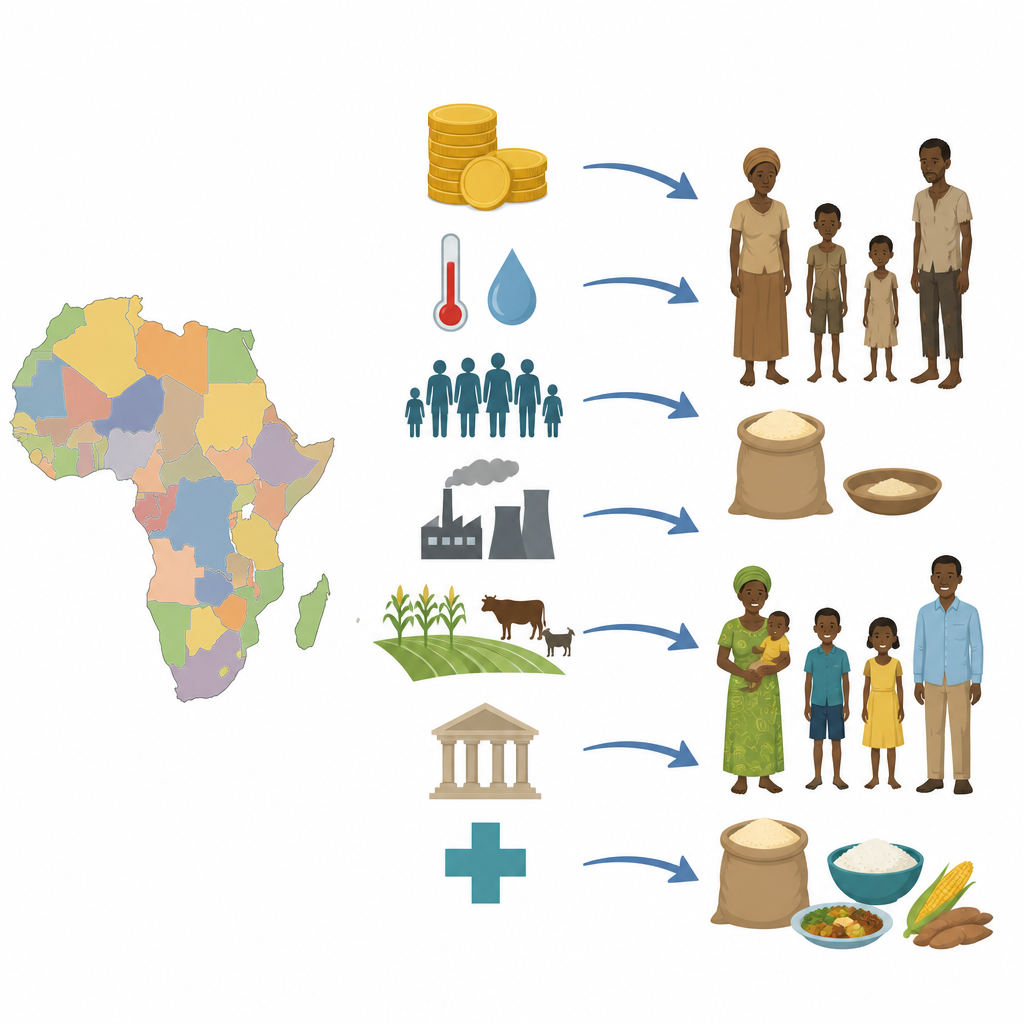
Most past research on hunger has zoomed in on households or villages. While that local focus is vital, it can miss the wider forces that shape prices, jobs and food supplies for entire populations. This study instead looks at all African countries between 2015 and 2021 and asks how broad economic, environmental, political and health conditions translate into severe food insecurity. The authors combine information from the Food and Agriculture Organization, the World Bank and the Malaria Atlas Project to build a continent-wide picture of hunger risk.
Using smart algorithms to find hidden patterns
The researchers feed dozens of national indicators into a range of machine learning models. These indicators include inflation, unemployment, climate and greenhouse gas emissions, malaria, livestock and crop production, food losses, trade dependence, foreign investment, electricity access, water and sanitation, and political stability. The goal is to predict how common severe food insecurity is in each country and year, defined as people going without food for at least a full day. By comparing many types of models, they test which methods best capture the tangled, often nonlinear relationships among these factors.
Which model and which factors matter most
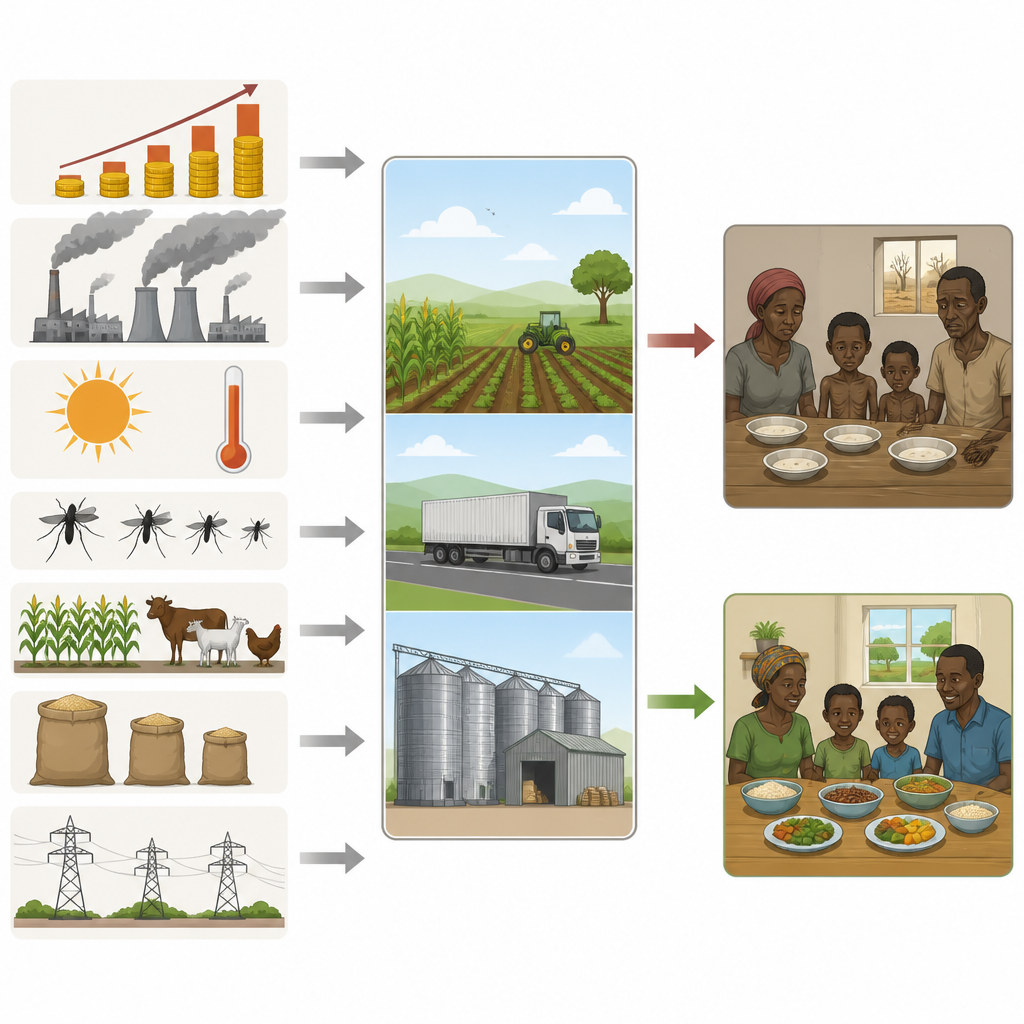
Among all the approaches tested, a method called extreme gradient boosting, or XGBoost, gives the most accurate predictions when asked to forecast later years from earlier data. The team carefully tunes this model and checks its performance on unseen data to avoid overfitting. They then probe the trained model to see which factors it relies on most, and in what direction they push hunger risk. They find that high inflation, rising temperatures, greater unemployment, more malaria, higher greenhouse gas emissions, larger caloric losses in the food chain and heavier dependence on imported cereals all go hand in hand with higher predicted rates of severe food insecurity. In contrast, higher livestock and cereal crop production, more foreign investment, greater dietary energy and protein supply, better electricity access, higher income per person and stronger political stability all line up with lower predicted hunger.
The few strongest warning signs
The analysis does more than list many influences; it ranks them. Four factors stand out as especially powerful in shaping the model’s predictions: unemployment, livestock production, greenhouse gas emissions and caloric losses at the retail level. High unemployment signals weak labor markets and shrinking household income, directly limiting people’s ability to buy food. Strong livestock production, by contrast, appears to buffer households by providing animal products, income and a form of savings. Greenhouse gas emissions are a marker of climate pressures that threaten harvests and water supplies, while caloric losses highlight waste and inefficiencies that erode food availability even when production is adequate.
What this means for tackling hunger
Put simply, the study shows that severe hunger across Africa is not driven by a single cause but by a bundle of national forces that pull in different directions. Some, like inflation, unemployment and climate stress, push families toward going without food. Others, such as reliable jobs, healthy herds, steady harvests, stable politics and strong infrastructure, offer protection. By spotlighting unemployment, livestock systems, emissions and food losses as especially important levers, the research suggests that policies creating jobs, supporting climate-resilient livestock and farming, cutting food waste and curbing climate-warming pollution are likely to have outsized benefits for food security across the continent.
Citation: Ayalew, M.M., Dessie, Z.G., Mitku, A.A. et al. Machine learning-based approaches to identify key drivers and predict severe food insecurity in Africa. Sci Rep 16, 15499 (2026). https://doi.org/10.1038/s41598-026-47139-9
Keywords: food insecurity, Africa, machine learning, unemployment, livestock production