Clear Sky Science · en
Unveiling earthquakes: thermoluminescence signal resetting of a natural polymineral sample in laboratory-produced fault gouge
Why glowing rocks matter for earthquakes
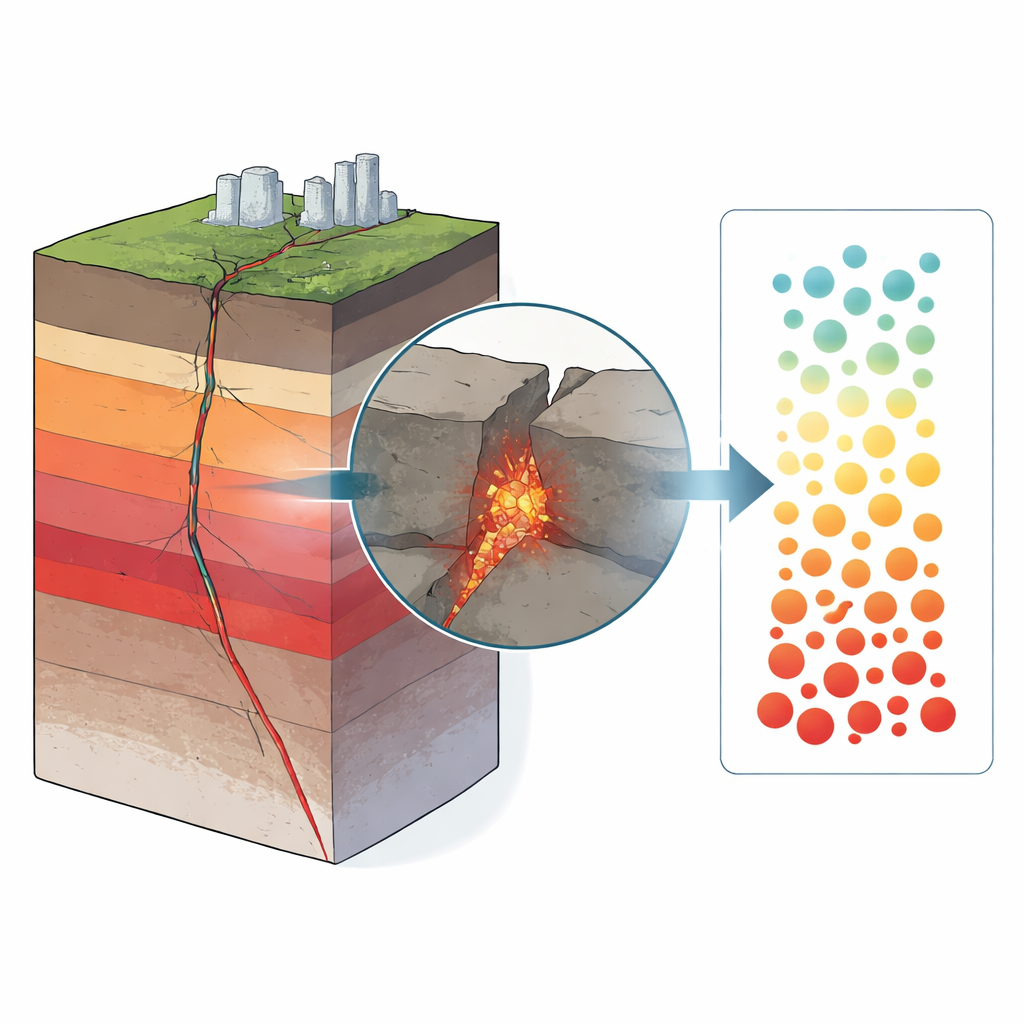
When an earthquake strikes, rocks grind past one another deep below our feet. In that brief moment, intense friction can heat and alter the crushed rock powder along the fault. Some minerals inside these rocks store a tiny “glow” created by natural radiation over time, and heating can erase and rewrite that glow. If scientists can read when this glow was last reset, they can date past earthquakes—even ones that happened long before written history. This study explores whether that glow really gets wiped clean during slipping, and how tricky it is to find the specific parts of a fault where this happens.
How rocks record the ticking of geological time
In tectonically active regions, major earthquakes repeatedly rupture the same faults over hundreds to thousands of years. Each big slip grinds the surrounding rock into a fine powder called fault gouge. Over long periods between earthquakes, natural radiation slowly fills defects in the minerals in this gouge with trapped energy, like tiny batteries charging in the dark. When heated strongly enough, these traps empty and release light—a phenomenon called thermoluminescence, or TL. By measuring how much energy is stored, researchers can estimate when the material was last heated. The challenge is that not every grain along a fault experiences the same frictional heat during an earthquake, so the “clock” may be fully reset in some places but only partly in others.
Recreating a fault in the laboratory
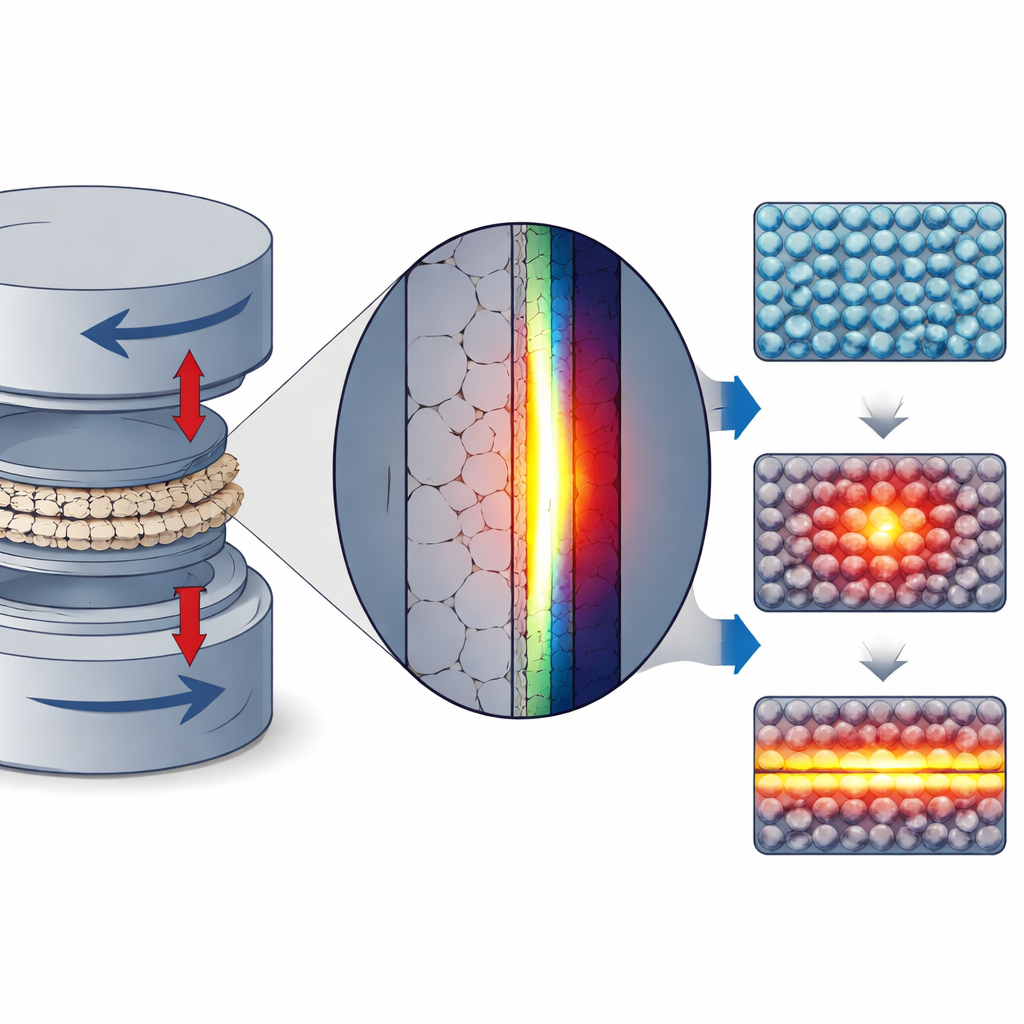
To probe this problem, the authors recreated fault slip in a controlled laboratory setting. They collected intact rock from near the North Tehran Fault in Iran, crushed part of it into a fine powder without chemical treatment, and first wiped its TL memory by heating it in a furnace. They then gave the sample a known dose of radiation so that every grain started with a carefully calibrated glow. This prepared material was placed between two metal rings in a rotary shear machine that presses and spins the sample, imitating the grinding motion along a natural fault. During several experiments, the researchers applied a moderate slip speed (0.05 meters per second) and strong normal stress (12 megapascals), conditions similar to shallow crustal depths, while a high-speed infrared camera watched the temperature rise through a sapphire window.
Hot spots that are tiny and hard to find
The thermal images revealed that heating during slip was anything but uniform. In one experiment, a narrow band less than a millimeter wide reached nearly 300 °C, hot enough in principle to fully erase the TL signal relevant to earthquake dating. Yet most of the surrounding gouge stayed much cooler, often below about 200 °C. Small differences in how the sample contacted the spinning metal or how grains were squeezed into gaps created strong temperature spikes and patches. After the experiment, the team painstakingly separated the brightest and most heavily deformed zones from more weakly disturbed material, but under dim red light the crucial thin slip layer was difficult to isolate cleanly.
Reading the faint glow of heated grains
Back in the luminescence laboratory, the researchers compared the glow of the sheared samples to that of the original, unsheared reference material. They gradually reheated small subsamples and measured the light released over a range of temperatures. The main TL peak used as a dating signal, centered around about 160–180 °C, was reduced by up to roughly half in the most strongly sheared gouge, and somewhat less in the mixed material. This showed that the laboratory slip had partially—but not completely—reset the stored signal. At higher temperatures, however, the glow pattern changed in a different way. A high‑temperature feature near about 520 °C became brighter in the sheared samples, hinting that frictional heating had altered the minerals themselves or their sensitivity to radiation in a lasting manner.
What this means for dating ancient earthquakes
These findings suggest that, even when enough heat is briefly generated to reset the TL clock, it is confined to extremely narrow slip patches within the fault gouge. In nature, faster slip speeds than those achievable in the laboratory should allow heating to erode the TL memory over larger volumes of rock, so dating fault gouge can, in principle, provide reliable ages for past earthquakes. But the study also shows that unless geologists manage to sample precisely from the thinnest, hottest layers, the mixed-in cooler grains will dilute the signal and make earthquakes appear older than they truly are. At the same time, the newly observed enhancement of a high‑temperature glow feature offers a possible fingerprint of where frictional heat was greatest. With further work, this subtle glow pattern could guide future sampling and improve our ability to read the hidden earthquake history stored in crushed rocks.
Citation: Heydari, M., Kreutzer, S., Hung, CC. et al. Unveiling earthquakes: thermoluminescence signal resetting of a natural polymineral sample in laboratory-produced fault gouge. Sci Rep 16, 12746 (2026). https://doi.org/10.1038/s41598-026-47125-1
Keywords: fault gouge dating, thermoluminescence, earthquake history, frictional heating, North Tehran Fault