Clear Sky Science · en
The optimization path of smart ice and snow sports tourism industry development under hybrid neural network model
Why winter travel needs smarter planning
As skiing and snowboarding explode in popularity, especially in countries like China, ski resorts are struggling with a basic question: how many people will actually show up, and how many rooms, instructors, and lifts will they need ready each day? Guessing wrong can mean long lines, empty hotel beds, wasted staff hours, or safety risks on crowded slopes. This study explores a new data-driven way to forecast visitor numbers and room demand at ski resorts, aiming to make ice and snow vacations smoother for tourists and more efficient for operators. 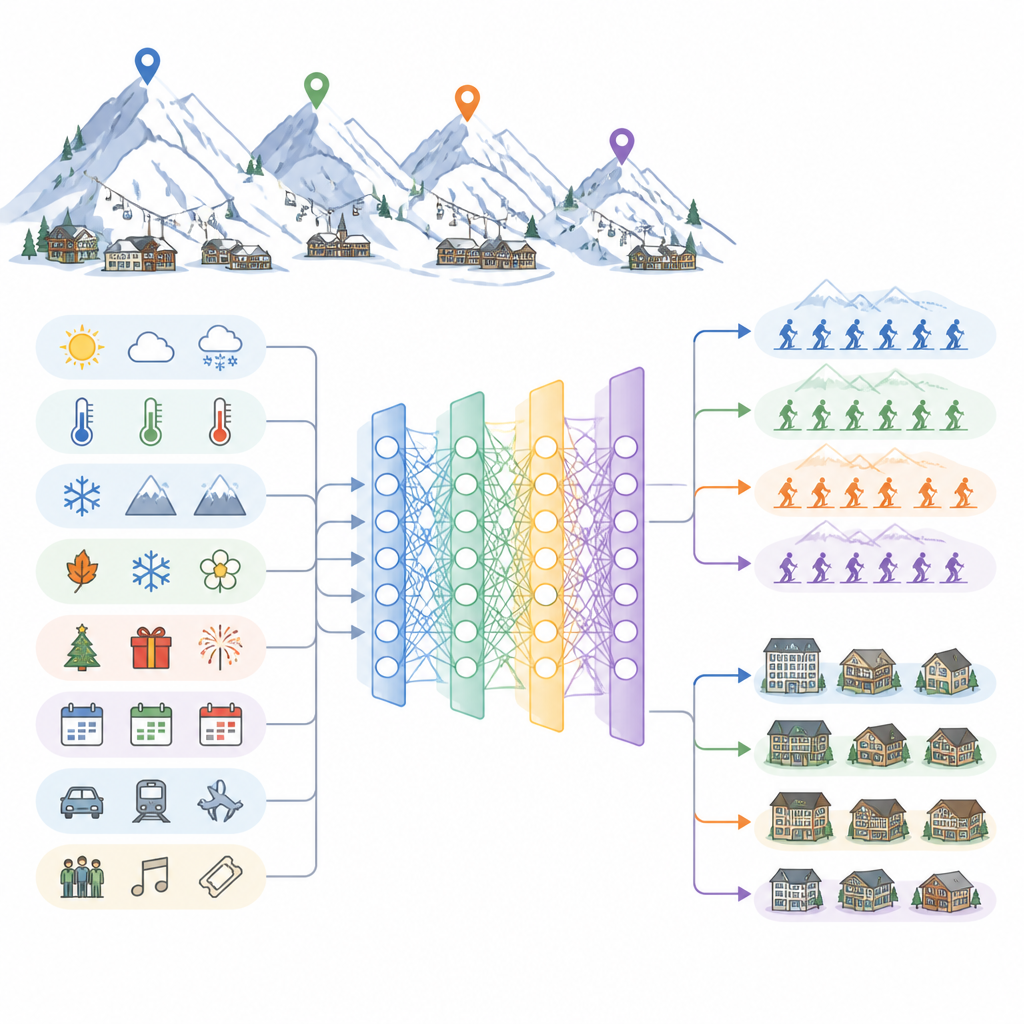
The rise of smart ice and snow tourism
Ice and snow tourism has become a pillar of winter leisure spending, driving not only ticket sales at ski resorts but also shopping, dining, and transport in nearby towns. Traditional ways of planning rely on simple statistics or experience, which struggle to juggle many different influences at once. Visitor numbers depend on school holidays, weekends, special events, ticket promotions, and constantly changing weather. Old models usually look only at past visitor counts or a few single factors. They often miss the full picture and cannot respond quickly enough for precise daily decisions about staffing or pricing.
A new model that looks at both time and context
The researchers propose a hybrid neural network, a computer model inspired by the brain, that is built to handle two kinds of information at the same time. One part of the model focuses on sequences, such as how tourist numbers change day by day, picking up patterns like weekly cycles or seasonal trends. Another part looks at static or slowly changing clues, such as whether a day falls on a holiday, what the weather is like, or what recent rolling averages of visitors and room use look like over the past week or month. By fusing these two branches, the model can connect yesterday’s patterns with today’s broader context, giving a more realistic view of what tomorrow may bring.
Letting an intelligent swarm tune the model
Computer models like this depend heavily on many internal settings, such as how fast they learn, how many units each layer uses, and how long a time window they consider. If these settings are chosen poorly, the model can get stuck in a so called local best solution and never reach its full accuracy. Instead of adjusting these dials by trial and error, the authors use an improved version of a swarm optimization method, in which many virtual particles explore different settings together. A chaos based twist helps this swarm search the space more widely at first and then settle carefully on the best region later. This process automatically discovers combinations of settings that make the hybrid network both accurate and stable. 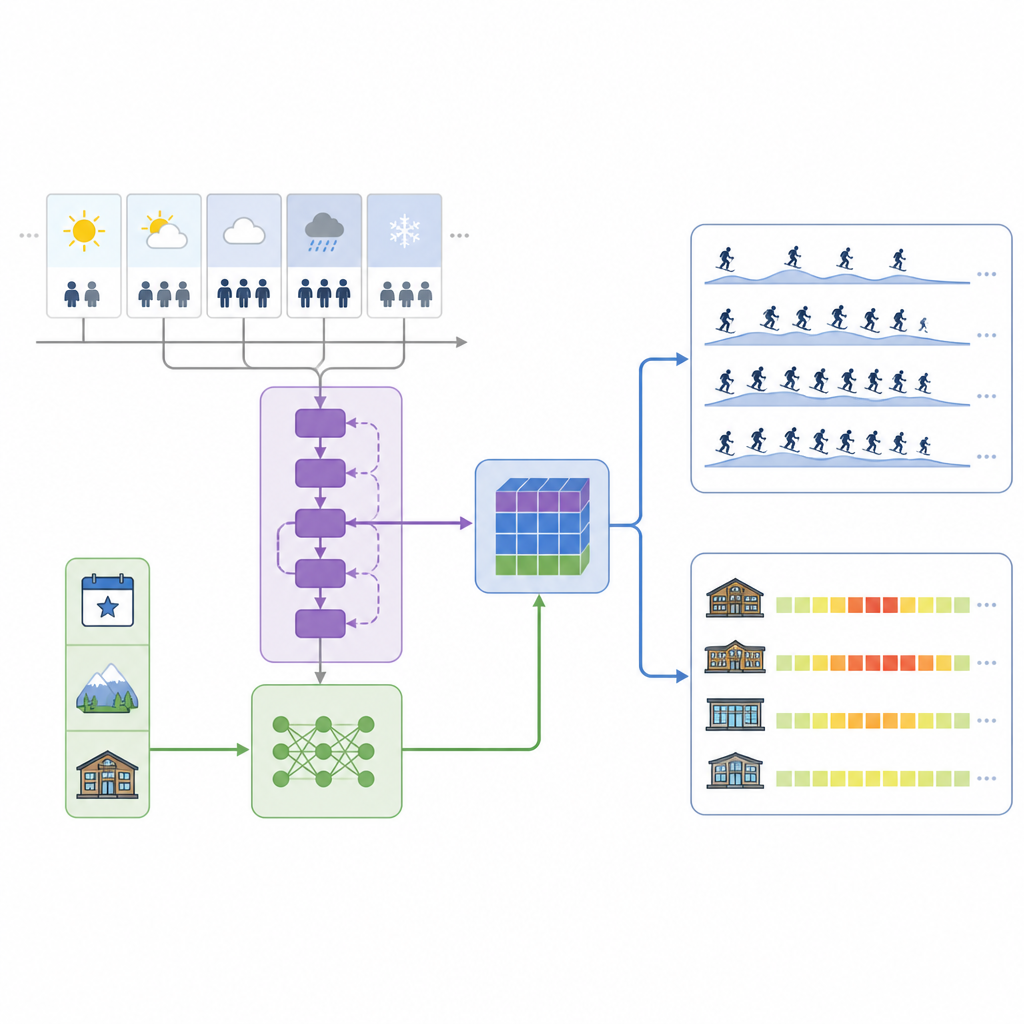
What the tests show on real ski resorts
The team trained and tested their model on a large public ski resort dataset and on detailed daily records from several actual ski resorts in China, including one flagship resort in a cold, snow rich region. Inputs included visitor counts, room occupancy, dates, holiday flags, and weather measures such as temperature, snowfall, wind, and precipitation chances. On unseen data, the hybrid model predicted visitor numbers and room occupancy more accurately than a range of well known methods, including traditional time series models and newer deep learning designs like pure LSTM networks and Transformer based models. Error measures were smaller and the fit to real trends was tighter, and repeated runs showed the results were not just a fluke but remained consistent over time and across different resorts.
How this can help winter travelers and resorts
For non specialists, the core message is simple: combining rich data about weather, calendar patterns, and recent history with an automatically tuned hybrid network makes it easier to foresee how busy a ski resort will be. Managers can use these forecasts to schedule staff, open or close slopes, adjust room prices, plan promotions, and prepare for holiday surges or quiet weekdays. While the method can still struggle during rare shocks such as sudden storms or pandemics, it offers a practical template for turning the buzzword of smart tourism into a working tool. In plain terms, better forecasts mean more reliable, safer, and more enjoyable winter trips, while helping the ice and snow tourism industry grow in a more efficient and sustainable way.
Citation: Sun, Y., Nuobu, N., Pan, X. et al. The optimization path of smart ice and snow sports tourism industry development under hybrid neural network model. Sci Rep 16, 15643 (2026). https://doi.org/10.1038/s41598-026-47099-0
Keywords: smart tourism, ski resort, tourist flow prediction, neural network, winter sports