Clear Sky Science · en
Hydrogenated Cs₂AgBiBr₆ double perovskites: a sustainable lead-free route toward high-efficiency solar cells
Cleaner sunlight for everyday life
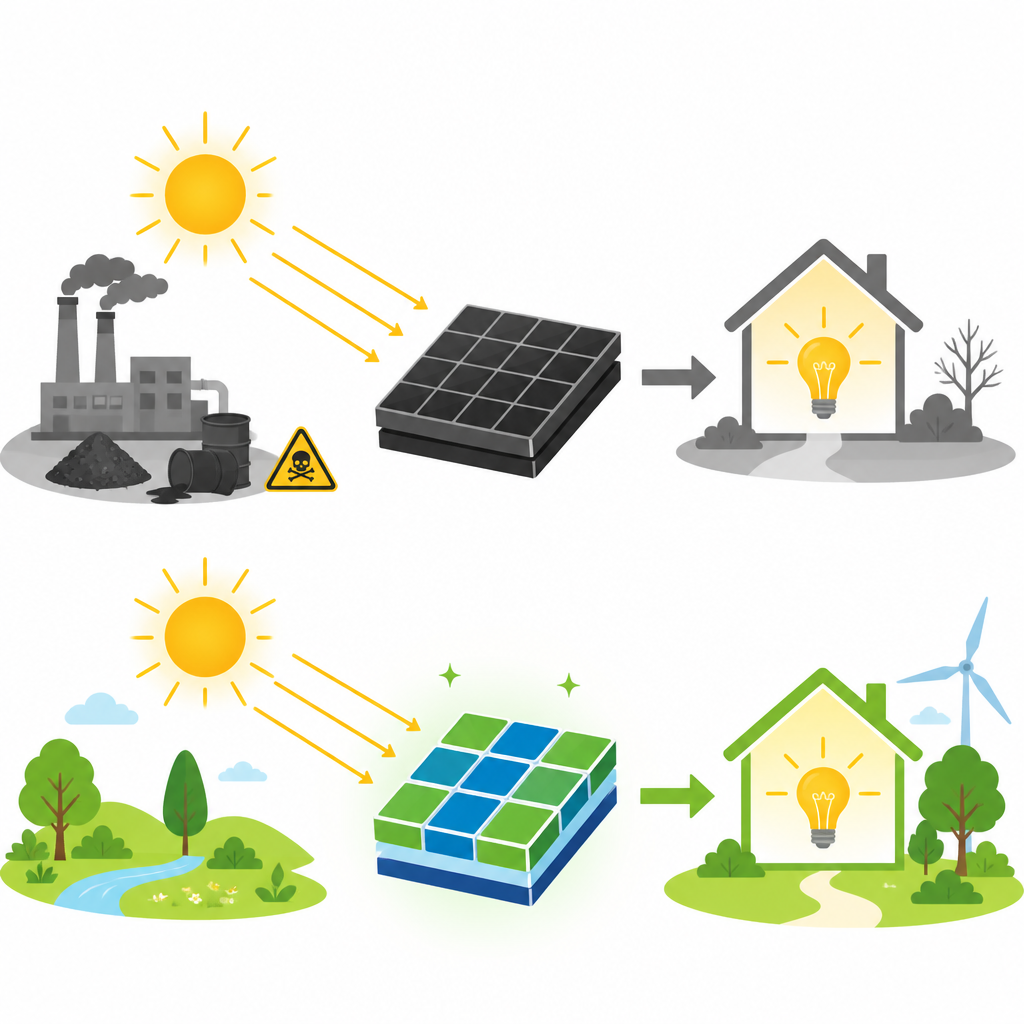
Solar panels are often praised as a clean way to power our homes, yet many of the most efficient versions rely on lead, a toxic metal that can threaten health and the environment if it leaks out. This study explores a different recipe for solar cells that removes lead while still reaching high performance, using computer simulations to show how careful design choices could make these safer cells attractive for real-world use.
A new kind of solar material
The researchers focus on a family of crystals called double perovskites, built from cesium, silver, bismuth, and bromine instead of lead. A particular compound, written as Cs2AgBiBr6, stands out because it is stable and far less toxic, but in its original form it does not absorb sunlight as efficiently as today’s record-setting cells. Earlier experiments showed that exposing this material to hydrogen can subtly reshape its electronic structure, narrowing the energy gap it needs to absorb light and reducing internal defects where charge can be lost. The new work takes these experimental hints and builds a detailed digital model of a complete solar cell that uses hydrogenated Cs2AgBiBr6 as the light-absorbing heart.
Testing virtual solar cells
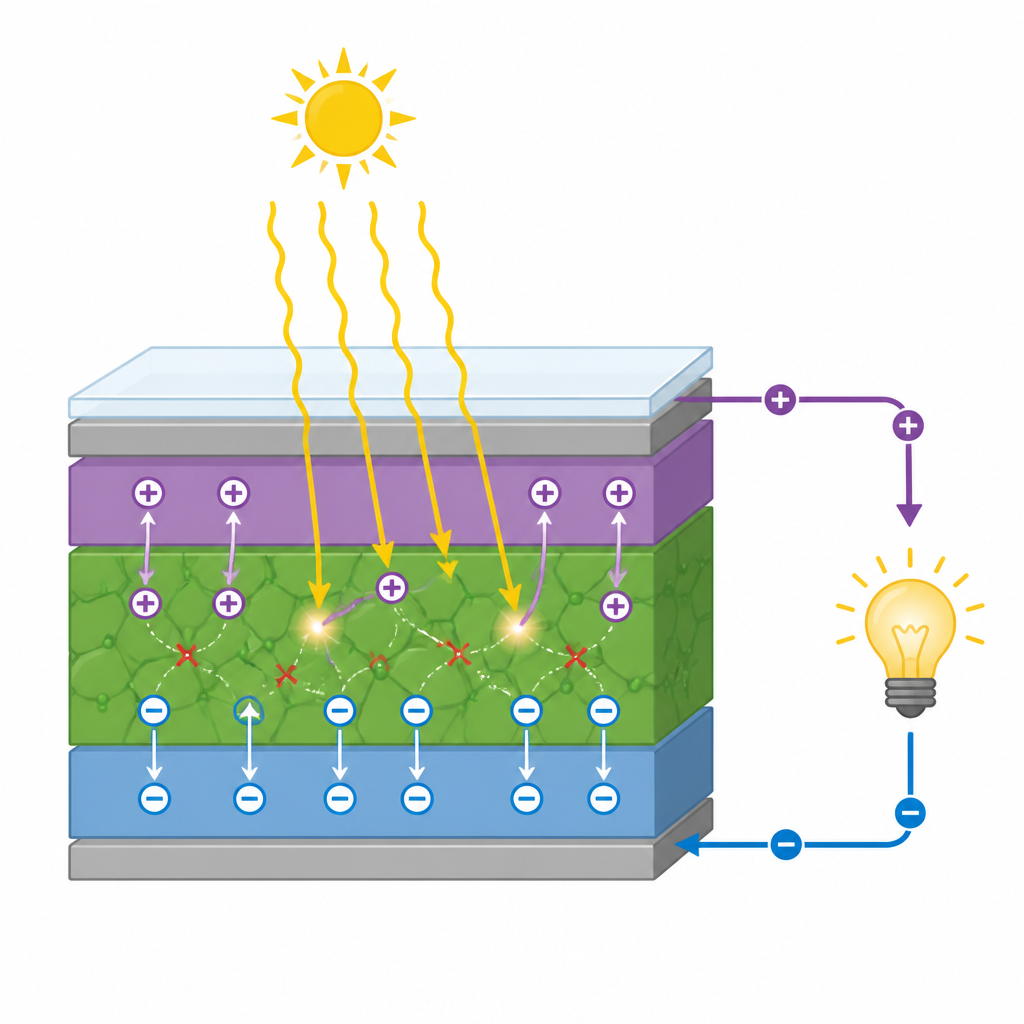
To explore many design options quickly, the team used a popular computer tool called SCAPS-1D, which simulates how electric charges move through the layers of a solar cell under sunlight. They studied an “inverted” layout, in which light first passes through a thin hole-carrying layer, then into the perovskite absorber, and finally to an electron-carrying layer on the back. Without changing atoms directly, they mimicked hydrogen treatment by adjusting the bandgap and defect levels of Cs2AgBiBr6 according to recent measurements, and then scanned through a wide range of layer thicknesses, defect densities, and doping levels to see how each choice affected the voltage, current, and efficiency.
Finding the right supporting layers
One key decision in any solar cell is which material will collect the electrons. The team compared two common candidates: tin oxide and zinc oxide. Both are transparent and stable, but zinc oxide offers higher electron mobility and a better energy match with the hydrogenated perovskite. The simulations confirmed this advantage. When zinc oxide was used instead of tin oxide, the model cell showed much higher quantum efficiency, meaning more incoming photons were converted into charge carriers. The overall power conversion efficiency nearly doubled in this step alone, revealing how an improved interface can cut down on wasted charge.
Balancing thickness and imperfections
The study then turned to the perovskite layer itself. If this layer is too thin, it fails to capture enough sunlight; if it is too thick, many charges recombine before they can be collected. By sweeping the thickness from 0.2 to 1.2 micrometers, the researchers found an optimal value around 0.4 micrometers, which delivered strong current without excessive losses. They also varied the number of internal defects over five orders of magnitude. Low defect densities allowed charges to live longer and move farther, but as defects increased, efficiency and fill factor fell sharply. The best performance appeared when the simulated defect density was held near 10^14 per cubic centimeter, highlighting the importance of clean crystal growth.
Tuning the top layer for smoother charge flow
Finally, the team examined the layer that carries positive charges, made from an organic material known as Spiro-OMeTAD. They investigated both its thickness and the amount of added dopants that improve conductivity. Thicker films tended to absorb more light that should have reached the perovskite and increased electrical resistance, which hurt current and efficiency. In contrast, a very thin layer around 0.01 micrometers performed best. Increasing the doping level raised the material’s conductivity, boosting the fill factor and overall efficiency without greatly changing the voltage. With high doping and an optimized thin layer, this top contact worked more like a smooth highway for charges than a bottleneck.
What this means for future solar panels
When all the best choices were combined in the virtual device, the hydrogenated Cs2AgBiBr6 cell reached a simulated efficiency of about 26 percent, along with strong voltage and current values. While these numbers come from models rather than finished products, they suggest that carefully engineered lead-free double perovskites could one day rival or even match the performance of today’s lead-based champions. For everyday users, the message is simple: with thoughtful design at the microscopic level, it may be possible to build solar panels that deliver plenty of clean power while also being kinder to people and the planet.
Citation: Kumar, A., Tannu, Bhatia, H. et al. Hydrogenated Cs₂AgBiBr₆ double perovskites: a sustainable lead-free route toward high-efficiency solar cells. Sci Rep 16, 15846 (2026). https://doi.org/10.1038/s41598-026-47055-y
Keywords: lead-free perovskite, double perovskite solar cell, hydrogenated Cs2AgBiBr6, solar cell simulation, photovoltaic efficiency