Clear Sky Science · en
Study on the strength and erosion resistance of soil-amended substrates for rock slopes in Fugu County
Saving Steep Slopes from Washing Away
In the dry, windswept hills of northern China, steep rock slopes made of fragile Pisha sandstone are crumbling under the combined force of rain and gravity. Bare rock and thin soil patches cannot hold plants, so each storm strips away more earth and threatens nearby roads and homes. This study explores a simple idea with big practical value: can we mix two common, mostly eco friendly additives into local soil to make a tougher, more water smart skin for these slopes, buying time for vegetation to take root and cutting erosion at its source?
Fragile Hills and a Protection Gap
Pisha sandstone weathers easily, creating steep faces where a thin layer of loess soil is held in place by concrete lattice beams and hollow hexagonal bricks. Engineers fill these bricks with soil to grow grass and other plants, but hot dry summers, cold winters, and intense summer downpours leave seedlings struggling. Before plants form a dense cover, there is a protection gap when young roots are too weak to resist heavy rain. Soil inside the bricks washes away, leaving bare frameworks and unstable slopes. The researchers set out to strengthen this vulnerable topsoil layer itself so that it can withstand harsh weather long enough for vegetation to establish.
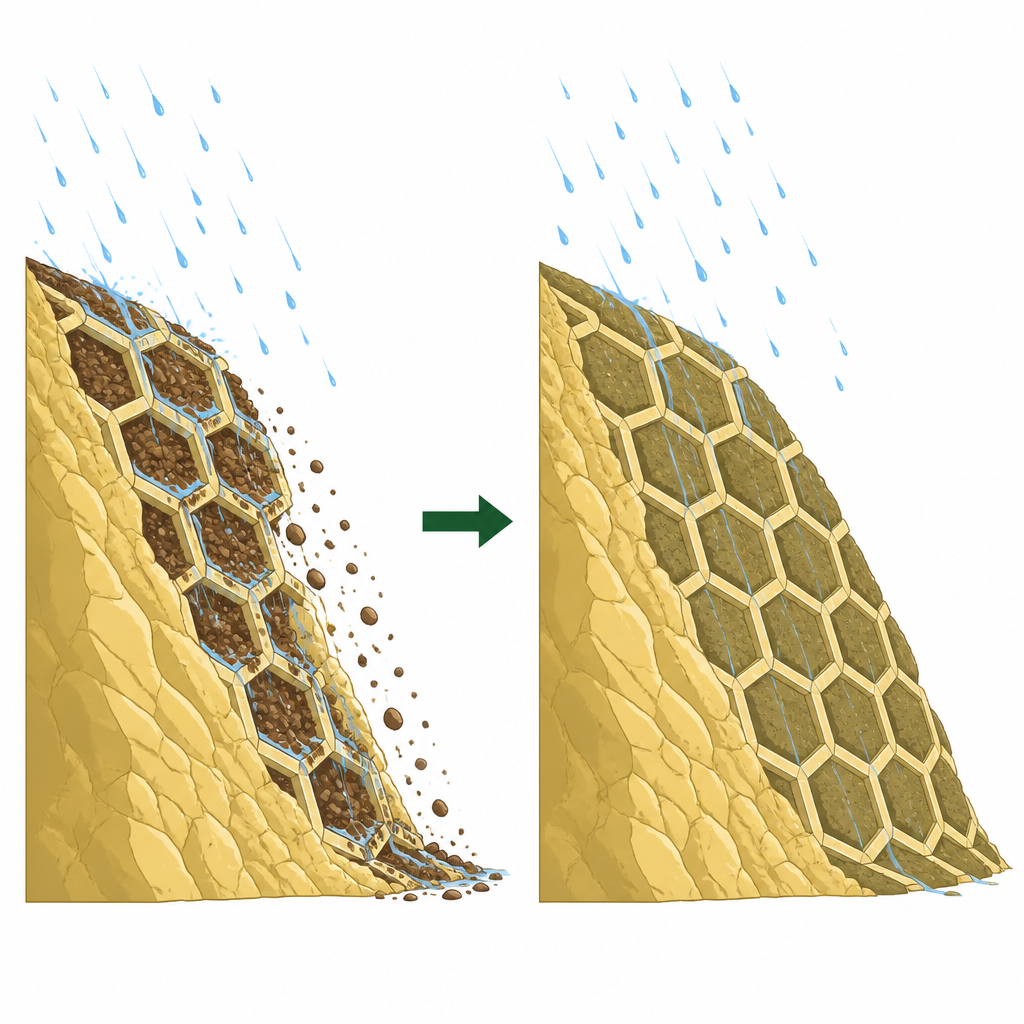
Two Helpful Additives in the Soil Mix
The team focused on two additives already used in farming and environmental work. Xanthan gum is a natural, food grade thickener that becomes a sticky gel in water and can glue soil grains together. Superabsorbent polymer is a powder that swells into soft beads when wet, acting like tiny water reservoirs in the ground. Working with loess soil from a Fugu County slope, the researchers prepared mixtures with different small percentages of each additive. They shaped these into standardized samples and tested how strongly the soil resisted sliding when pushed, and how much soil washed away under artificial rain that matched local storm patterns.
Stronger Soil and Less Erosion
Shear tests showed that the right small doses of these additives made the soil much stronger. At about 0.3 percent xanthan gum and 0.15 percent superabsorbent polymer by soil weight, the maximum shear strength rose by roughly one third, and the soil’s internal “stickiness,” or cohesion, jumped by more than seventy percent. When they went beyond these levels, strength gains leveled off or even declined, meaning that more additive is not always better. In rainfall simulations at 70 millimeters per hour on a steep 60 degree model slope, amended soils lost far less material. At a higher xanthan gum dose of 0.6 percent combined with 0.3 percent polymer, soil loss dropped by about 42 percent and water soaking through the slope dropped by about one third compared to untreated soil, indicating both better resistance to washing and a tighter pore structure.
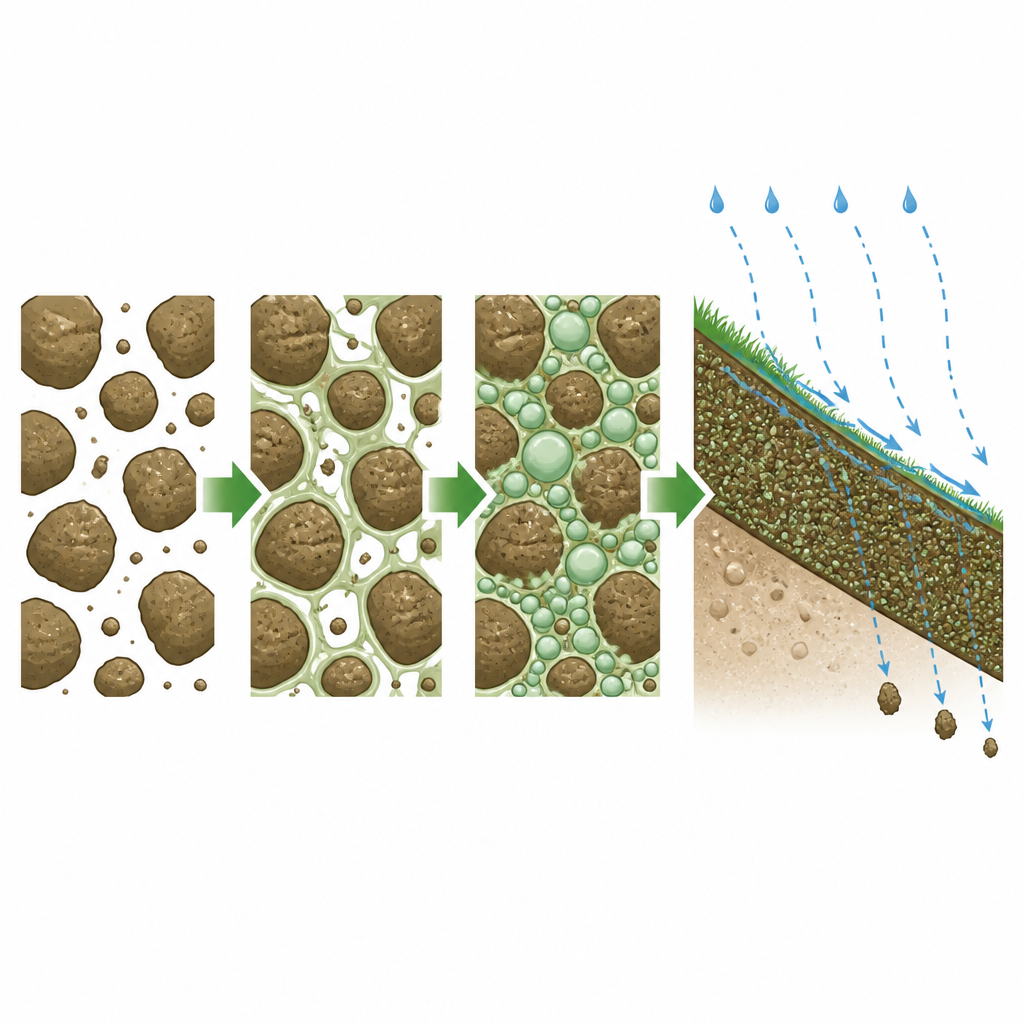
What Happens Inside the Soil
Microscope images explained why these modest additions had such large effects. Xanthan gum formed thin films that coated and bridged soil grains, turning loose, point like contacts into broader, face to face bonding and filling some of the gaps between particles. This three dimensional gel network tied grains together and reduced empty spaces. The swollen polymer particles sat in remaining pores like cushions, storing water and further locking the structure in place. Together, the two materials created a denser, better connected soil fabric that deformed less under stress, cracked less when drying, and resisted being broken apart and swept away by flowing water.
From Lab Findings to Greener Slopes
To a non specialist, the outcome is clear: with a few kilograms of these additives per ton of soil, engineers can turn a fragile planting layer on a rock slope into a tougher, more water retentive blanket. This reinforced soil loses less material during storms and can keep moisture available for plants, easing the critical early years of ecological restoration. While long term field trials are still needed, the study suggests that carefully chosen amounts of xanthan gum and superabsorbent polymer offer a practical, relatively low cost way to help unstable sandstone hills hold their ground and support lasting vegetation cover.
Citation: Deng, N., Xu, C., Bai, X. et al. Study on the strength and erosion resistance of soil-amended substrates for rock slopes in Fugu County. Sci Rep 16, 15809 (2026). https://doi.org/10.1038/s41598-026-47030-7
Keywords: slope erosion, xanthan gum, superabsorbent polymer, soil stabilization, ecological restoration