Clear Sky Science · en
Evaluating the coupling coordination between industrial chains and innovation chains in the construction industry of Western China from a production–manufacturing perspective
Why building and innovation need to move together
The cranes and concrete of Western China’s building boom hide a quieter story: whether new ideas can keep up with the speed of construction. This study asks a simple but crucial question for anyone who cares about safer, greener, more efficient cities: are the firms that design, build and operate projects moving in step with the universities, labs and tech companies that invent new methods and materials? By tracking both sides of this relationship, the authors show how better “sync” between building and innovation can lift entire regions—and what happens when that link is weak.
Two chains that shape every building
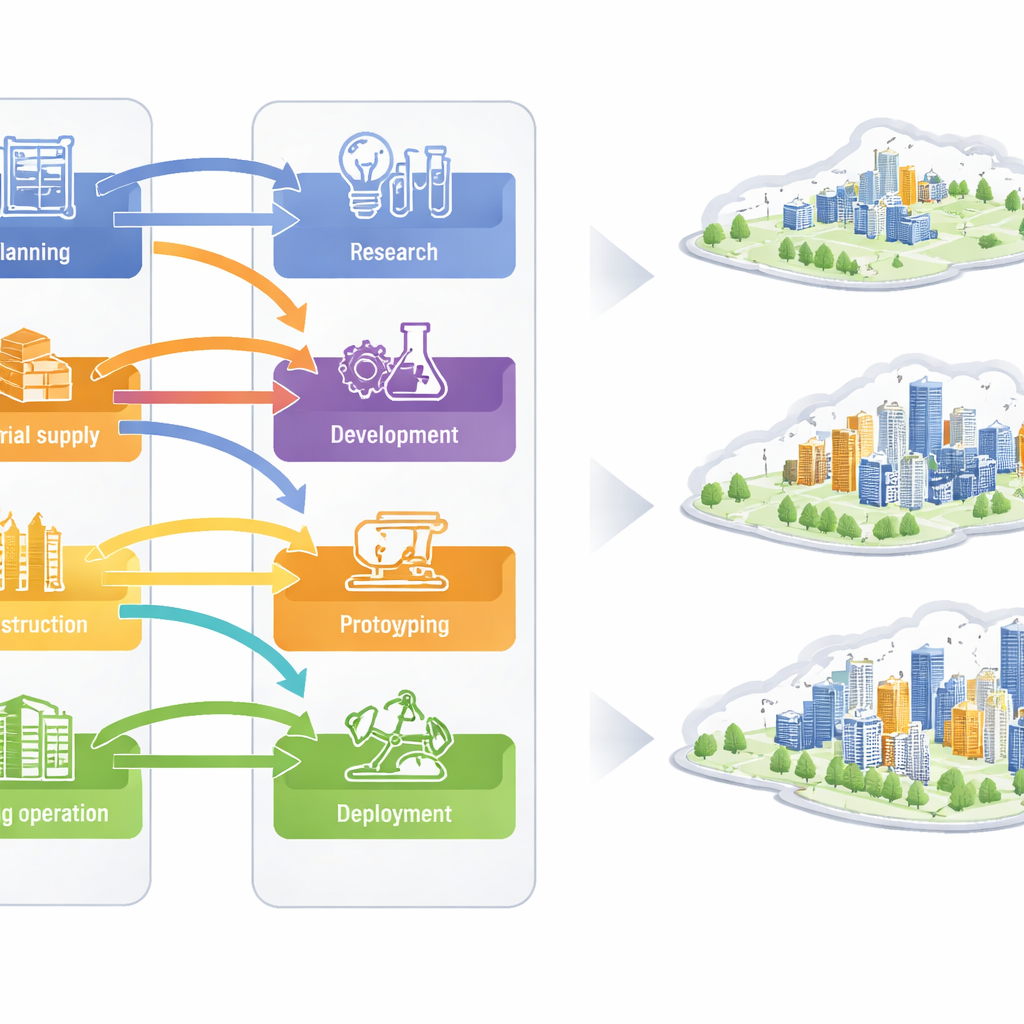
Behind any major project sit two invisible chains. The industrial chain covers the full life of a building, from early planning and material supply, through on-site work, to sales and long-term property management. The innovation chain covers basic research, applied research, testing and real-world use of new technologies such as smart construction tools, digital design and eco-friendly materials. In Western China, these chains have often developed out of step: local construction networks can be fragmented, and advanced ideas from universities and research institutes may not travel far beyond the core cities. The study argues that real progress depends on how tightly these two chains are linked, especially during the production and manufacturing stage where technologies either prove their worth—or stall.

Measuring how well the chains work together
To turn this broad idea into something measurable, the authors built an indicator system with 29 concrete signals drawn from official statistics for 11 western provinces between 2018 and 2023. For the industrial side, they looked at the number and scale of key firms along the chain, how productive construction workers are, and how strongly each province participates in the national market. For the innovation side, they counted research institutions, R&D spending, science funding and outputs such as patents, award-winning projects and technology transfer contracts. Using a mathematical approach called the entropy weight method, they let the data determine which indicators matter most, then applied an improved “coupling coordination” model to judge how balanced and mutually reinforcing the two chains are in each place and year.
Uneven progress across the West
The results show steady overall improvement: from 2018 to 2023, Western China’s construction sector generally moved toward better alignment between building activity and innovation. But this upward trend hides sharp regional contrasts. Provinces in the southwest—especially Sichuan and Chongqing—stand out as cores where strong research bases, active markets and dense construction chains reinforce one another. Their influence spills over into neighbors like Yunnan and Guangxi, which are catching up from a lower starting point. By contrast, many northwestern provinces, including Qinghai and Ningxia, remain stuck at low coordination levels: they invest in R&D but struggle to turn that effort into widely adopted technologies or thriving construction ecosystems. Statistical tools that track inequality over space and time show that gaps between regions are still the main source of imbalance, though they are slowly narrowing.
Different paths to the same goal
To understand what drives success, the study looks beyond single causes and examines combinations of conditions: the strength of market forces, the role of government, the availability of finance and the depth of the talent pool. Using a comparative method that searches for recurring patterns across provinces, the authors identify four workable “recipes” for high coordination. Some regions, like Sichuan and Chongqing, rely on an all-round mix of vibrant markets, supportive policy, ample capital and abundant researchers. Others, such as Guangxi and Yunnan, lean more on market energy and investment even with a thinner talent base. Still others depend on strong government guidance plus talent development to compensate for weaker markets, or on talent and reforming markets when capital is scarce. What matters is not a single magic ingredient but how these factors are combined to fit local realities.
What this means for the future of Western cities
For non-specialists, the takeaway is clear: the quality of future homes, offices and infrastructure in Western China will depend less on how much concrete is poured and more on how well construction activity is tied to a living innovation ecosystem. Where those links are tight, regions move toward cleaner, smarter and more competitive building industries that can pull neighboring areas upward. Where they are loose, growth risks becoming lopsided and hard to upgrade. The study’s message to policymakers and industry leaders is to focus on building bridges—between firms and labs, between core cities and their surroundings, and between markets, finance, government and talent—so that ideas can travel the full distance from research benches to construction sites and long-term building operations.
Citation: Xu, J., Zhang, Y. & Chen, Z. Evaluating the coupling coordination between industrial chains and innovation chains in the construction industry of Western China from a production–manufacturing perspective. Sci Rep 16, 14667 (2026). https://doi.org/10.1038/s41598-026-47020-9
Keywords: construction industry, innovation chain, regional development, Western China, industrial upgrading