Clear Sky Science · en
Deep learning-based detection of bowel sound events in continuous recordings
Listening to the Gut in a New Way
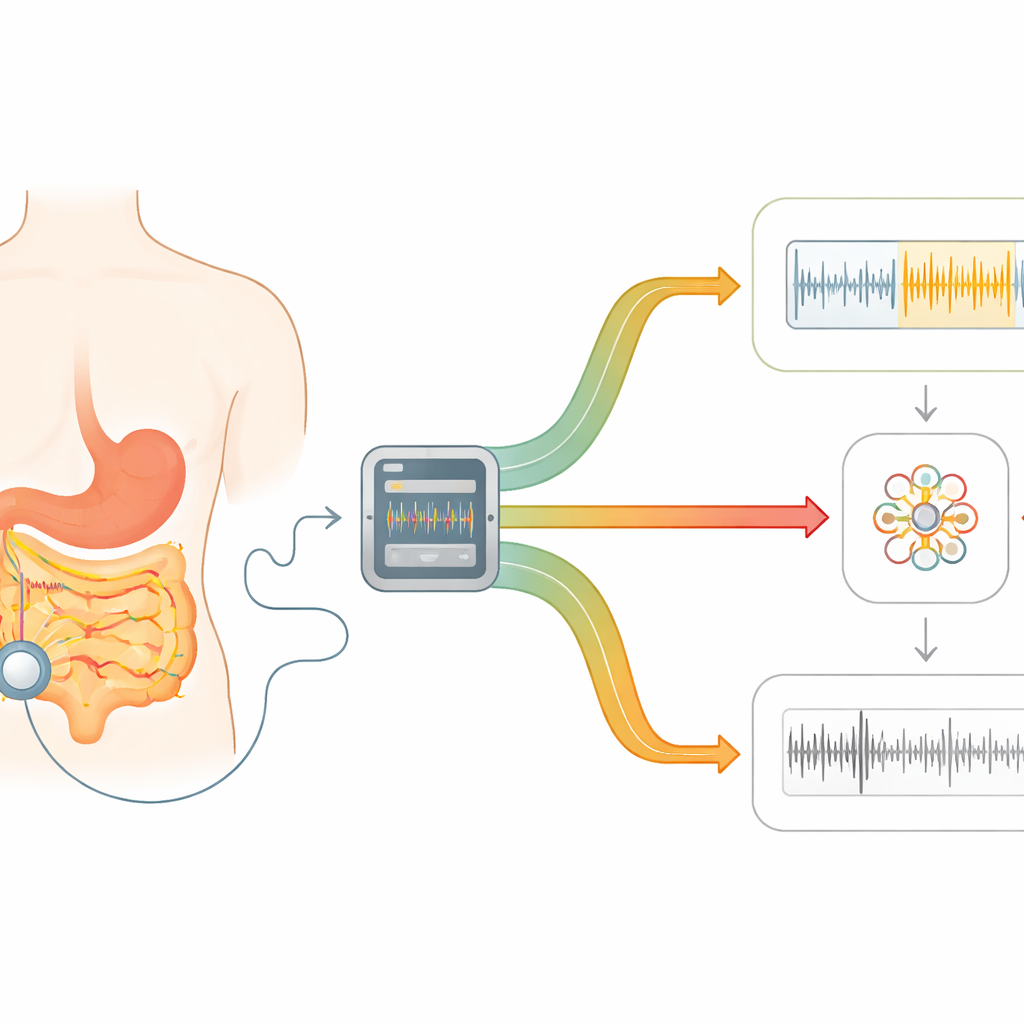
Doctors have long pressed a stethoscope to the belly to judge how well the gut is working, but those brief, subjective listenings miss most of what happens over hours. This study shows how modern artificial intelligence can turn subtle bowel sounds into a continuous, objective signal of digestive activity. By teaching a compact deep learning system to recognize tiny sound events inside long audio recordings, the work points toward wearable devices that quietly monitor gut health in the background, much like heart-rate or sleep trackers do today.
Why Belly Sounds Matter
Bowel sounds are more than random gurgles—they reflect how muscles and fluids move through the intestines. Continuous, noninvasive listening could help track digestion after surgery, monitor fragile newborns, or flag diseases early, all without blood tests or radiation. Until recently, however, researchers lacked large, well-annotated datasets and robust algorithms. Many previous systems were either too sensitive to noise, limited to short clips, or focused only on whether a sound was present in a tiny time slice, not across an entire overnight recording.
Building a Reliable Sound Library
The study relies on a publicly available dataset collected at night from 19 volunteers using a contact microphone on the abdomen. The audio was split into short segments and labeled by gastroenterology experts into several types of bowel sounds, non-bowel noises, and silence. Before analysis, the recordings were carefully cleaned: quiet background parts were suppressed, loudness was normalized, and the sounds were converted into a time–frequency picture that shows how energy spreads across different pitches over time. This transformation allowed the system to keep the key patterns of bowel activity while making the data more uniform and easier for a computer to learn from.
Two Ears for Different Tones
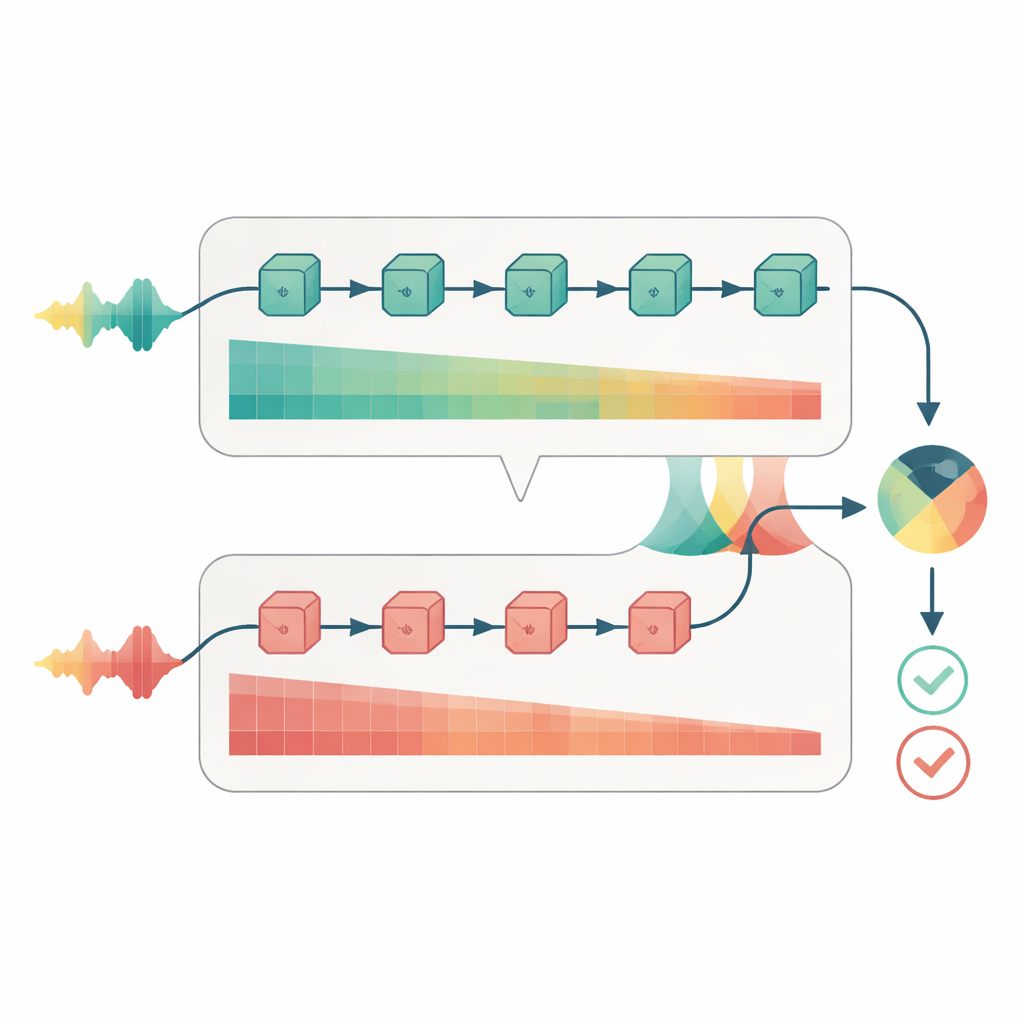
A central idea of the work is that bowel sounds have distinct behaviors at low and high pitches, so the authors designed the model to “listen” with two specialized ears at once. The transformed audio was split into a low band, capturing longer and smoother rumblings, and a high band, capturing brief, sharper clicks and bursts. Each band was fed into its own processing pathway made of lightweight one‑dimensional convolutional layers that look for patterns across short stretches of time and across slightly longer intervals. An attention mechanism then decided how much weight to give each band at each moment, before combining them into a single probability that a bowel sound event is present in a tiny time frame.
From Tiny Moments to Whole-Night Judgments
The system first produced decisions for very short time slices, but the real clinical question is often whether a whole recording contains bowel activity and how stable the detection is over time. To bridge this gap, the researchers smoothed the frame‑by‑frame probabilities to remove isolated glitches and then used a simple rule: if any frame in a recording had a sufficiently high probability of being a bowel sound, the whole file was marked as containing an event. This “maximum over time” strategy greatly reduced the impact of occasional misclassifications while preserving sensitivity to brief but real sounds.
How Well the System Performed
Across two different ways of splitting the data into training and test sets, the model delivered strikingly high performance. On the smallest time slices, it correctly distinguished bowel sound events from silence or other noises in more than 98% of cases, with strong balance between catching true events and avoiding false alarms. When decisions were aggregated to the level of whole recordings, accuracy rose above 99.8%, meaning the system almost never misjudged whether a file contained bowel activity. These results surpassed several previous deep learning approaches tested on the same dataset, even though bowel sounds made up only a small fraction of all time in the recordings.
What This Means for Everyday Care
To a non-specialist, the takeaway is that computers can now listen to the gut with remarkable reliability over long periods, extracting meaningful events from a sea of background noise. The method does not yet distinguish between different diseases or patient groups; it simply answers whether bowel activity is present and when. Still, this sturdy foundation opens the door to smart belts, patches, or shirts that could track digestion in real time, help doctors monitor recovery, or support at-home management of chronic gut conditions, all by quietly listening to the body’s own internal soundtrack.
Citation: Çelik, Y. Deep learning-based detection of bowel sound events in continuous recordings. Sci Rep 16, 10595 (2026). https://doi.org/10.1038/s41598-026-47018-3
Keywords: bowel sounds, deep learning, gastrointestinal monitoring, medical acoustics, wearable health