Clear Sky Science · en
GC–MS profiling and antivirulence potential of limonene-rich Citrus medica cv. ‘Rugosa’ essential oil: in vitro and in silico evaluations
Why a fragrant citrus oil matters for health
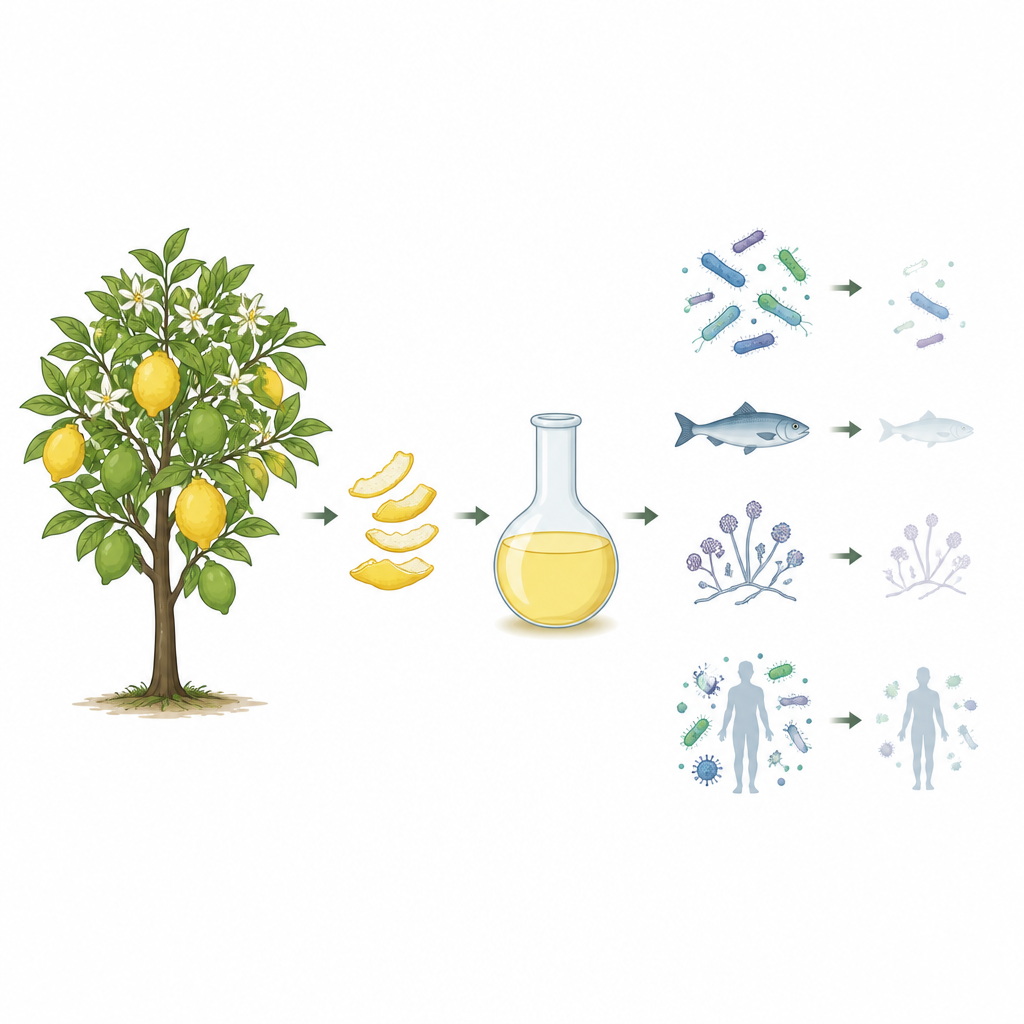
Many of us know citrus fruits for their bright scent in kitchens and perfumes. This study explores whether the same fragrant oil from a bumpy old lemon variety, Citrus medica cv. “Rugosa,” can help fight germs that no longer respond well to common antibiotics. By testing this peel oil in the lab and in computer models, the researchers looked at how it slows harmful microbes, blocks their ability to form slimy protective layers, and interferes with the way they “talk” to one another.
A closer look inside a rugged citron
The team began by extracting essential oil from the thick peels of Rugosa fruits grown in Saudi Arabia. Using gas chromatography and mass spectrometry, they identified 39 different ingredients in the oil. Most belonged to a family of light, volatile molecules, with one compound, limonene, making up about three quarters of the mixture. Several other ingredients were present in much smaller amounts, including limonene oxide, trans-carvyl acetate, nerol, cis-carveol, myrcene, carvacrol, and beta-bisabolene. Even though limonene dominated, the full oil behaved differently from limonene alone, hinting that the minor components play important supporting roles.
Stopping tough microbes and stubborn growth
To test its power, the oil was applied to a broad collection of bacteria and yeasts taken mainly from fish and shellfish, many of which resist standard drugs. On simple culture plates, the citrus oil created large clear zones where microbes could not grow, often larger than those produced by pure limonene or the antibiotic ampicillin. In tests that measure the lowest amount needed to halt growth or kill cells outright, the full oil worked at relatively low doses and was mainly lethal rather than just slowing growth. It also held its own against a powerful antifungal medicine when tested on Candida yeasts and common food molds, suggesting that the blend of compounds is more potent than limonene by itself.
Disrupting slime shields and microbial “chatter”
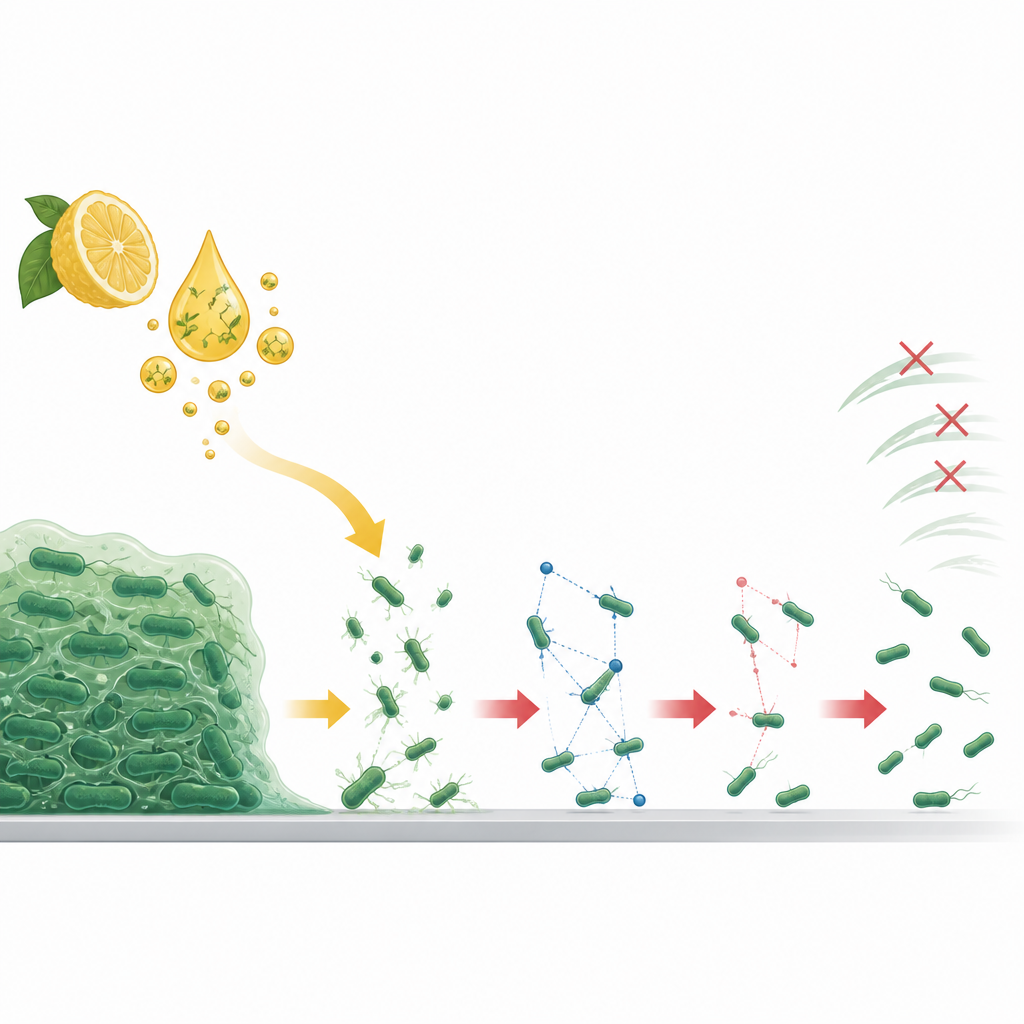
Many infections become hard to treat because microbes huddle in sticky biofilms on surfaces, where they are far less sensitive to antibiotics. The Rugosa peel oil strongly reduced biofilm formation by several bacteria and by Candida, especially at higher test doses, with the greatest effect seen on Bacillus subtilis. Even when the oil concentration was lowered below the level needed to stop growth, it still weakened biofilms, though some species remained more stubborn than others. The researchers also examined how the oil affected quorum sensing, the chemical “language” bacteria use to coordinate behavior. In purple-pigmented test bacteria that depend on this signaling, the oil sharply reduced pigment production and created clear zones where the usual color was missing, showing that the communication system had been disrupted. It also cut down the swarming movement of Pseudomonas aeruginosa, a hospital problem germ that uses motion to colonize new sites.
What computer models reveal about citrus molecules
Beyond the lab bench, the researchers used computer docking and long molecular dynamics simulations to see how individual oil components might lodge into important microbial proteins. Several larger, less abundant molecules, such as valencene, aromadendrene, beta-bisabolene, and beta-eudesmol, showed particularly strong and stable fits in the binding pockets of targets linked to virulence and survival. Additional computer tests that estimate how a drug behaves in the body suggested that many of these compounds might be absorbed well, move through tissues appropriately, and have low predicted toxicity. A further layer of quantum chemical calculations looked at how electrons are arranged in these molecules, helping explain their relative stability and reactivity.
What this could mean for future treatments
Put simply, the peel oil from this rugged citron does not just kill or slow germs; it also undercuts their defenses by breaking down biofilms, silencing their chemical conversations, and limiting their movement. While these findings are still at the experimental and computer modeling stage, they suggest that such natural mixtures and some of their purified ingredients could become part of new strategies to manage infections that no longer respond well to familiar antibiotics. Rather than replacing existing drugs outright, these citrus-derived substances might one day be combined with them to make microbes easier to control.
Citation: Noumi, E., Alabbosh, K.F., Alsenani, Q. et al. GC–MS profiling and antivirulence potential of limonene-rich Citrus medica cv. ‘Rugosa’ essential oil: in vitro and in silico evaluations. Sci Rep 16, 15445 (2026). https://doi.org/10.1038/s41598-026-47009-4
Keywords: Citrus medica essential oil, antimicrobial, biofilm inhibition, quorum sensing, natural antivirulence