Clear Sky Science · en
Multifunction plasma genus holographic antenna for near/far-field focusing using a single structure
Bringing Sharper Wireless Beams to Everyday Technology
From airport security scanners to satellite internet and even future cancer therapies, many modern systems rely on antennas that can send and collect radio waves with great precision. This paper presents a new kind of flat plasma-based antenna that can both zoom energy onto a tiny spot nearby and send strong, steerable beams far into space, all using the same compact surface. That combination of flexibility and power could make future wireless devices more accurate, more adaptable, and easier to hide when not in use.
Why Focusing Radio Waves Matters
Microwave imaging and sensing use high-frequency radio waves to “see” inside materials, find hidden objects, or monitor human tissue without cutting or touching. To produce clear pictures or deliver energy safely to a small region, engineers want antennas that can concentrate waves like a magnifying glass focuses sunlight, or else point narrow beams toward specific directions. Traditional antenna arrays achieve this with many metal parts and complex wiring, which can be bulky, expensive, and slow to adjust. The authors explore a different path: using plasma—gas turned into an electrically active state—to create a lightweight, reconfigurable surface that can change how it reflects waves in real time.
A Flat Screen of Controllable Plasma
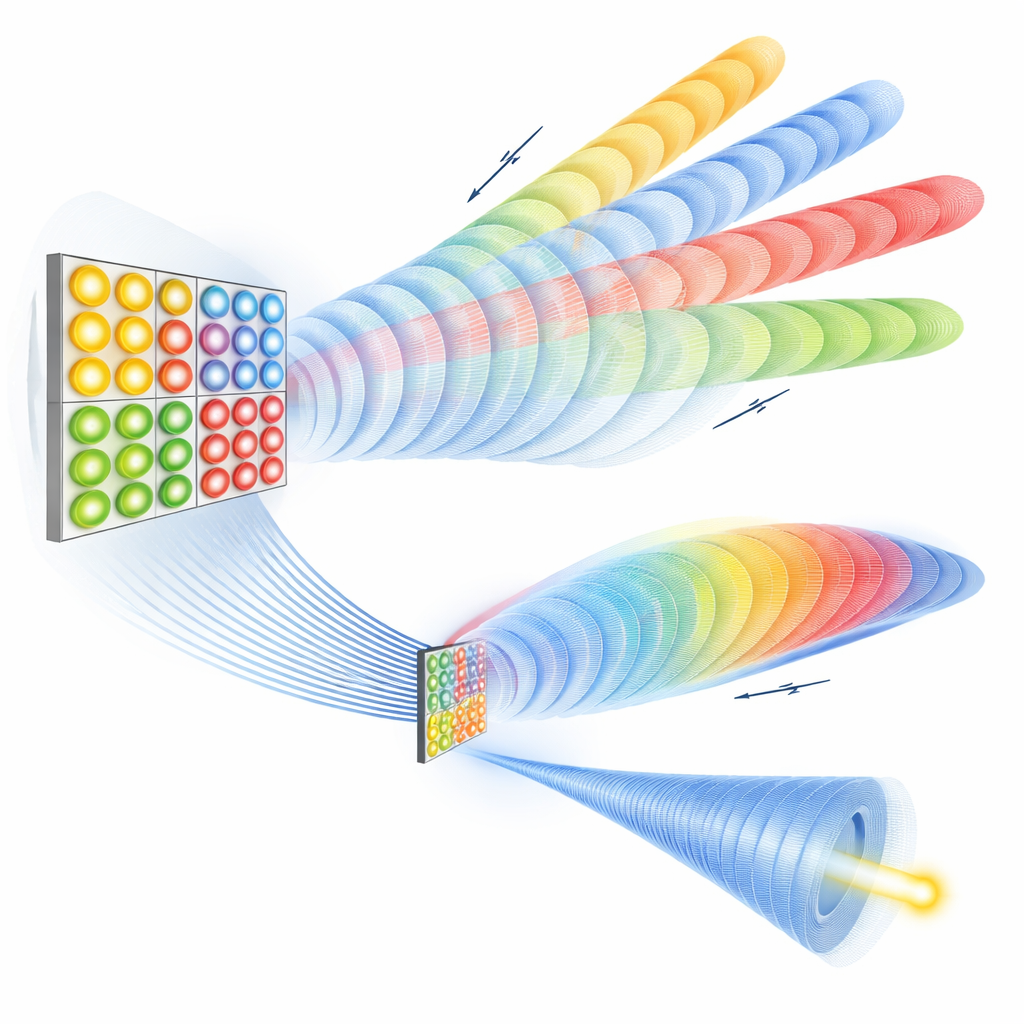
At the heart of the design is a square panel made of 441 tiny ring-shaped glass tubes filled with an inert gas such as argon. When a voltage is applied, the gas becomes plasma and behaves somewhat like a metal that can be smoothly tuned from very reflective to almost transparent by changing the electron density. Two of these patterned plasma surfaces are mounted back-to-back, separated by a metal sheet, and illuminated by simple horn antennas that feed microwave energy at 10 GHz. By carefully controlling the plasma state of each ring, the surface acts like a “holographic mirror” that sculpts how waves leave the panel. Instead of physically moving parts, the antenna changes its behavior electronically by adjusting voltages.

Steering and Splitting Beams in the Distance
Using computer simulations, the researchers show that when one surface is active, this plasma panel can form a very narrow main beam pointing straight out or scan it across a wide range of angles. The antenna reaches a high gain—essentially, how strongly it radiates in the chosen direction—of about 28.7 dBi when pointing straight ahead and still maintains useful strength at angles up to 40 degrees away. Losses remain moderate despite the use of plasma, and unwanted side lobes and backward radiation are kept reasonably low for such a compact 31.5 cm by 31.5 cm structure. By arranging the elements in a chessboard pattern and assigning different plasma settings to alternating cells, the same surface can produce two separate beams at different angles at once, and activating both sides of the structure can generate dual beams in opposite directions, effectively serving multiple users or regions simultaneously.
Sharp Targeting in the Near Field
Beyond long-range links, the antenna also focuses energy at a precise spot just over half a meter in front of its surface. To do this, the team calculates how much extra phase delay each element needs so that all reflected waves meet in step at the chosen point, much like timing a crowd to clap in perfect unison. By programming that pattern into the plasma states, the panel shapes the wavefront into a converging “bubble” of energy. The resulting focal spot is only a few centimeters across—about 3.25 cm by 3.75 cm—with much lower leakage around it than an unfocused version, which is crucial for safely concentrating power in medical therapy or for inspecting a tiny region inside a structure. Remarkably, the system can shift this focus off to the side without any moving parts and, when both surfaces are used together, can focus nearby while still sending a strong beam into the far field.
What This Means for Future Systems
The study demonstrates that a single, flat, plasma-based holographic antenna can replace multiple specialized devices by offering far-field beam steering, multi-beam operation, and sharp near-field focusing in one reconfigurable platform. Because the plasma tubes can be turned off and become nearly invisible to incoming waves, the structure could also be less detectable to radar than conventional metal antennas. With its ability to electronically re-shape where energy goes—whether to a precise point in the body, several users in space, or different industrial targets—this technology points toward more agile, compact, and stealthy wireless systems for medical treatment, satellite communications, and advanced radar.
Citation: Eltresy, N.A., Malhat, H.A., Deen, S.Z. et al. Multifunction plasma genus holographic antenna for near/far-field focusing using a single structure. Sci Rep 16, 12854 (2026). https://doi.org/10.1038/s41598-026-47001-y
Keywords: plasma antenna, beam steering, near-field focusing, holographic reflectarray, microwave imaging