Clear Sky Science · en
Optimizing green hydrogen production: a comparative analysis of MPPT control strategies for PV-powered PEM electrolyzers using differentiated creative search optimization algorithm
Turning Sunlight and Water into Clean Fuel
Hydrogen made with renewable energy is often called green hydrogen, and it is attracting interest as a clean fuel that could power industry, transport, and homes while cutting climate pollution. This article explores how to squeeze more useful hydrogen out of sunlight by pairing solar panels with a special water-splitting device and smarter electronic control. By fine-tuning how electricity flows from the solar panels into the water splitter, the researchers show that the same sunshine can produce more hydrogen, more reliably, and at lower energy waste.
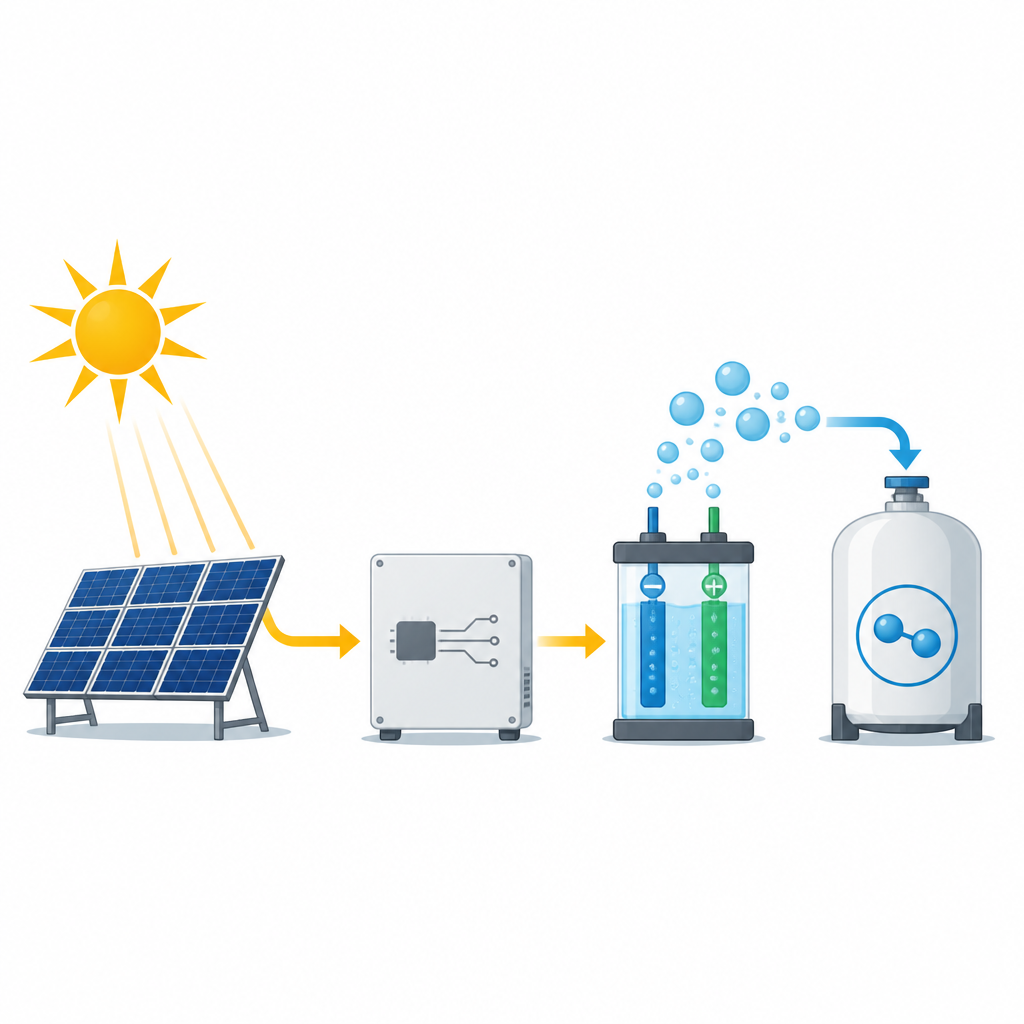
From Solar Panels to Bottled Hydrogen
The study looks at a complete chain that starts with sunlight hitting a solar photovoltaic (PV) array and ends with streams of hydrogen gas. The PV array turns light into direct current electricity, which is routed through an electronic converter before it reaches a proton exchange membrane (PEM) electrolyzer. Inside the electrolyzer, water is split into hydrogen and oxygen using that electricity. Because sunshine constantly changes with clouds, temperature, and time of day, the power coming from the solar panels is rarely steady. If the panels operate away from their best operating point, a large fraction of the available solar energy is simply lost as heat instead of becoming hydrogen. The central question in this work is how to keep the panels working near their sweet spot while feeding the electrolyzer with suitable power.
Helping Solar Panels Work at Their Sweet Spot
To manage the PV array, the authors use a family of methods called maximum power point tracking, which nudge the operating voltage and current of the panels until they are close to the point where power output is largest. They focus on a widely used strategy known as perturb and observe, and then test different controller “brains” that sit on top of it. These include a traditional proportional–integral controller, a more flexible fractional-order version, and a rule-based fuzzy logic controller. The key twist is that they do not pick the controller settings by hand. Instead, they let computer-based search techniques, inspired by group problem solving, hunt for the values that minimize the error between the ideal panel voltage and the actual one over time.
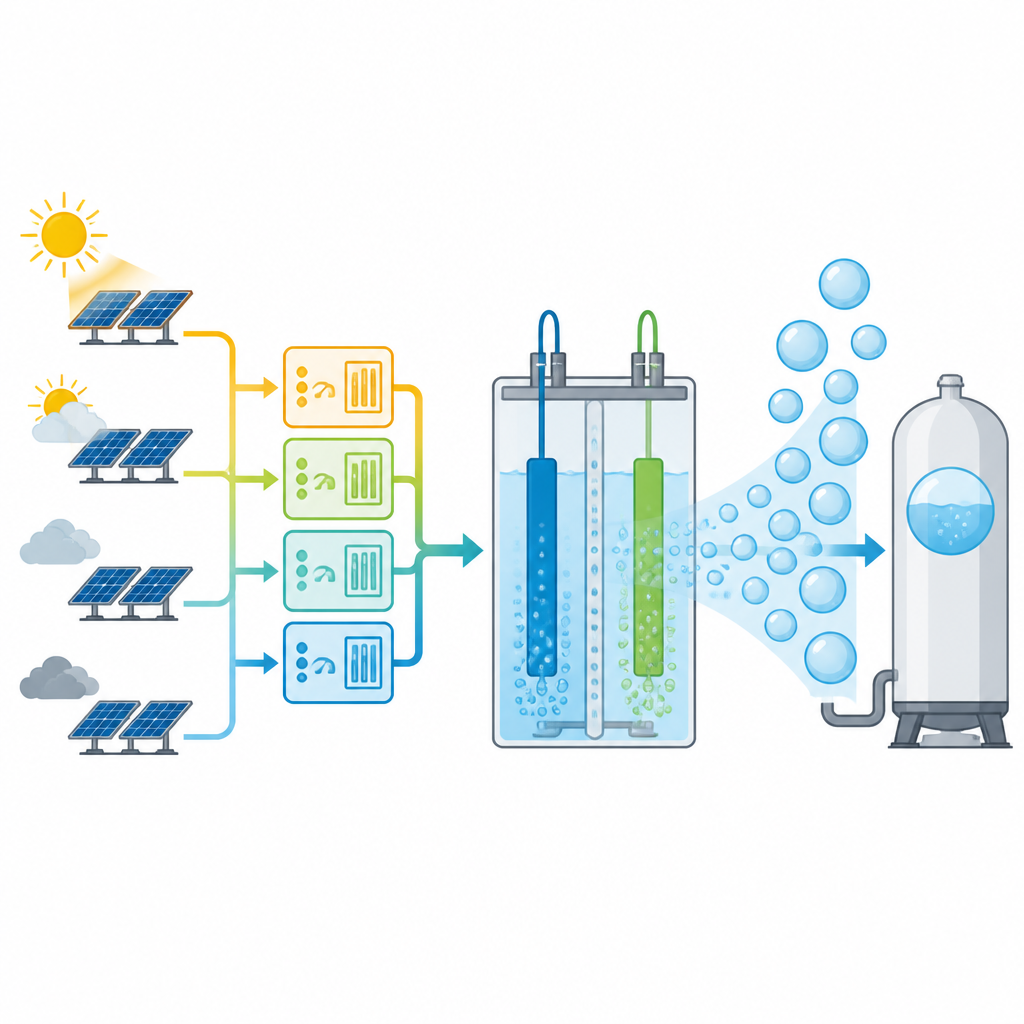
Smarter Search for Better Control
The standout search method in the study is called the differentiated creative search optimization algorithm. It treats each trial set of controller settings like a member of a team that learns at its own rate. High-performing candidates explore new possibilities while poorer ones help fill in gaps in the search space. The researchers compare this approach to two other popular search methods and run all three under the same conditions. In computer simulations, the optimized traditional controller guided by the creative search algorithm allows the PV array to deliver about 6.99 kilowatts, slightly more than competing methods and clearly more than the fuzzy logic approach. It does this while keeping the response quick and smooth when sunlight or temperature change.
How the Water Splitter Responds
On the hydrogen side, the study models in detail how the PEM electrolyzer behaves as pressure, temperature, and power input vary. Under standard conditions, it reaches an efficiency of roughly two-thirds while producing tens of liters of hydrogen per minute. As the temperature rises, the device needs less voltage to drive the same current, so the hydrogen output grows, but losses inside the membrane also change. The authors also test different converter types between the PV array and the electrolyzer. A buck converter, which steps the voltage down, turns out to give the best match between the solar panels and the stack, keeping both the power electronics and the electrolyzer in a comfortable and efficient operating range.
What This Means for Clean Energy Systems
For non-specialists, the key message is that control and matching are just as important as hardware size when designing green hydrogen systems. By carefully adjusting how solar panels are driven and how their power is delivered to the water splitter, the same field of panels can produce more hydrogen with less waste. In these simulations, a conventional controller that is automatically tuned by the differentiated creative search algorithm delivers the highest solar power to the electrolyzer, while a simple voltage step-down converter keeps the water splitter operating efficiently. Together, these choices lift the overall performance of the solar-to-hydrogen chain, pointing toward more practical and scalable ways to turn sunlight and water into a clean fuel.
Citation: Mohamed, A.A., Ali, M.H., Omar, A.I. et al. Optimizing green hydrogen production: a comparative analysis of MPPT control strategies for PV-powered PEM electrolyzers using differentiated creative search optimization algorithm. Sci Rep 16, 15176 (2026). https://doi.org/10.1038/s41598-026-46999-5
Keywords: green hydrogen, solar photovoltaics, PEM electrolyzer, power electronics, control optimization