Clear Sky Science · en
Design and analysis of dual-stator hybrid brushless vernier motor for direct-drive applications
Smarter motors for everyday machines
From washing machines to factory robots, many modern devices need motors that spin slowly but push hard. Instead of using bulky gearboxes, engineers are now designing motors that can deliver high twisting force, or torque, directly at low speeds. This paper explores a new motor design that aims to give strong, efficient, and reliable drive with fewer moving parts and lower long term costs.
Why gearboxes are getting in the way
Traditional direct drive systems avoid gears by relying on permanent magnet motors, which are compact, efficient, and powerful. However, they often depend on expensive rare earth magnets and can struggle with heat and mechanical stress at high speed. Wound rotor motors, which create their magnetic field using coils instead of magnets, avoid rare earth materials but need brushes and slip rings that wear out and waste energy. The challenge is to combine the best of both worlds without the weaknesses of either.
A motor with two shells and a shared heart
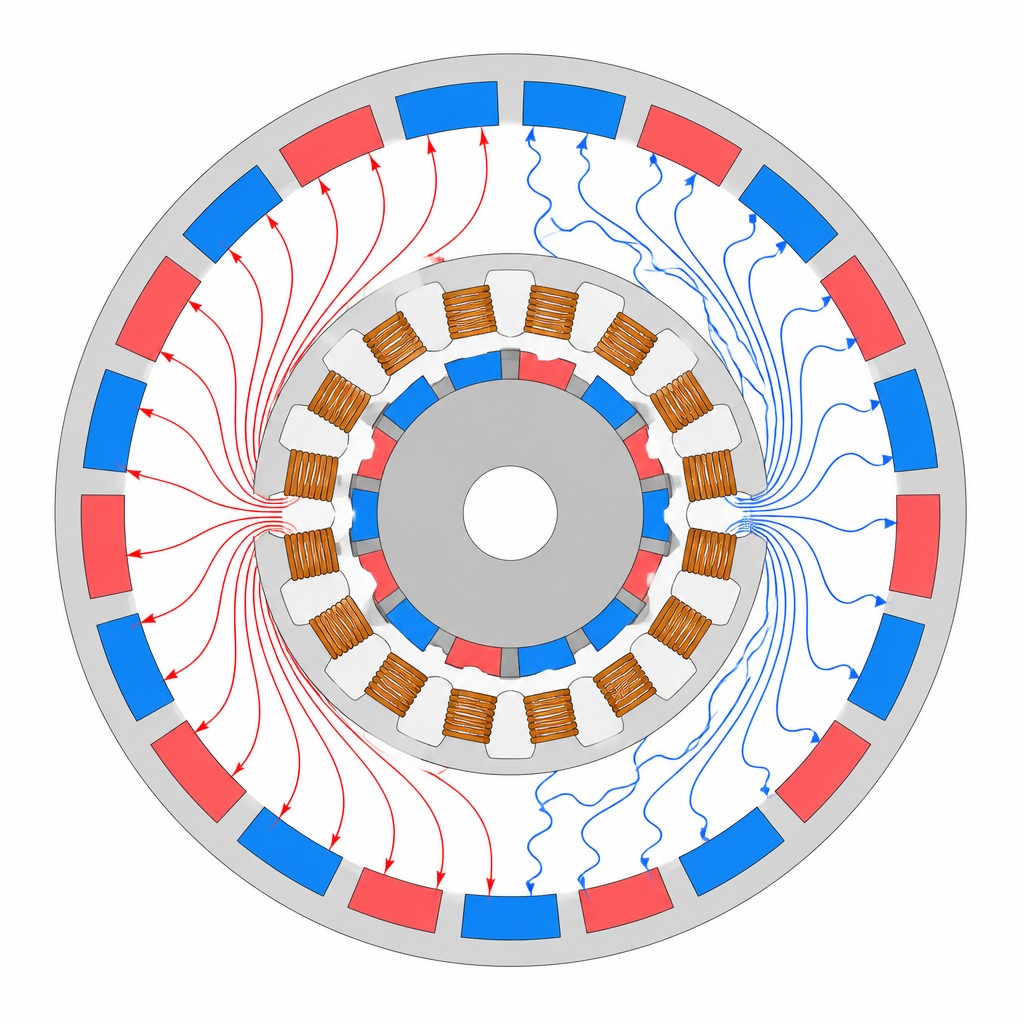
The researchers propose a dual stator hybrid brushless vernier motor, which wraps two stationary shells, or stators, around a single sandwiched rotor. The inner stator carries both a standard three phase winding and an extra single phase winding, while the outer stator carries only the three phase winding. The rotor itself has two functional sides: one side holds windings that behave like a brushless wound rotor, and the other side carries permanent magnets. By placing these parts carefully and using a special way of feeding currents, the motor can build up a strong magnetic field without any physical brushes or slip rings, while also using fewer magnets per unit of torque than many conventional designs.
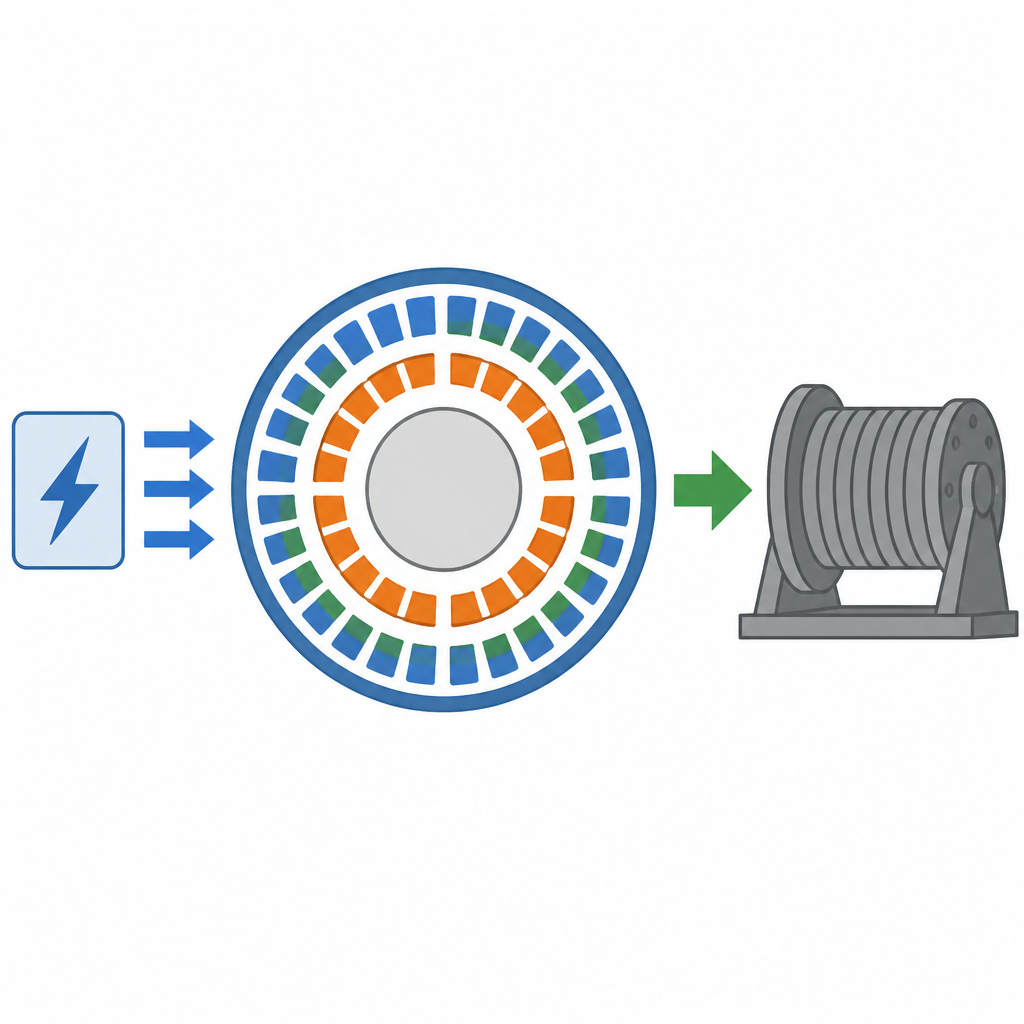
How the magnetic gearing trick works
Inside the motor, different windings on the inner stator create two magnetic patterns in the air gap: one with four poles and another with two poles. The two pole pattern energizes a small excitation winding on the rotor, which then feeds a larger field winding wrapped with many more poles. At the same time, the outer stator interacts with a ring of magnets on the rotor. Together, these interactions produce a Vernier or magnetic gearing effect, where a low pole count field on the stators mixes with a high pole count field on the rotor. The result is a motor that turns slowly but can deliver high torque, well suited to spinning a washer drum or driving a conveyor directly.
Comparing two ways to place the magnets
The team studied two versions of this dual stator motor that differ only in how the magnets are built into the rotor. In the surface mounted version, magnets sit on the outside of the rotor, creating a smooth and uniform magnetic field across the air gap. In the interior version, magnets are buried inside the rotor iron, which gives better mechanical strength and helps shape the magnetic field for smoother running. Using detailed computer simulations, both designs were tested at low washing speed and higher spin speed under the same size and material limits, so that their strengths and trade offs could be compared fairly.
What the simulations reveal
The surface mounted design delivered the highest torque, reaching about 44 newton meters at low speed and over 20 newton meters at high speed, while still keeping efficiency above 90 percent. This makes it attractive for heavy duty tasks that demand strong pull from a compact motor. The interior magnet design produced less torque, around 32 newton meters at low speed, but showed a dramatic cut in torque ripple, especially at high speed, where the variations in torque were reduced by nearly 89 percent. Lower ripple means smoother motion, less noise, and less vibration, which is important for precision equipment and quiet appliances. Both versions also used the magnets more effectively than a reference machine by adding torque from the inner brushless winding without increasing magnet mass.
What this means for future machines
For non specialists, the key message is that this dual stator hybrid motor can act like a built in magnetic gearbox, producing strong, smooth torque at low speeds without mechanical gears. The surface mounted magnet version is better when raw pulling power is the top priority, while the interior magnet version trades some torque for quieter and more stable motion. Because the rotor is excited without brushes, maintenance needs are reduced, and careful use of magnets can ease reliance on costly rare earth materials. The authors note that future work will still need to tackle heat buildup and power quality, but their results show a practical path toward more efficient, robust direct drive motors in everyday machines.
Citation: Kumar, K., Akbar, G., Ahmed, S. et al. Design and analysis of dual-stator hybrid brushless vernier motor for direct-drive applications. Sci Rep 16, 15635 (2026). https://doi.org/10.1038/s41598-026-46998-6
Keywords: direct drive motor, permanent magnet motor, dual stator machine, brushless excitation, torque density