Clear Sky Science · en
AI-supported qualitative analysis of free-text responses on home care burden and support needs in Saxony
Why this matters for families
Across Germany, more and more people are growing old while the number of professional caregivers is not keeping pace. As a result, families increasingly shoulder the work of caring for parents, partners, and relatives at home—often on top of jobs and their own children. This study looks closely at what these family caregivers in the German state of Saxony say they struggle with, what kind of help they need, and how modern artificial intelligence can help turn thousands of written comments into clear messages for policymakers.
Listening to hidden voices
The research team drew on a large 2019 survey of adults in Saxony about home care. At the end of the questionnaire, participants could freely write about their situation, worries, or ideas for improvement. About one in five used this chance, leaving over 300 short comments. While these brief notes cannot represent all caregivers, they offer vivid snapshots of real life: juggling care with work, battling long forms, and worrying about money and old age. The authors wanted to systematically sort and interpret these comments so that day‑to‑day experiences would not be lost in tables of numbers.
How AI helped sort the stories
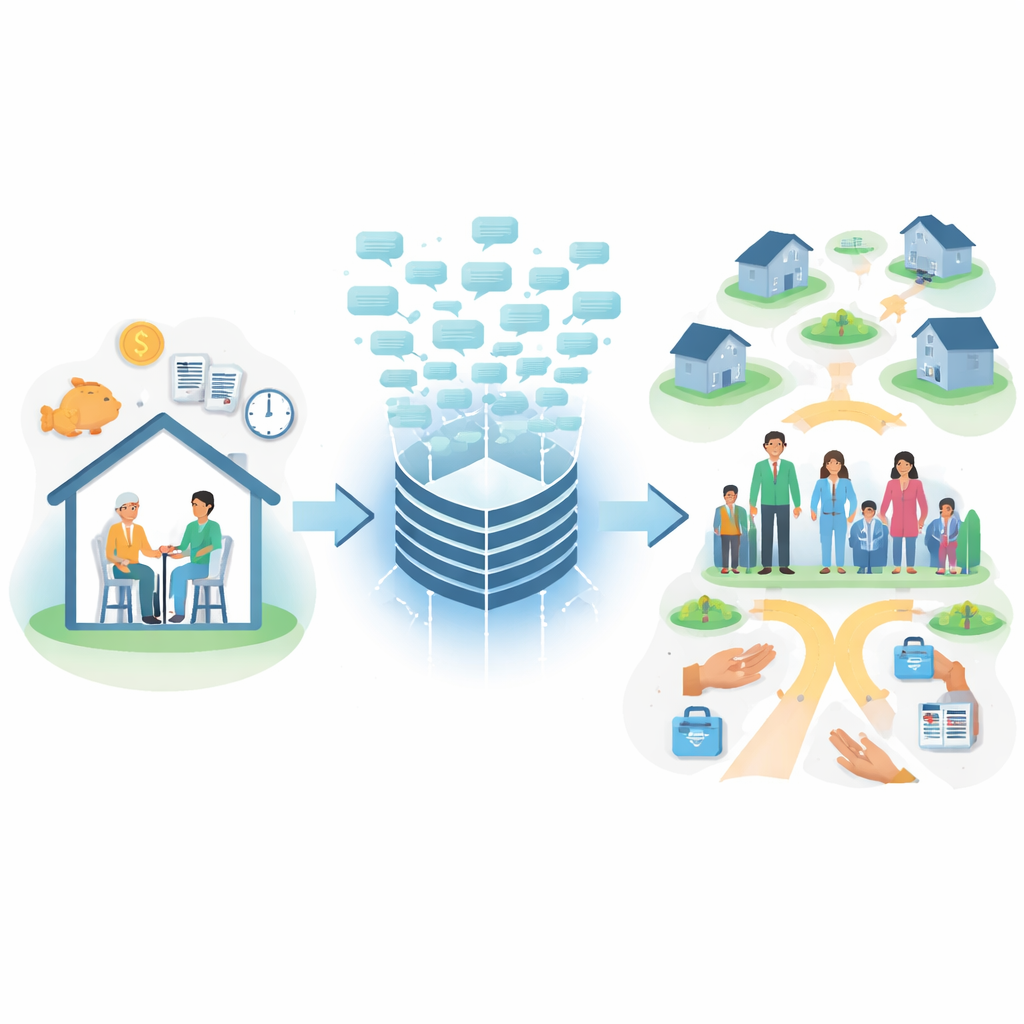
To analyze the comments, the team used a powerful language model (GPT‑4 Turbo) within a carefully guided human–AI workflow. First, they extracted all free‑text answers into a spreadsheet and uploaded them to the AI system. They asked the model to propose themes that appeared in the texts—such as financial strain, application hurdles, or emotional overload—and to assign each comment to the most suitable theme. The researchers then checked a sample of these AI decisions, refined the theme descriptions, and repeatedly reran the classification until the AI produced a full table with categories and, for some areas, more detailed subtopics.
What caregivers and relatives reported
The comments reveal a picture of heavy strain and patchy support. Many respondents described caring for relatives as both physically exhausting and emotionally draining, especially when combined with full‑time work and family duties. Some felt left alone with little short‑term relief, few replacement options at home, and limited understanding from employers. Others criticized the quality of professional services, pointing to staff shortages in nursing homes and home‑care agencies. When too few staff are available, they said, personal attention, conversation, and activating care often fall away, leaving only the bare essentials.
Money worries and maze‑like rules
Financial pressure was another recurring theme. Respondents reported that the costs of home help or nursing homes often exceed pensions, forcing families to dip into savings or cover bills themselves—sometimes for more than one parent at a time. Informal caregivers also spoke of long‑term financial risks: interrupted careers, fewer pension credits, and difficulties returning to work after intense care periods. At the same time, the system of benefits meant to help them was described as bureaucratic and hard to navigate. People complained about thick paper forms, unclear wording, and confusing responsibilities among agencies. Many called for simpler procedures, clearer information long before a crisis hits, and counseling that actively reaches out to families, especially in rural areas.

What this means for future care
Based on these first‑hand accounts, the authors argue for several practical changes. They recommend strengthening easily accessible counseling services, making it easier to combine work and care through flexible working hours and paid leave, and improving the financial security of family caregivers with better pension rules and targeted relief. They also call for more staff and better working conditions in professional care, so that homes and services can provide truly person‑centered support. Finally, the study shows that AI can speed up the sorting of many written comments but cannot replace human judgment: more than a third of the AI’s classifications had to be corrected. Used carefully, however, this hybrid approach can help turn scattered voices from surveys into concrete guidance for a fairer, more humane care system.
Citation: Rau, E., Geithner, S. & Schaal, T. AI-supported qualitative analysis of free-text responses on home care burden and support needs in Saxony. Sci Rep 16, 11223 (2026). https://doi.org/10.1038/s41598-026-46989-7
Keywords: informal caregiving, home care burden, family carers, care system support, AI-assisted analysis