Clear Sky Science · en
Mitochondria-targeting ACSL6 variant drives mitochondrial fragmentation potentially through local DHA-CoA production
How a fish oil fat shapes tiny power plants in our cells
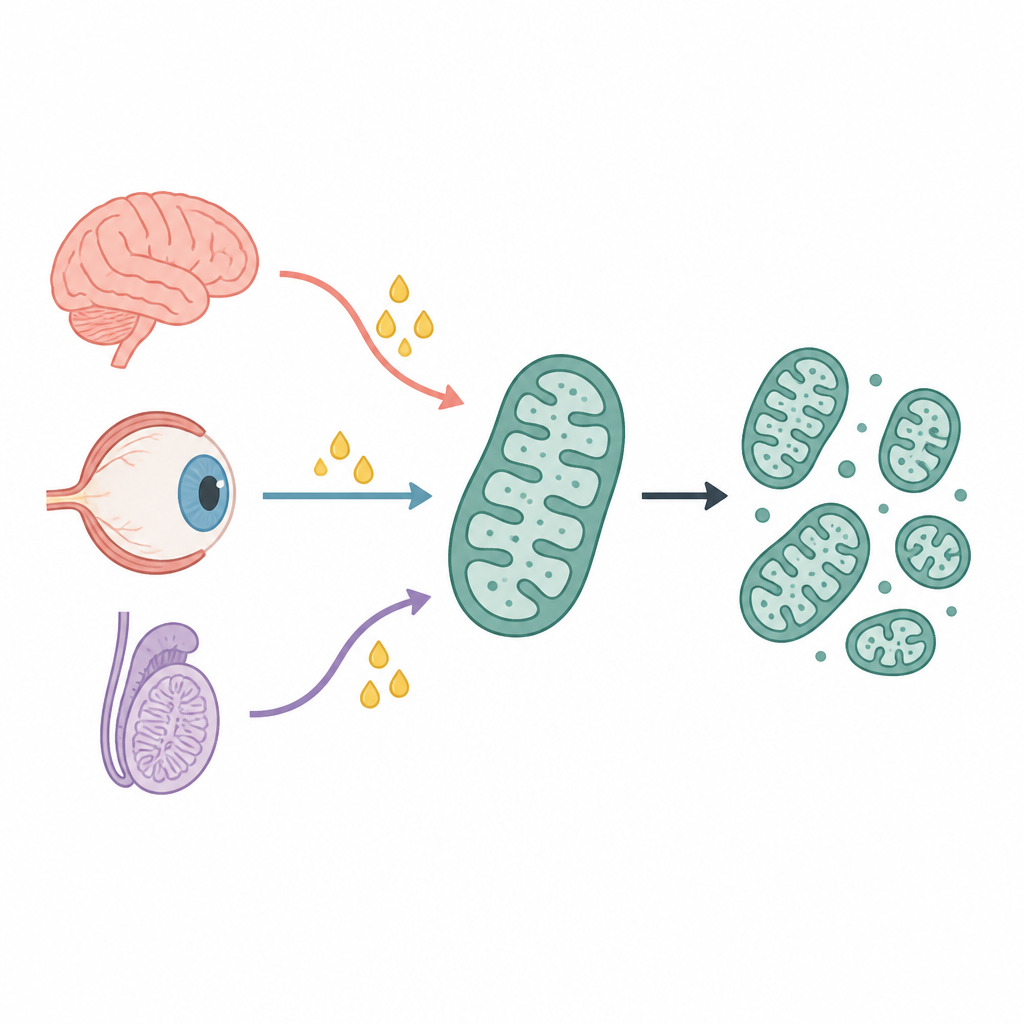
Fish oil is famous for its omega-3 fats, but scientists are still uncovering how these molecules act inside our cells. This study looks at how one omega-3 fat, called DHA, teams up with a specific protein to reshape mitochondria, the tiny power plants that fuel brain cells, photoreceptors in the eye, and sperm. Understanding this hidden relationship may help explain why DHA is so important for thinking, seeing, and male fertility.
A special fat-handling protein with many versions
Cells turn fatty acids into an activated form, fatty acyl-CoA, using a family of enzymes. One member, called Acsl6, prefers to work with highly unsaturated fats such as DHA, which is abundant in the brain, retina, and testes. The gene for Acsl6 can be read in different ways, producing several versions of the protein that differ in both their active site and their starting tail. The authors measured which versions appear in mouse tissues and found that a shorter form, called Acsl6-short, is the dominant variant wherever Acsl6 is strongly expressed. This version trims off part of the usual starting sequence and contains a “gate” configuration that favors DHA as a substrate.
Sending the short version straight to mitochondria
Next, the researchers asked where in the cell each Acsl6 form actually goes. When they made human HeLa cells briefly produce either the short or long version, they used fluorescent tags to track the proteins. Acsl6-short overlapped almost perfectly with a mitochondrial marker, while Acsl6-long spread more broadly and showed stronger overlap with the endoplasmic reticulum, a membrane network elsewhere in the cell. Biochemical isolation of mitochondria confirmed that much more Acsl6-short than Acsl6-long was pulled down with mitochondrial markers. The team traced this targeting to the first 47 amino acids of Acsl6-short. Removing this short stretch caused the protein to lose its mitochondrial residence, while this stretch alone was enough to direct a marker to mitochondria.
Local DHA processing triggers mitochondrial breakup
With the location mapped, the scientists then tested what Acsl6-short actually does to mitochondria. On its own, simply adding Acsl6-short did not change their usual thread-like network. But when the cells were supplied with DHA, mitochondria in Acsl6-short-producing cells shifted toward a fragmented pattern, and the average area of individual mitochondria shrank. Measurements showed that Acsl6-short sharply boosted production of DHA-CoA inside mitochondrial fractions, even though the overall mix of mitochondrial phospholipids changed very little. When the 47-amino-acid targeting tail was deleted, the mutant enzyme still made DHA-CoA at the whole-cell level but not in isolated mitochondria, and it no longer caused DHA-linked fragmentation. This pointed to local DHA-CoA generation at the mitochondrial surface as the key trigger.
Linking fat processing to the fission machinery
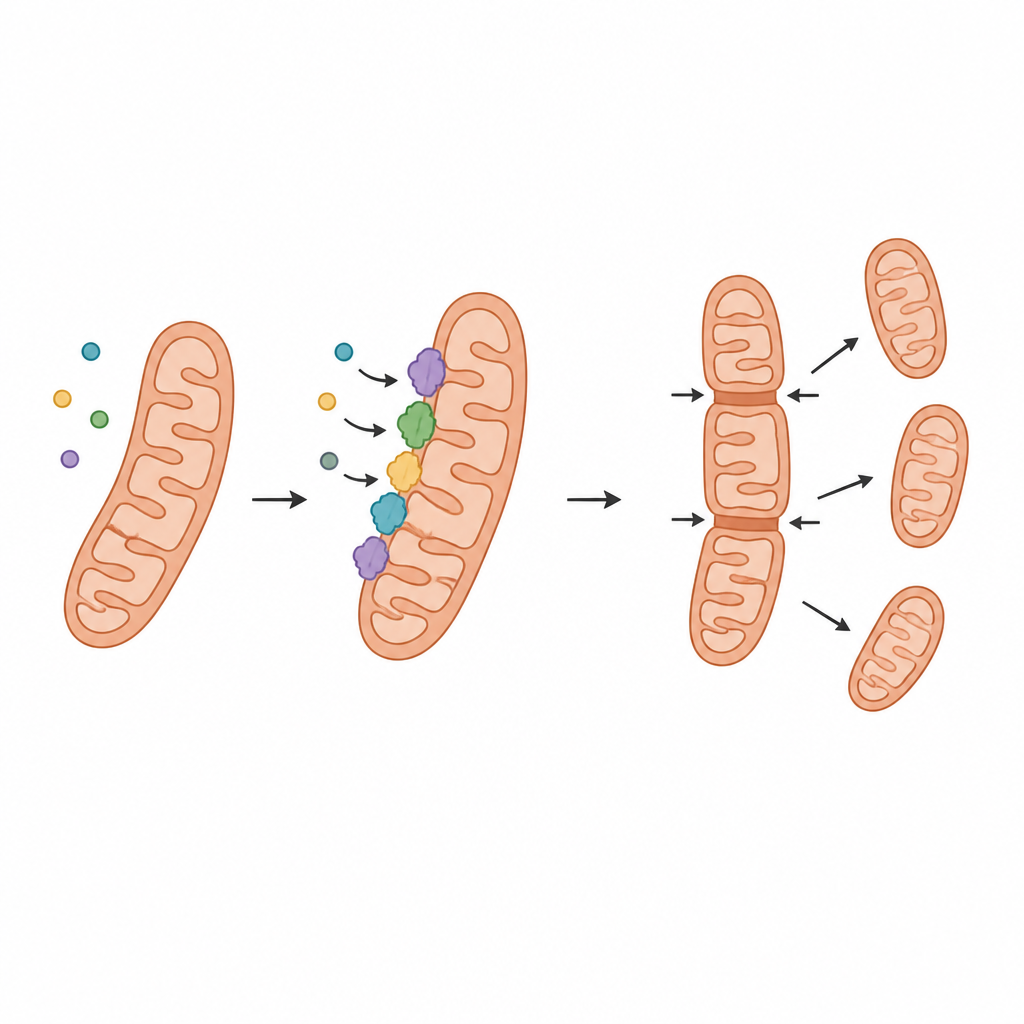
Mitochondria normally divide with help from dedicated proteins. One of them, Drp1, wraps around the outer membrane to pinch it into smaller pieces. Others, called Mid49 and Mid51, help recruit and organize Drp1. The study found that DHA treatment in Acsl6-short-expressing cells increased the Drp1 signal on mitochondria without changing total Drp1 levels, suggesting more Drp1 was being drawn to the organelle. When Mid49 and Mid51 were reduced by targeted RNA interference, the DHA-triggered fragmentation in Acsl6-short cells was blunted and mitochondrial size patterns resembled those of control cells. A catalytically dead version of Acsl6-short, which could still sit on mitochondria but could not make DHA-CoA, also failed to induce fragmentation. Together, these results suggest that local DHA-CoA, not DHA itself, promotes Mid49/Mid51-driven recruitment of Drp1 and mitochondrial fission.
Why reshaping mitochondria matters
The findings offer a new view of how fatty acid metabolism can influence the architecture of cell power plants. In tissues where Acsl6 and DHA are abundant, such as neurons and developing sperm, controlled mitochondrial fragmentation is known to be important for cell differentiation, synapse formation, and sperm shaping. Mice lacking Acsl6 show brain inflammation, visual defects, and male infertility, all conditions where altered mitochondrial dynamics may play a role. This work suggests that the short, mitochondria-targeted Acsl6 variant acts as a local switch, turning DHA into DHA-CoA right where it can feed into the fission machinery. In simple terms, a fish oil–derived fat, processed by a specific enzyme variant at the right spot, helps decide when and how mitochondria break apart, with consequences for brain health, vision, and reproduction.
Citation: Ota, R., Isobe, Y., Ohba, Y. et al. Mitochondria-targeting ACSL6 variant drives mitochondrial fragmentation potentially through local DHA-CoA production. Sci Rep 16, 15456 (2026). https://doi.org/10.1038/s41598-026-46977-x
Keywords: mitochondria, DHA, ACSL6, mitochondrial fragmentation, fatty acid metabolism