Clear Sky Science · en
Modeling the environment-related risk of frogeye leaf spot (Cercospora sojina) in soybean across the United States
Why this soybean disease matters
Across the United States, soybean farmers face a quiet but costly threat called frogeye leaf spot. This leaf disease can trim yields enough to cut into already tight profit margins, and it has become harder to control as the fungus behind it grows resistant to some common fungicides. The study described here set out to answer a practical question: based on everyday weather, when is this disease most likely to worsen, and how can that knowledge help farmers spray less often but more effectively?
How a leaf spot spreads through fields
Frogeye leaf spot is caused by a fungus that survives in crop residue and sometimes in seed, then infects young soybean leaves. Small water-soaked spots appear 10 to 14 days after infection and grow into gray centers with reddish borders. Under warm and humid conditions, the fungus produces spores that ride rain and wind to nearby plants, starting new cycles of infection. These repeated cycles can cause large yield losses, and outbreaks in the Americas have cost farmers billions of dollars. Many soybean varieties lack strong resistance, so growers rely heavily on fungicides to keep this disease in check.
Why smarter spraying is needed
For years, a popular class of fungicides called QoIs worked well against frogeye leaf spot. Over time, however, the fungus evolved resistance, and this group of products now often fails in U.S. fields. Other fungicide groups still work, but overusing them raises the risk that resistance will spread there too. Many sprays are applied even when disease pressure is low, mainly as insurance for yield. That practice adds cost, increases selection pressure on the fungus, and can waste time and chemicals. A reliable risk forecast could help farmers treat only when the odds of disease increase are high, preserving fungicide usefulness while protecting yields.
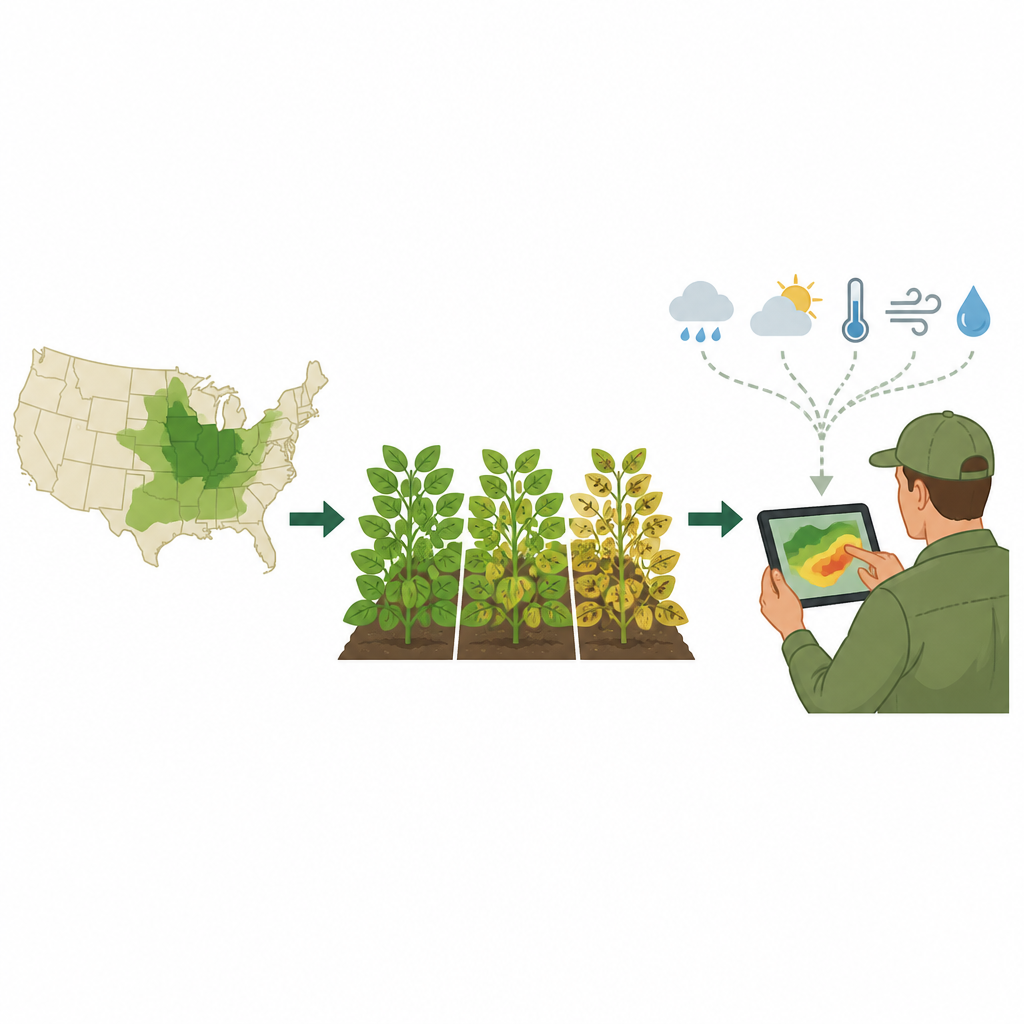
Turning weather patterns into risk
The research team gathered frogeye leaf spot observations from 279 site-years of soybean trials across 20 U.S. states, along with detailed hourly weather data for each location. They focused on how disease severity changed between field checks, then linked those changes to recent patterns of temperature, humidity, rain, wind, and leaf wetness. Instead of looking only at daily averages, they calculated moving averages over windows of 5 to 30 days to capture longer stretches of favorable or unfavorable conditions. Using this large dataset, they tested many statistical and machine learning models to see which best predicted whether disease would increase between visits.
Humidity, heat, and the best risk model
Among dozens of weather factors, long daily periods of high relative humidity stood out as the strongest driver of disease increase, especially when combined with warm conditions. The most useful and practical model relied on just two numbers: the 30 day average of daily hours with relative humidity at or above 80 percent, and the 30 day average of daily maximum temperature. Risk of frogeye leaf spot stayed low when fields had fewer than about five hours per day of such moist air, regardless of temperature. Risk climbed sharply when daily moist hours reached roughly 15 to 20 and maximum temperatures were between about 24 and 36 degrees Celsius, peaking when both humidity and heat were high. More complex machine learning approaches were slightly more accurate overall but tended to flag disease risk too often, which could encourage unnecessary sprays.
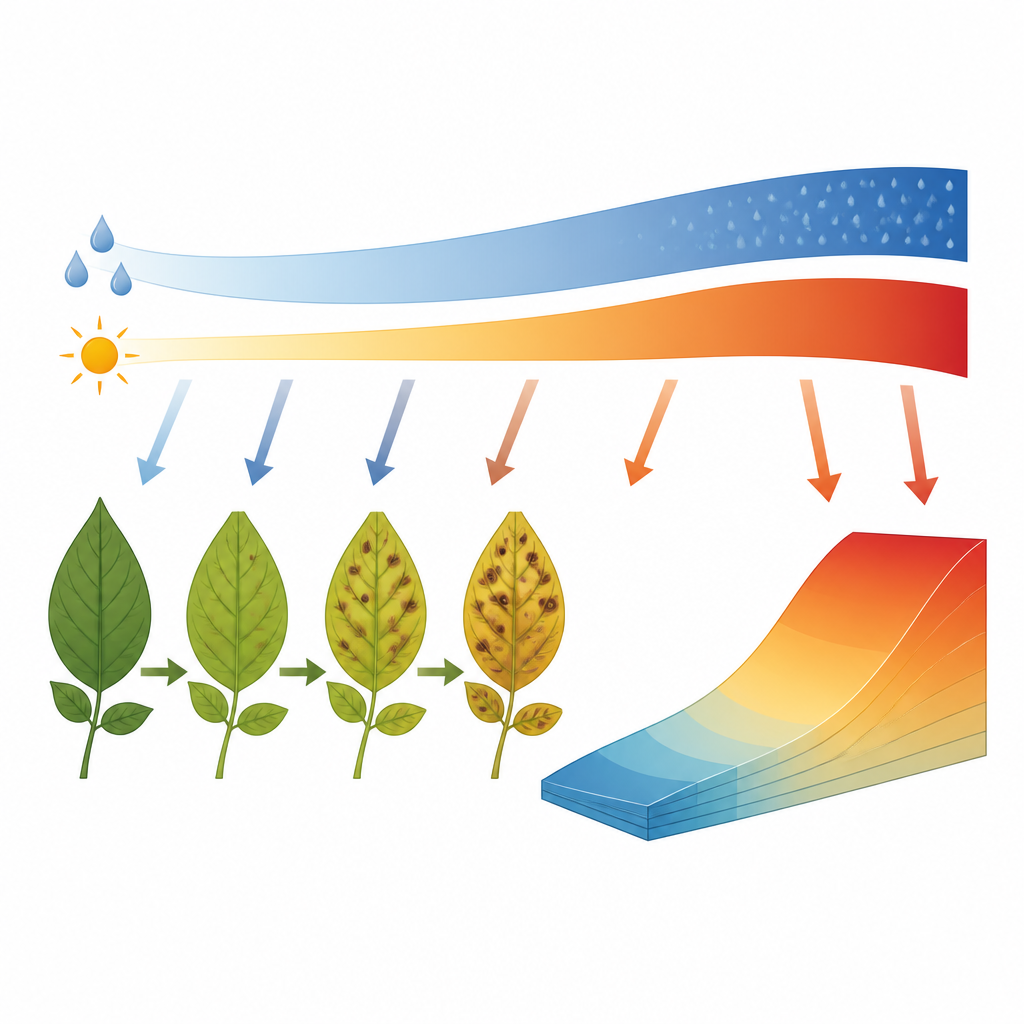
From research model to farmer tool
Because the simpler two factor model was accurate, easier to understand, and faster to compute, the authors chose it for use in a public online decision support system. This tool now provides real time frogeye leaf spot risk maps for U.S. soybean regions, allowing growers and advisers to see when recent weather patterns favor disease build up. While the model does not include every field specific detail, such as variety choice or past crop history, it offers a solid weather based foundation for deciding whether a fungicide spray is truly needed. In plain terms, the study shows that watching the combination of humidity and warmth over the prior month can help soybean producers time treatments better, protect current fungicides, and avoid spraying when the likelihood of disease increase is low.
Citation: González-Acuña, J.F., Allen, T.W., Bish, M.D. et al. Modeling the environment-related risk of frogeye leaf spot (Cercospora sojina) in soybean across the United States. Sci Rep 16, 16236 (2026). https://doi.org/10.1038/s41598-026-46975-z
Keywords: frogeye leaf spot, soybean disease, fungicide use, weather risk model, decision support tool