Clear Sky Science · en
Adsorption of methylene blue onto clay: experiments and statistical physics interpretation
Why dirty water and simple clay matter
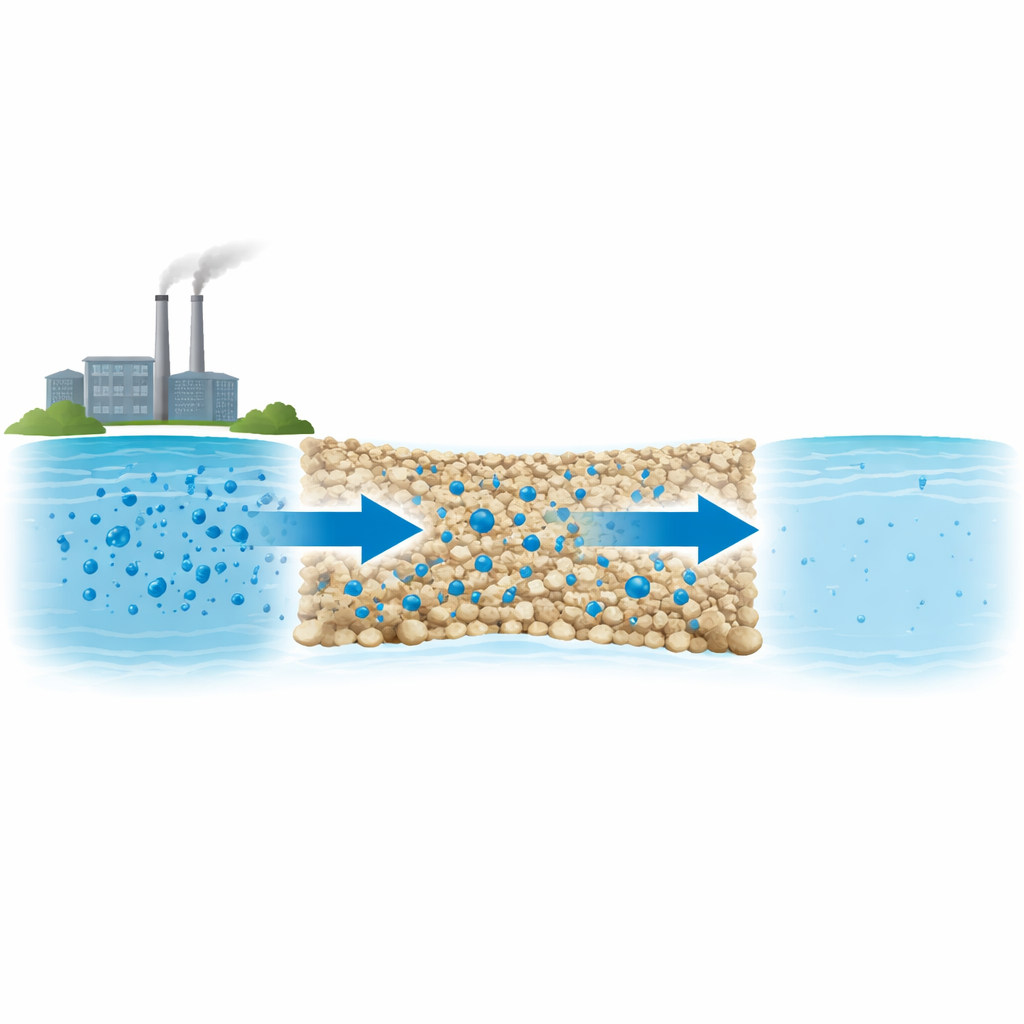
Colorful wastewater from textile factories and other industries may look harmless, but the bright blues and reds often come from synthetic dyes that can harm people and ecosystems. One of the most common examples is methylene blue, a dye that can be toxic and difficult to break down once it reaches rivers and lakes. This study asks a surprisingly simple question with big implications: can an abundant natural clay from southern Tunisia act as a cheap, reusable "sponge" to pull methylene blue out of water, and what exactly happens at the microscopic level when it does?
Turning local clay into a water cleaner
The researchers collected raw clay from an oil-field region in southern Tunisia and used it without complicated treatment—just drying to remove moisture. They then prepared water containing different amounts of methylene blue and added small doses of this clay, tracking how much dye disappeared from the water over time. By changing how long the clay stayed in contact with the water, how concentrated the dye was, how much clay they used, and how acidic or basic the solution was, they could map out the best conditions for dye removal. Under the right settings, the clay removed up to about 97 percent of the dye, showing that a common geological material can rival many engineered products in cleaning performance.
How time, dose, and water conditions shape cleanup
The team found that dye removal happens in two main stages. In the first few minutes, removal is very rapid, because the clay surface is fresh and packed with open spots that strongly attract the positively charged methylene blue molecules. After that, the process slows as those easy-access spots fill up and dye must travel deeper into the tiny spaces within the clay grains. More clay generally meant better cleaning, because more surface was available for the dye to attach to, but beyond a certain amount the benefit leveled off—most dye molecules were already captured, so extra clay added cost without much extra effect. The water’s acidity also mattered: slightly acidic to near‑neutral conditions gave the best results, because the clay surface carried more negative charge, helping to pull in the positively charged dye molecules.
Peeking under the hood with mathematical lenses
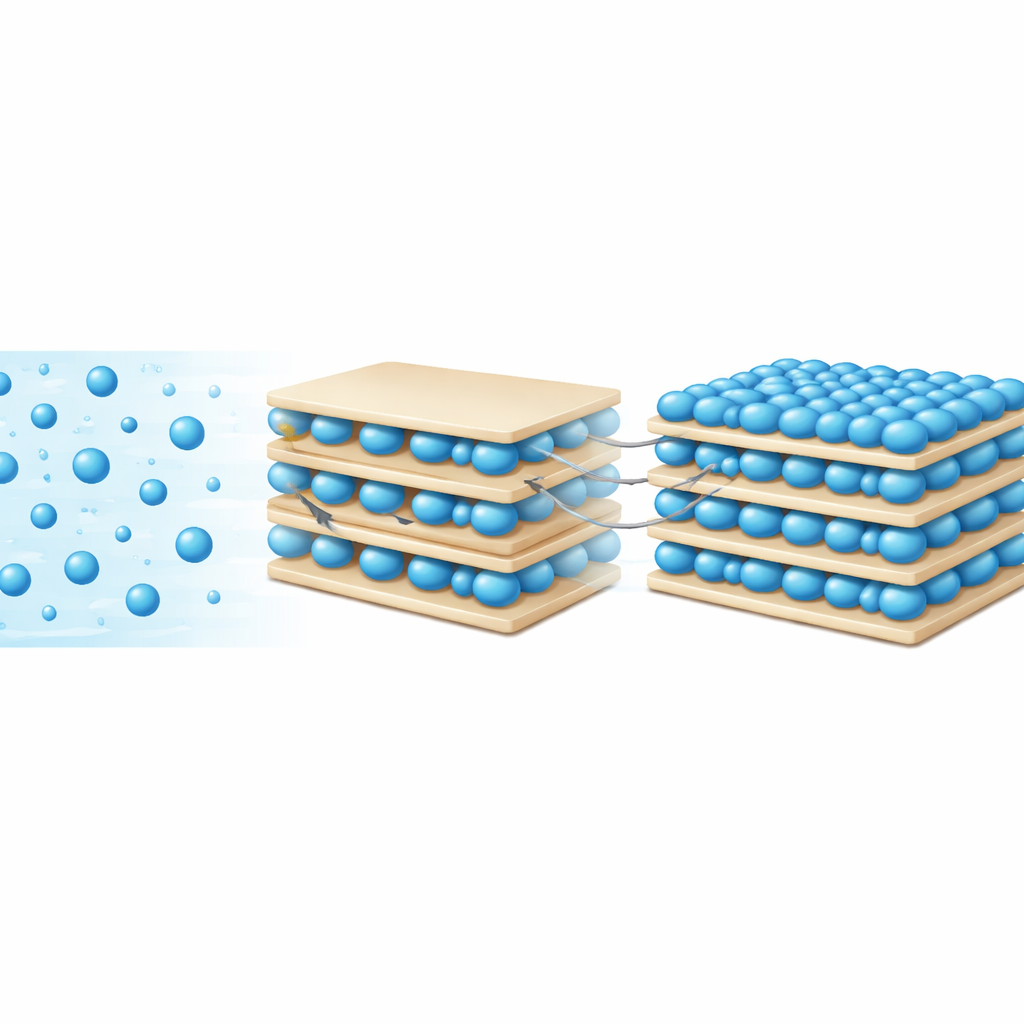
To understand not just that the clay works but how it works, the authors fit their measurements to several mathematical models that describe how molecules move and stick to surfaces. The timing of the uptake matched a model where the rate depends on how many surface spots remain unoccupied, a hallmark of relatively strong binding rather than weak, fleeting contact. Looking at how much dye the clay could hold at different concentrations and temperatures, they found that a model allowing for several stacked layers of dye on the clay matched the data best. In this picture, the first layer of methylene blue nestles directly onto the clay surface, and later layers pile on top, held together by interactions between dye molecules themselves. Calculations of energy and disorder showed that the first layer sticks more strongly than the later ones, and that the overall process happens spontaneously over the tested temperature range.
What happens at the microscopic scale
By using a framework borrowed from statistical physics, the researchers extracted more detailed information from their experiments. They estimated how many dye molecules share each active spot on the clay, how densely such spots are spread across the surface, how many layers of dye can form, and how much dye the clay can hold when it is saturated. Their results suggest that methylene blue molecules tend to lie more or less flat against the clay rather than clumping into bulky stacks, and that the attraction is strong enough to be effective but still belongs to the realm of physical forces—electrostatic pull and hydrogen bonding—rather than permanent chemical reactions. As the temperature rises, the clay can ultimately hold more dye in total, reflecting subtle shifts in how dye molecules arrange themselves on and between the clay layers.
From lab findings to real‑world promise
Put simply, this work shows that an inexpensive, locally available clay can efficiently strip a troublesome blue dye from water, again and again, without major loss of performance. The dye molecules are drawn to the negatively charged, layered clay surface, forming a well‑organized coating that builds up in one or more layers. Because the process is naturally favored and does not rely on exotic materials or complex treatments, it offers a practical route for communities and industries—especially in regions rich in similar clays—to treat colored wastewater more affordably while reducing harm to rivers, lakes, and the people and wildlife that depend on them.
Citation: Jedli, H., Bouzgarrou, S.M., Hassani, R. et al. Adsorption of methylene blue onto clay: experiments and statistical physics interpretation. Sci Rep 16, 13640 (2026). https://doi.org/10.1038/s41598-026-46966-0
Keywords: wastewater treatment, methylene blue, natural clay, dye removal, adsorption