Clear Sky Science · en
Observing abilities of satellite-tagged sea turtles: comparison of reconstructed temperature profiles with ocean model data in the Adriatic and Ionian Seas
Why sea turtles can double as ocean scouts
Measuring the oceans is hard, especially below the surface where ships and buoys reach only a few spots. This study asks a simple question with big implications: can wild sea turtles, fitted with tiny sensors, help us watch how seawater warms and cools with depth, and how well computer models capture those changes in the Adriatic and Ionian Seas?
Turtles as moving ocean thermometers
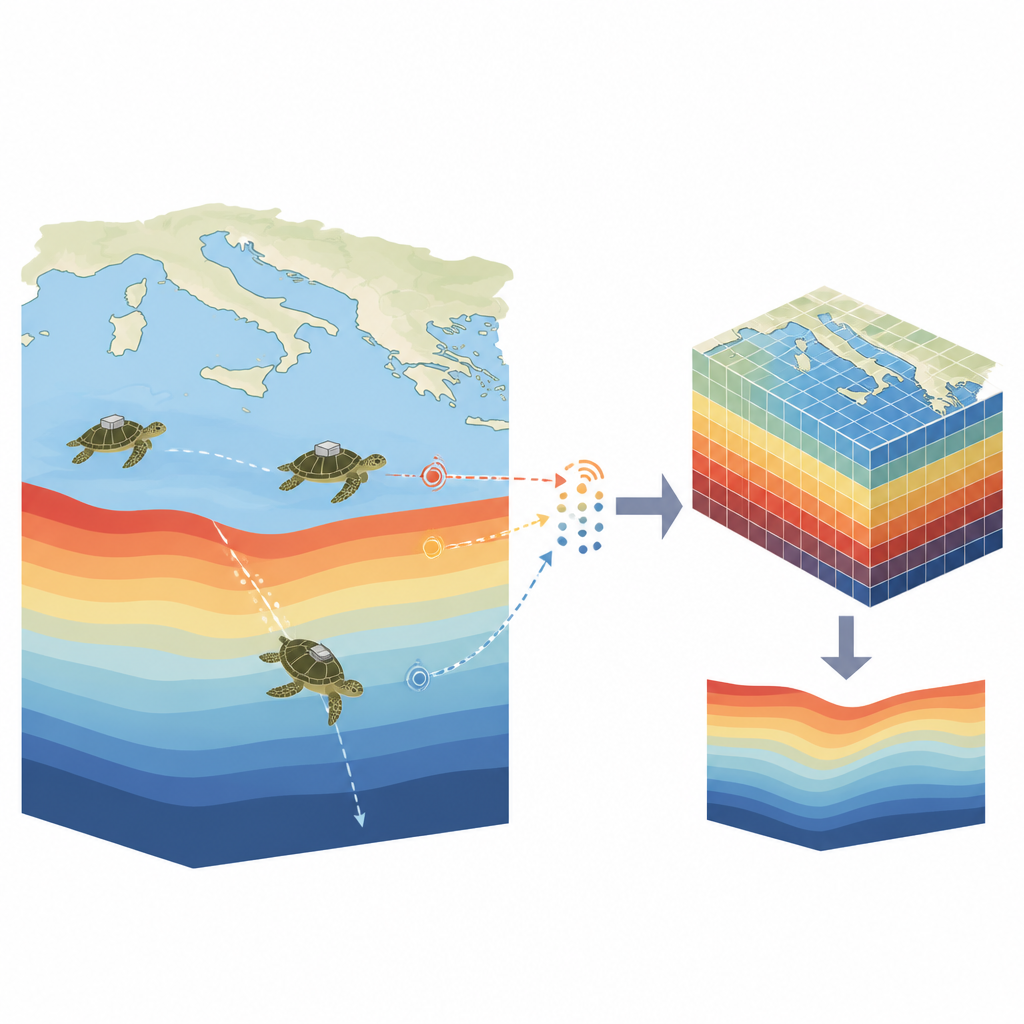
The researchers worked with seven rescued loggerhead sea turtles released off southern Italy, each carrying a small satellite tag that recorded depth and water temperature during every dive. Whenever a turtle surfaced, its tag sent the dive data and location to satellites. From these streams of depth–temperature pairs, the team rebuilt vertical temperature profiles, essentially turning each dive into a miniature, mobile thermometer cast through the water column.
Checking turtles against digital oceans
To see how well turtle dives reflected the real sea, the team compared the reconstructed temperature profiles with a high resolution computer model used by the Copernicus Marine Service for the Mediterranean. They focused on the upper 100 meters of the water column and grouped the data by season and depth bands. At the surface and near surface, especially in spring and autumn, temperatures from turtles and from the model lined up very well, with strong statistical agreement that shows the animals were tracking the same broad patterns of warming and cooling seen by the model.
Where the match becomes harder
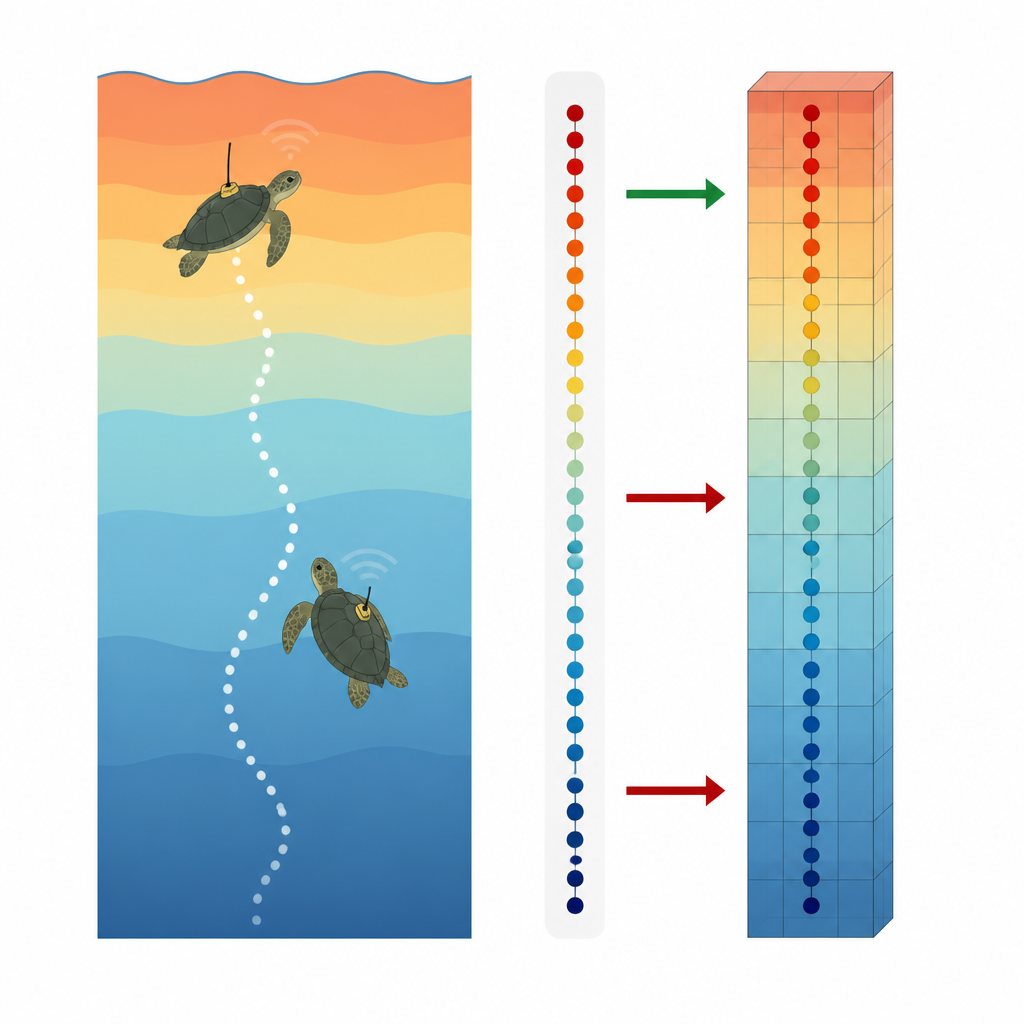
Deeper in the water, the picture grew more complex. Between about 15 and 50 meters, and again from 50 to 100 meters, differences between turtle readings and model output increased, particularly in summer and winter. In summer, strong layering in the water made the thin warm surface cap sit on cooler water below, and even small shifts in that boundary were hard for both sensors and models to capture. In winter, fewer deep dives and fewer independent measurements in the region reduced the certainty of the comparison, and the turtles often reported slightly warmer water than the model. These mismatches were largest in coastal and highly dynamic areas, such as along the Western Adriatic Coastal Current, where rivers, winds, and fine scale coastal processes change conditions faster and on smaller scales than the model grid can fully resolve.
Cross checks with other ocean watchers
To further test the turtle data, the scientists also compared them with measurements from ARGO floats, robotic instruments that drift and profile the upper ocean. In the southern Adriatic, where both platforms operated close in time and space, differences between turtle and float temperatures in the top dozen meters were mostly within one degree Celsius. Near the surface, turtles tended to read slightly warmer than floats, while just below this layer the floats sometimes reported higher values, a pattern linked to the limited number of paired measurements at depth.
What this means for watching the sea
Overall, the study shows that satellite tagged sea turtles can reliably capture the main vertical temperature structure of the upper ocean, especially near the surface, and can reveal where models struggle in deeper or more dynamic layers. While the number of tagged animals was small and sensor calibration and model limits still matter, the results highlight sea turtles as valuable partners for traditional floats, buoys, and ships. Used together, these animal borne sensors can fill gaps in hard to reach coastal and offshore regions, helping scientists refine ocean models and better track how the sea is changing with time.
Citation: Piazzolla, D., Bonamano, S., Cherubini, C. et al. Observing abilities of satellite-tagged sea turtles: comparison of reconstructed temperature profiles with ocean model data in the Adriatic and Ionian Seas. Sci Rep 16, 15258 (2026). https://doi.org/10.1038/s41598-026-46945-5
Keywords: sea turtles, animal borne sensors, ocean temperature, Adriatic Sea, ocean models