Clear Sky Science · en
Quantifying human adaptation to a novel split-belt walking condition after broad experience at different belt speeds
Why changing our walk matters
We walk thousands of steps a day without thinking about how our bodies choose a particular walking style. Yet small tweaks in how long each step is can change how much energy we burn. This study asks a simple but important question: once people have practiced walking in one unusual situation, can they carry that experience over and keep fine tuning their walk when the situation changes slightly?
Two belts, one body
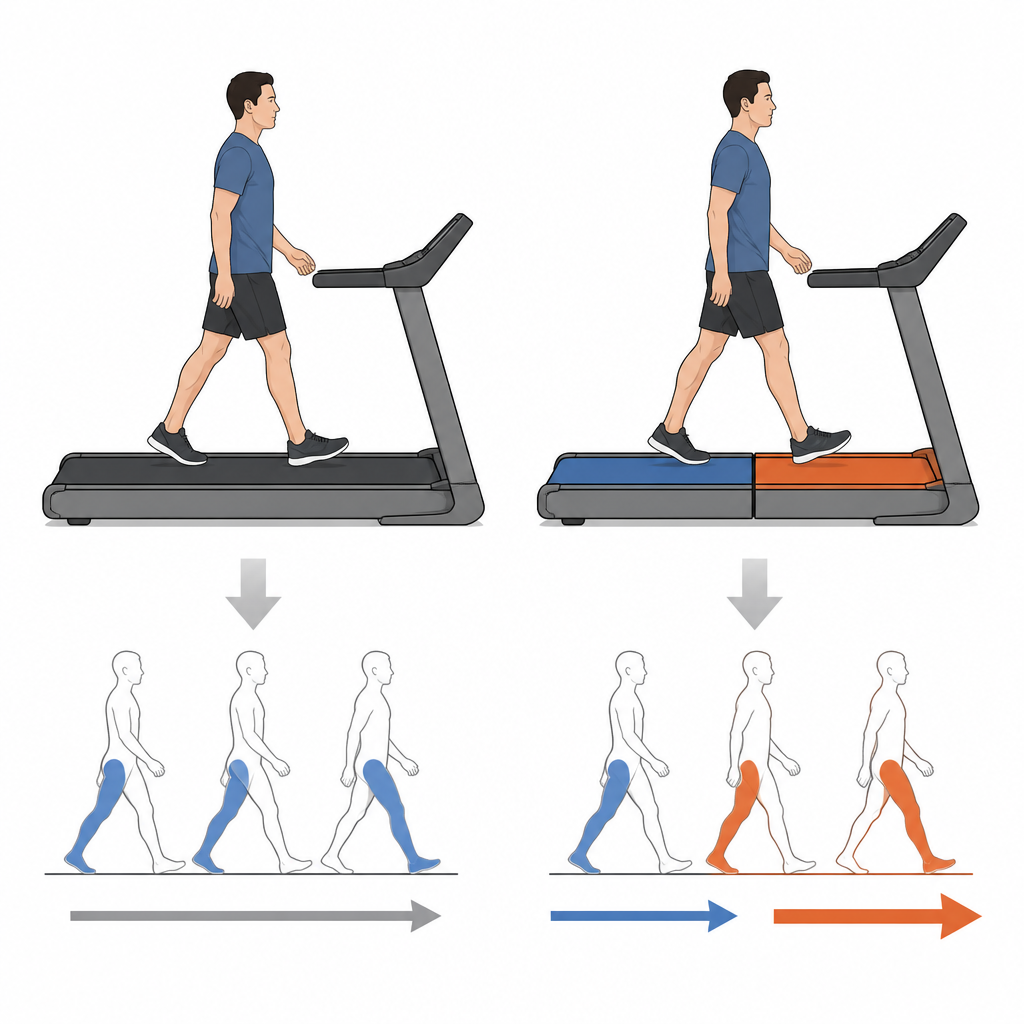
To probe this, researchers used a special treadmill with two belts side by side. One belt can move faster than the other, forcing people to walk with an uneven pattern. In theory, if you take slightly longer steps on the fast belt than on the slow one, the machine can do more work for you and your muscles can relax a bit, lowering your energy use. The team focused on how different the step on the fast side was from the step on the slow side, a measure of step length difference that captures how asymmetric the person’s walk is.
Guided practice in an unfamiliar walking world
Fifteen volunteers first stood quietly so the researchers could measure their resting energy use. They then walked with both belts moving at the same speed to capture each person’s normal, nearly symmetric walk. After this, the belts were set so that one moved three times faster than the other. Using a tablet that showed simple bars linked to their foot positions, participants were guided to practice seven distinct patterns, from clearly shorter steps on the fast belt to clearly longer ones. Each pattern was held for six minutes, giving people broad experience with many different ways of walking in this unusual setting.
Energy savings that people did not choose
During these guided trials, the machine and body behaved as expected from earlier theories. As people were guided toward patterns with longer steps on the fast belt, the treadmill did more helpful work on them, their legs did less effortful pushing, and their measured energy use declined. In other words, there were real energetic rewards available if they adopted certain asymmetric step patterns. But when the visual guidance was removed and people were simply told to walk comfortably, they did not choose those energy-saving patterns. Their self-selected step difference stayed close to their original, nearly symmetric walk, even though they had already experienced that some asymmetric patterns cost less energy.
What happens when the belt speeds change
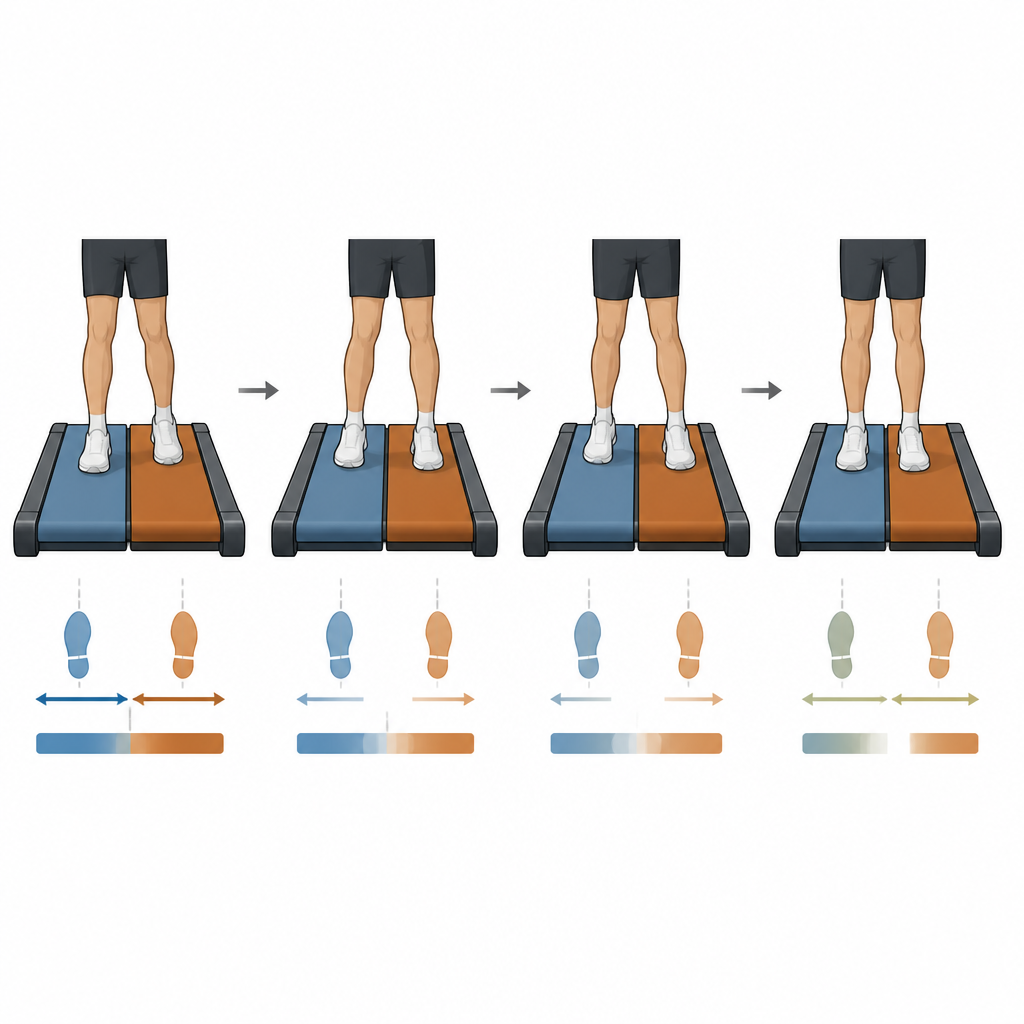
The key test came next. After the first free-walking trial at the larger speed difference, the researchers changed the belt speeds so the fast belt was only twice as fast as the slow one, but the average speed stayed the same. This created a new, but related, walking situation. When people first encountered this new setup, they immediately adjusted how far their feet swung and how long they spent on each belt, keeping their overall step lengths surprisingly similar. Over six minutes, they continued to tweak their pattern by lengthening steps on the fast belt, yet their overall step difference still did not shift strongly toward the energy-saving region they had practiced earlier.
A flexible strategy, not pure energy chasing
The findings suggest that practice in one unusual walking situation helped people form a stable strategy that they could adapt when the belt speeds changed, but that strategy was not driven solely by the goal of saving energy. Participants clearly modified details of how and when their feet contacted the belts as conditions changed, and their energy use was lower at the smaller speed difference. Still, they did not naturally adopt the more extreme asymmetric steps that would have reduced energy cost further. This hints that comfort, balance, perceived effort, or a preference for symmetry may limit how far people are willing to push their gait, even when a more economical option is available.
Citation: Jin, Z., Isa, J., Burden, S.A. et al. Quantifying human adaptation to a novel split-belt walking condition after broad experience at different belt speeds. Sci Rep 16, 15627 (2026). https://doi.org/10.1038/s41598-026-46937-5
Keywords: split-belt treadmill, gait adaptation, walking energetics, step asymmetry, motor learning