Clear Sky Science · en
The evolution of gravity waves as they propagate into shallower water: a field experiment
Why waves change shape near the shore
Anyone who has watched waves roll in from the open sea has seen them grow taller and finally crash in shallow water. This paper explains, using detailed field measurements, how those waves change as they climb a steep underwater slope and why some become unusually large or break in unexpected ways. The findings matter for coastal safety, harbor and energy design, and understanding how rocky shorelines face wave damage.
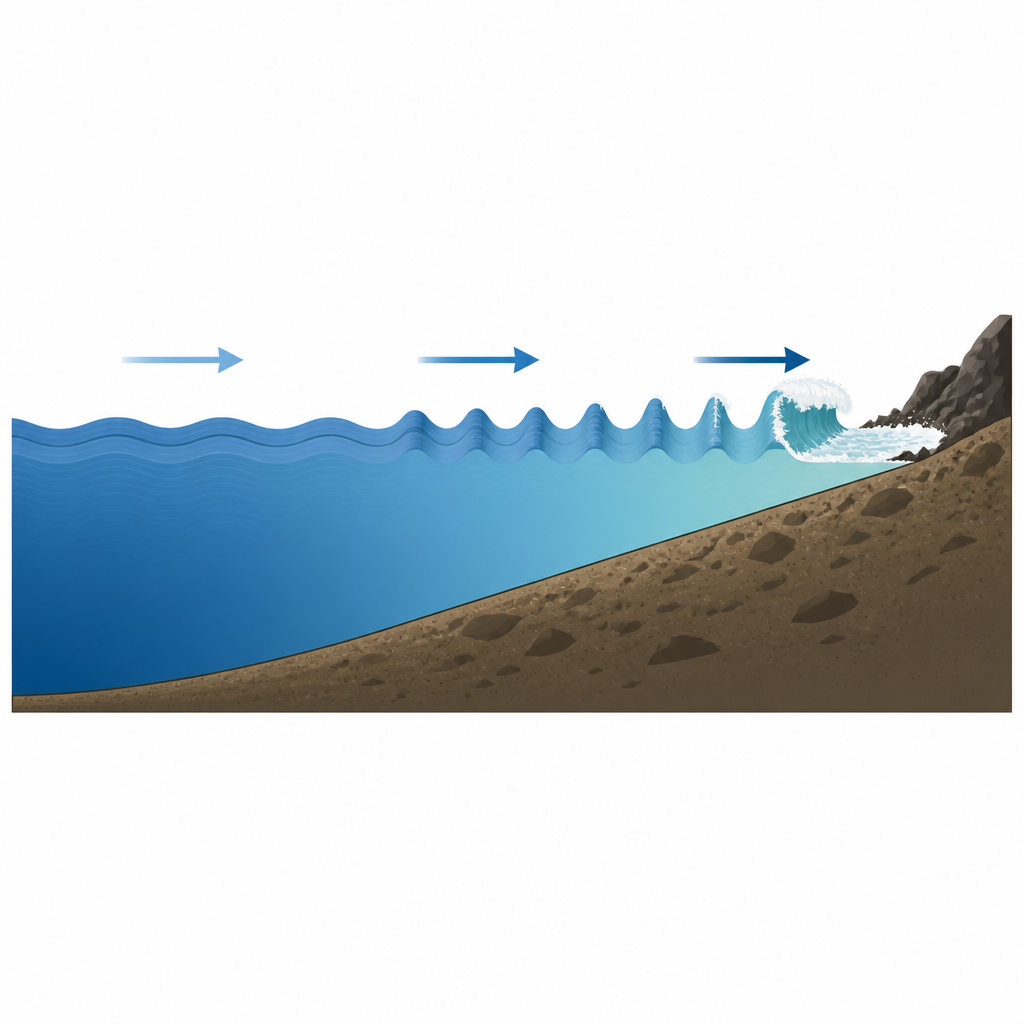
Where and how the waves were measured
The study took place at the Natural Ocean Engineering Laboratory on the coast of southern Italy, a site where the seabed rises sharply from about four meters deep to half a meter over a short distance. The researchers installed a line of seven ultrasonic sensors above the water surface at three depth levels, all aligned with the main wave direction. Local winds over a limited fetch created short-period wind waves that resemble scaled-down open-sea storms, letting the team observe many different sea states under realistic conditions.
Turning raw surface motion into clean data
Because real seas are messy, the team invested considerable effort in cleaning and checking the measurements. They sampled the surface height ten times per second to avoid missing sharp crests, then split the continuous record into many one-hour periods. They removed spikes, corrected rare sensor lockups, filtered out slow tidal changes, and carefully estimated the still water level at each sensor. Only time intervals that passed several standard stationarity tests were kept. This rigorous process ensured that the remaining data truly reflected the waves themselves, especially the rare largest events.
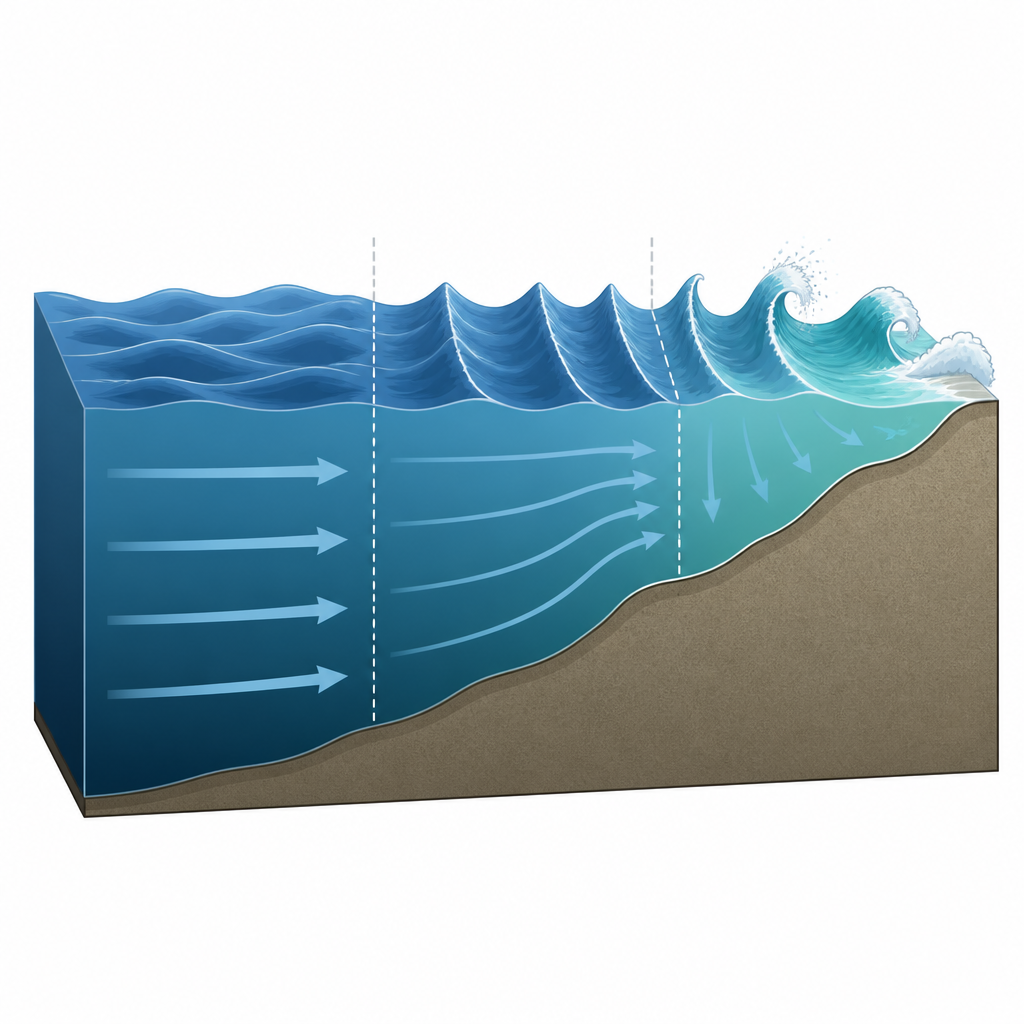
How waves evolve on a steep underwater slope
As waves moved from deep to intermediate depths, their energy became concentrated around a narrower range of frequencies. In simple terms, the wave pattern became more uniform and organized as the water shallowed. Many of the largest waves in these deeper and mid-depth zones had shapes predicted by a theory called quasi-determinism, in which a big wave looks like a focused group rising from its neighbors. But once the water became quite shallow, the wave trains changed character. Instead of broad, dispersive groups, the record began to show more isolated, almost solitary waves that traveled with less change in form. At the very shallowest points, steep waves began to break, spilling or plunging forward and rapidly losing energy.
Extreme waves and limits set by breaking
The team examined thousands of individual waves from six representative sea states, ranging from gently sloping surfaces to very steep, energetic conditions. They found that in intermediate depths, some waves approached the common rule-of-thumb for a “rogue” event, with heights nearly twice the significant wave height and especially high crests. As water depth decreased further, however, extreme growth was cut off by breaking. Many of the largest shallow-water waves approached or even exceeded classic theoretical limits for how tall a wave can be relative to its depth, confirming that depth-induced breaking was the main control on the upper range of wave heights over the steep slope.
Testing common statistical tools for wave heights
Engineers often rely on statistical models to estimate how often very large waves will occur. The researchers compared several widely used wave height distributions with their field data at each depth. In intermediate water, especially for less strongly nonlinear conditions, a modern model that adjusts for water depth and spectral shape matched the observations well. Traditional linear statistics, however, consistently underestimated crest heights. In the shallowest zones with the steepest waves, all models struggled: some overpredicted extremes, others failed to capture the way breaking suppresses the very largest waves while still allowing the bulk of waves to steepen.
What this means for coasts and design
To a lay observer, the study shows that waves do not simply “get bigger” as they move shoreward. Over steep seabeds like many rocky Mediterranean coasts, there is an orderly tightening of the wave pattern, a zone where extreme crests can stand out from their neighbors, and finally a shallow region where breaking and solitary-like forms dominate and place a firm cap on wave height. Existing engineering formulas work well in deeper and mid-depth water but are less reliable in the most nearshore, steep-slope settings. Better models that explicitly include seabed slope and the details of breaking are needed to predict coastal wave risk with confidence.
Citation: Spiliotopoulos, G., Katsardi, V., Fiamma, V. et al. The evolution of gravity waves as they propagate into shallower water: a field experiment. Sci Rep 16, 15911 (2026). https://doi.org/10.1038/s41598-026-46926-8
Keywords: shallow water waves, wave breaking, steep seabed, extreme waves, wave statistics