Clear Sky Science · en
Exploring the nonlinear relationship between robotics manufacturing and urban carbon emissions
Why robots and city air belong in the same story
As robots spread through factories, many people hope they will make industry cleaner as well as smarter. But building those robots is itself an energy-hungry business, often clustered in booming industrial cities. This study looks at hundreds of Chinese cities to ask a simple but vital question for anyone concerned with climate change and technology: does making more robots push city carbon emissions up or down, and does the answer change as the industry grows?
Rising smoke before cleaner skies
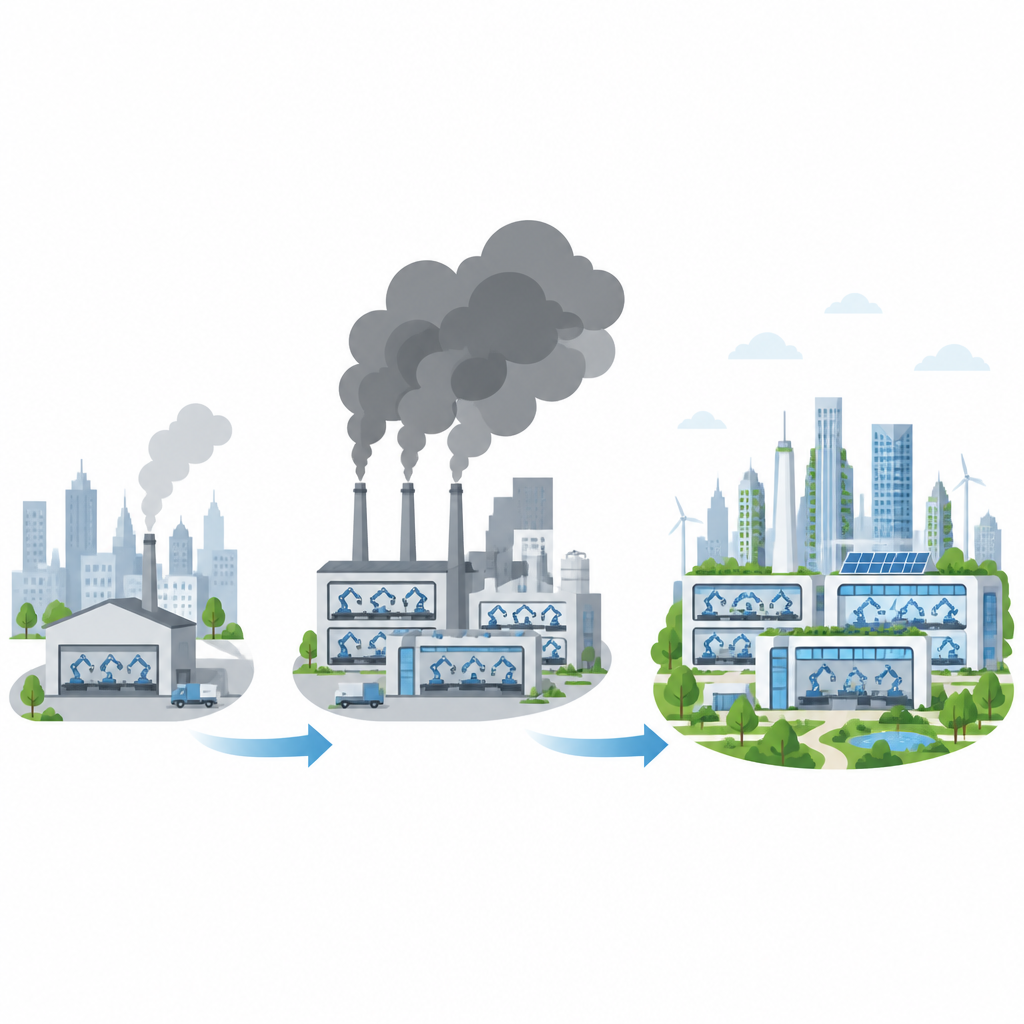
To explore this question, the researchers tracked the growth of robotics manufacturers in 277 Chinese cities between 2008 and 2019 and compared it with each city’s carbon emissions. They counted how many robot-making firms were registered and how large they were, then matched this with official data on carbon output, energy use, and local economies. Their analysis shows a clear pattern. When a city’s robotics industry is just getting started, adding more robot factories tends to increase carbon emissions. New plants must be built, machines installed, and supply chains created, all of which consume large amounts of electricity and materials. At this stage, the environmental costs of expansion outweigh any savings from smarter technology.
A turning point where more robots mean less pollution
The story changes once robotics manufacturing reaches a moderate size. Beyond a certain point, further growth in the industry is linked with lower citywide carbon emissions. In other words, the relationship follows an inverted U shape: emissions rise at first, peak, and then decline as the industry matures. The study estimates that after a city has around four robotics manufacturing firms, on average, adding more is associated with slightly lower emissions. By this stage, production processes become more standardized, firms learn from one another, and cleaner, more efficient technologies spread through the cluster. Many cities in the sample had already passed this turning point, suggesting that for them, supporting further robotics development can help climate goals rather than hinder them.
How robots help other industries waste less energy
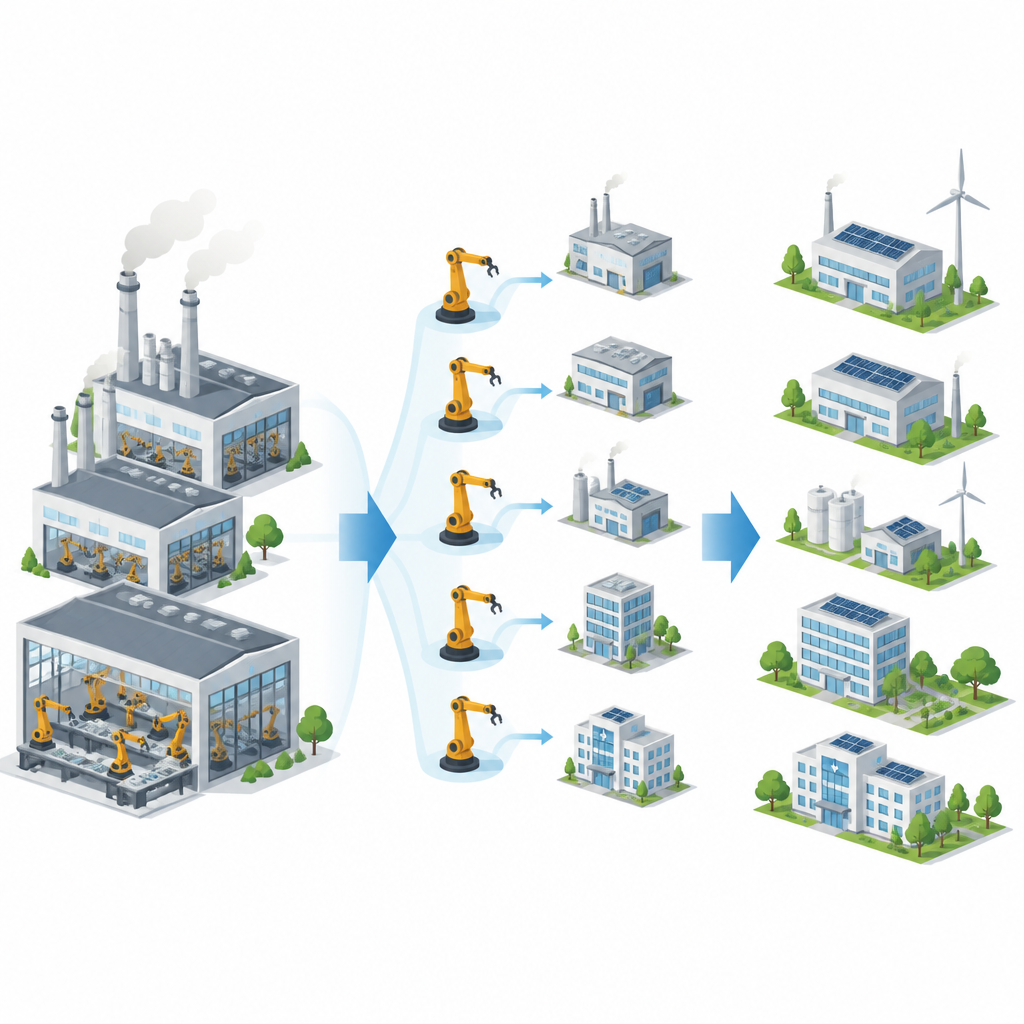
To understand why mature robotics hubs can cut emissions, the authors traced a step-by-step chain. First, more local robot makers make it easier and cheaper for nearby factories to install robots. The data confirm that as robotics manufacturing grows, the use of industrial robots in the same city rises. Second, the spread of robots inside user firms improves energy efficiency. Robots can run production lines more precisely and continuously, reduce mistakes, and coordinate tasks better, so each unit of output requires less electricity. The study finds that cities with more robot use get more economic value out of each unit of industrial power consumed. Third, these gains in energy efficiency translate into lower carbon emissions, especially once robot adoption is widespread. This full sequence is most visible in cities where robotics manufacturing has already passed the earlier expansion phase.
Not all regions and robot businesses are alike
The benefits of robotics manufacturing are not evenly spread across China. In the more developed eastern region, where robot-making is already dense, the study does not find a strong turning point where added factories clearly reduce emissions. There, simply scaling up may no longer be enough; cleaner technologies and better energy systems become more important. In contrast, central cities show a clear inverted U pattern, and the turning point arrives earlier, meaning they start to see carbon reductions with fewer robotics firms. Western cities also hint at strong potential gains as their industries grow. The type of robot business also matters. Firms that focus on system integration, such as software, control systems, and tailored automation solutions, deliver earlier and stronger emission cuts than firms that mainly build robot hardware, which tends to be more energy and material intensive.
What this means for greener industry
For readers interested in how technology can support climate action, this study offers a nuanced message. Robotics manufacturing is not automatically clean. In its early stages it can add to a city’s carbon burden, because building robot factories is energy intensive. Yet as the sector grows, spreads its know-how, and supplies robots to local firms, it can help cities use energy more wisely and gradually lower emissions. Policies that speed the move from small, scattered workshops to well-supported, efficient clusters and that encourage system integration and broad robot adoption are likely to make robotics a stronger ally in the effort to clean up urban industry.
Citation: Lin, J., Xie, Y. & Shen, J. Exploring the nonlinear relationship between robotics manufacturing and urban carbon emissions. Sci Rep 16, 15646 (2026). https://doi.org/10.1038/s41598-026-46922-y
Keywords: robotics manufacturing, urban carbon emissions, energy efficiency, industrial robots, China cities