Clear Sky Science · en
Prediction model for additional procedure requirement in flexible ureterorenoscopy using explainable artificial intelligence
Why predicting a second stone surgery matters
Kidney stone surgery is often described as a one-time fix, yet more than a quarter of patients who undergo a modern keyhole procedure called flexible ureterorenoscopy still need a second treatment. This study explores whether artificial intelligence can help doctors foresee which patients are likely to need another procedure, using details from scans and the operation itself to guide planning and spare patients extra stress, cost, and recovery time.
How kidney stones are treated today
Flexible ureterorenoscopy lets surgeons reach stones inside the kidney by threading a thin camera and laser through the natural urinary passage. It is less invasive than older surgical methods and has become a first-choice treatment for many stones. Still, complete removal is not always possible. Some patients are left with fragments that cause pain, infection, or blockage later on, forcing repeat endoscopy, shock wave therapy, or more invasive surgery. Existing scoring systems try to predict success, but they often use only a few measurements and can struggle when patients differ widely in anatomy and stone features.
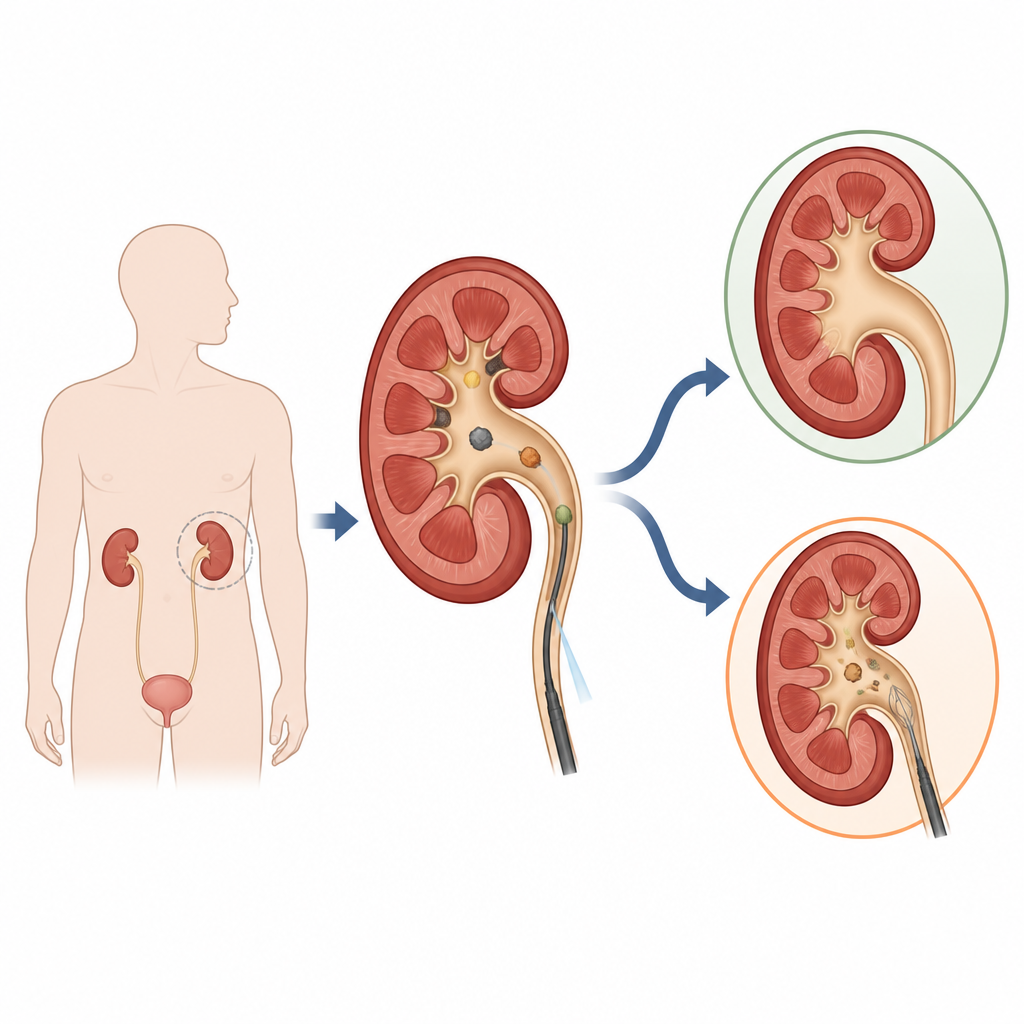
A new way to learn from past patients
The researchers analyzed records from 656 people who had flexible ureterorenoscopy over a ten-year period. For each patient they collected age, sex, stone size and location, details from CT scans, blood and urine results, and technical choices such as the size of the access tube used and whether a suction-assisted device was employed. They then trained and compared fourteen different computer learning methods, from simple logistic regression to more complex tree-based and boosting models, to predict whether a patient eventually needed an unplanned additional procedure.
A key bend inside the kidney
The standout finding was not a lab value or stone size, but an angle inside the kidney where the central collecting area meets the narrow tube that drains urine to the bladder. When this bend, called the ureteropelvic junction pelvis angle, was sharp rather than open, the risk of needing another procedure rose dramatically. Patients with an angle below 110 degrees had an additional surgery rate of more than four out of five, while those with a wider angle rarely needed more treatment. This pattern held across different stone locations within the kidney, suggesting that this single anatomical feature captures how easily instruments and stone fragments can pass.
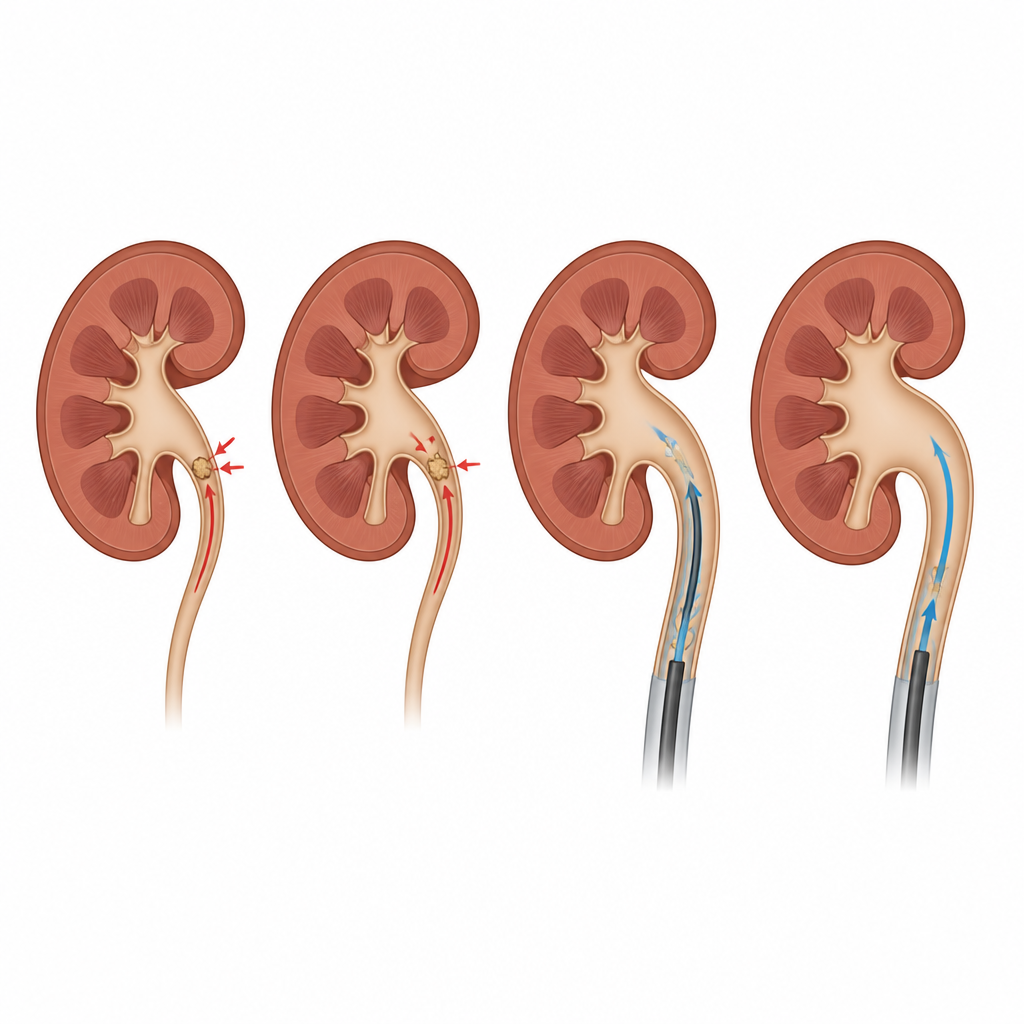
Tools and settings that can tilt the odds
Beyond anatomy, certain choices during surgery also shaped outcomes. Larger access tubes, which improve fluid flow and help remove fragments, were linked to fewer additional procedures, particularly in kidneys with a sharper bend. A newer suction-enabled access device also appeared protective, likely because it helps clear debris more efficiently. The study’s artificial intelligence models consistently highlighted these factors as influential, while also confirming that larger or multiple stones still add to the challenge. By using explainable techniques, the authors could show not just how accurate the models were, but which inputs drove each prediction and in what direction.
What this means for patients and doctors
The work suggests that a simple measurement from a preoperative CT scan, combined with a few key surgical choices, can give a clear picture of who is likely to need more than one kidney stone procedure. For patients, this could mean better counseling about risks, more tailored selection of treatment type, and smarter use of newer tools that may offset difficult anatomy. For clinicians, an easy-to-use calculator based on these models could support decisions without replacing judgment, helping to match each patient with the most suitable plan the first time.
Citation: Çoban, F., Kutlu, H. & Kalyenci, B. Prediction model for additional procedure requirement in flexible ureterorenoscopy using explainable artificial intelligence. Sci Rep 16, 15292 (2026). https://doi.org/10.1038/s41598-026-46898-9
Keywords: kidney stones, flexible ureterorenoscopy, ureteropelvic angle, machine learning, surgical planning